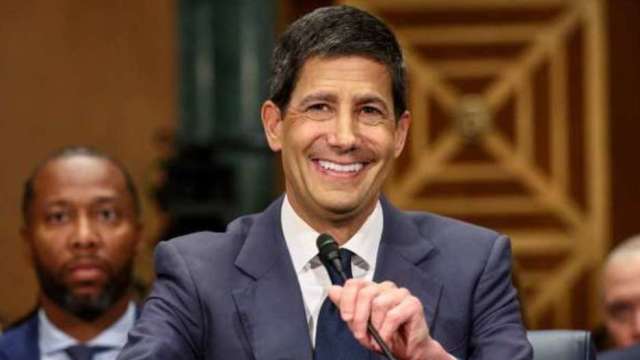
Kevin Warsh made his first appearance as Federal Reserve (Fed) Chair before Congress this week, reiterating his determination to bring inflation back to target, but he remained silent on what tools he might use. In contrast, other officials continue to publicly articulate their views on the economic outlook and interest rate policy. This stark contrast suggests that markets will find it increasingly difficult to predict the Fed’s next moves, reflecting the challenges Warsh faces in reforming the Fed’s communication strategy.
Unwavering Commitment to Fighting Inflation, But No Clarity on Policy Direction
With Middle East conflicts pushing energy prices higher and artificial intelligence (AI) investments continuing to drive up costs, the U.S. inflation outlook has become more uncertain.
During testimonies this week before the House and Senate Banking Committees, Warsh repeatedly stated that inflation remains too high. He explicitly told Senator John Kennedy, a Republican from Louisiana: "This will not become a permanent problem during my tenure."
When pressed with the follow-up question, "What are you going to do about it?" Warsh responded only: "We will examine tools such as the balance sheet and interest rates, assess economic developments, and decide whether to adjust policy to directly address inflation." However, he did not specify what economic conditions would trigger Fed action.
This prompted Kennedy to ask what options the Fed has, listing rate hikes, cuts, or holding steady. Warsh acknowledged all three as possible, then added:
"The truly important and difficult questions should not be carelessly handled by unproven policies, but instead studied in depth by five dedicated task forces."
He was referring to five new working groups he has led the Fed to establish, each headed by external experts. These groups are scheduled to deliver reform recommendations by December, covering monetary policy frameworks and communication strategies.
The Fed will hold its next policy meeting in less than two weeks, on July 28–29, with three more regular meetings scheduled before year-end.
On the topic of inflation, Warsh acknowledged that price pressures from AI could push "observable prices" higher over the next 12 months, but emphasized: "Whether that counts as inflation depends on the Fed, and the Fed will act accordingly."
Sharif, founder of the inflation research firm Inflation Insights, stated bluntly: "Warsh’s answers on inflation remain confusing, and it’s even less clear what measures he’s prepared to take—beyond saying the Fed will 'say something.'"
Colleagues Openly Share Policy Positions
In contrast, other Fed officials have been more explicit about their policy outlooks, outlining how they would adjust policy under different economic scenarios.
For example, Fed Governor Lisa Cook said Wednesday: "I believe a prudent approach is to wait and see a bit longer to observe how inflation evolves."
She noted that the AI investment boom, tariffs, and the Middle East war could all pose new inflationary risks.
Cook also stated clearly: "If I don’t see signs of inflation cooling in the near term, I am prepared to take action." Markets widely interpreted this as indicating Cook’s openness to supporting rate hikes.
John Williams, the Fed’s third-ranking official and President of the Federal Reserve Bank of New York, expressed a more optimistic view. "Inflation is indeed still high, around 4%, but there are several encouraging signs that it may have already peaked and should gradually decline over the coming quarters."
He believes current policy is "well-positioned," a phrase typically indicating no immediate need to adjust interest rates.
Fed Governor Christopher Waller said on Tuesday, before the release of June’s inflation data, that he needs to see "several months" of sustained disinflation before he gains confidence that inflation is moving toward the Fed’s 2% target.
Fed officials will enter their pre-meeting blackout period starting this Saturday. Before then, Dallas Fed President Lorie Logan and Vice Chair Philip Jefferson are still scheduled to speak.
Warsh: Markets Should Watch Data, Not Fed Speeches
Warsh has made it clear he wants to reduce the frequency of officials’ public statements, arguing the Fed should not provide excessive policy signals to financial markets.
This week, before the House Financial Services Committee, he said: "We want to get the policy right. I believe, at least for me, a more cautious approach to communication is a better way to objectively assess the situation."
He added: "There are already quite a few people on Wall Street unhappy that I’m not providing as much information as before. They think everything would be fine if I just submitted a dot plot."
He was referring to the quarterly interest rate projections from Fed policymakers. The June 2024 dot plot showed that half of the 18 policymakers expected at least one rate hike by year-end, but Warsh did not submit his own rate projection.
He urged markets: "Look at the economic data, not at what Fed officials say." He concluded with a succinct phrase: "Chase the ball, not the Fed."
However, other Fed officials appear to disagree with this approach.
Williams said Fed officials should clearly explain how their economic outlooks connect to their interest rate expectations. "That hasn’t changed. I believe that allowing all 19 members of the committee to fully share their views provides the market with a more complete and richer set of policy information."
FACT BOX
- Source: PR Times
- Category: News
- Organizations: Inflation Insights