Neurologica Announces Two Papers Selected for Oral Presentation at ICASSP 2026, a Top Conference in Signal Processing
Neurologica Inc. announced that two papers, "DecompSSM" for multivariate time-series forecasting and "PENGUIN" for vital sign reconstruction, have been selected for oral presentation at ICASSP 2026, a leading conference in the field of audio, speech, and signal processing. This recognition highlights the international acclaim for the company's AI technology.
📋 Article Processing Timeline
- 📰 Published: March 31, 2026 at 20:43
- 🔍 Collected: April 1, 2026 at 13:39 (16h 56m after Published)
- 🤖 AI Analyzed: April 22, 2026 at 08:24 (498h 45m after Collected)
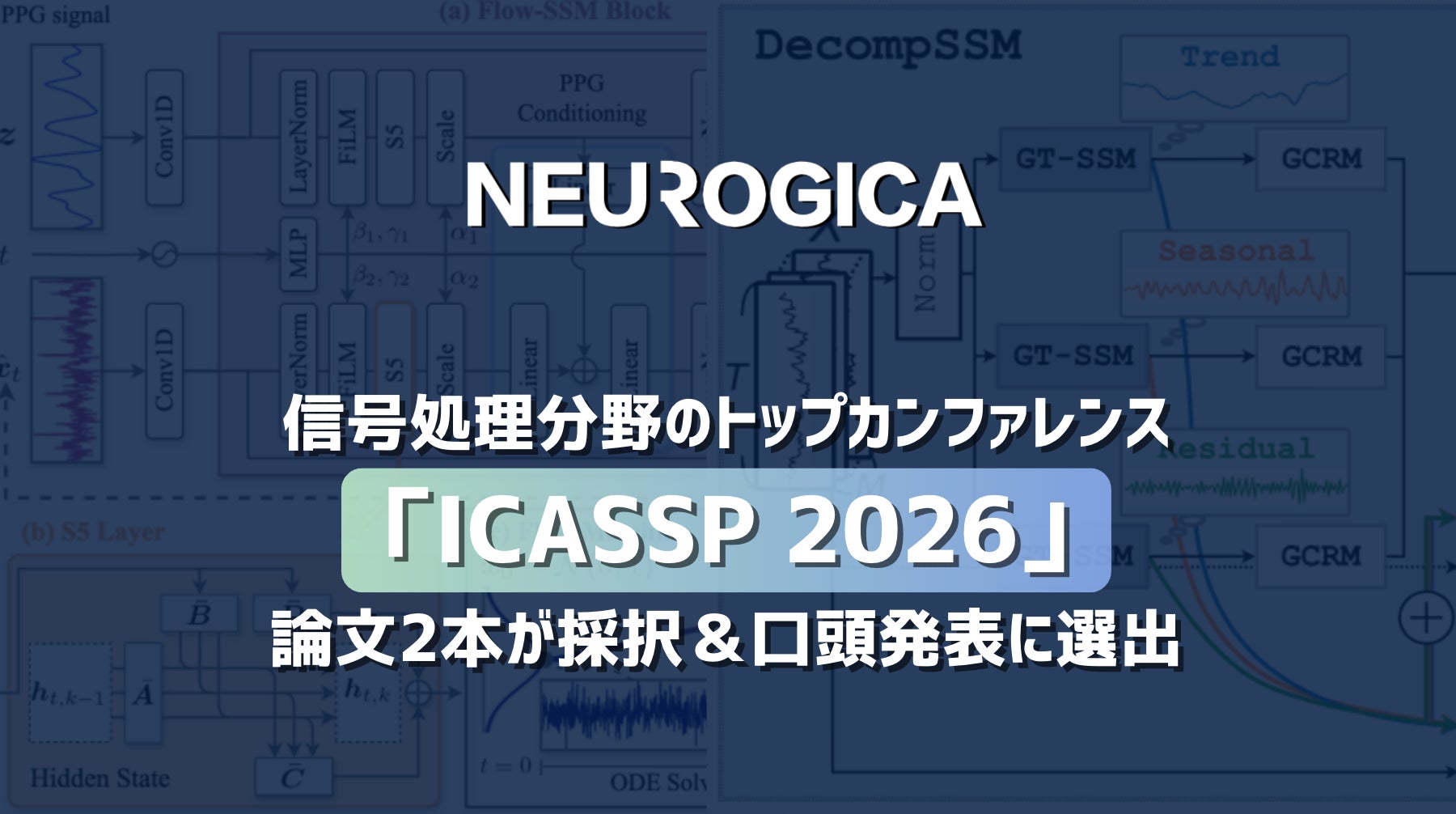
Neurologica Inc. (Headquarters: Shibuya-ku, Tokyo; Representative Director: Aidan Zephyr Peak) is pleased to announce that two papers have been accepted at "ICASSP 2026" (International Conference on Acoustics, Speech, and Signal Processing), one of the most authoritative international conferences in the fields of audio, speech, signal processing, and related areas, scheduled to be held in Barcelona, Spain.
The two papers accepted this time are "DecompSSM," which achieves improved accuracy in multivariate time-series forecasting, and "PENGUIN," which can reconstruct multiple vital signs from PPG (photoplethysmography). Both of these papers have been selected for "Oral Presentation."
About "ICASSP"
"ICASSP (International Conference on Acoustics, Speech, and Signal Processing)" is the world's largest international conference in signal processing and its applications, organized by the IEEE Signal Processing Society. Research results are submitted from universities and companies worldwide, and only papers that pass a rigorous peer review are accepted.
Overview of Accepted Papers
1. Multivariate Time-Series Forecasting Model "DecompSSM"
【Paper Title】
A Decomposition-based State Space Model for Multivariate Time-series Forecasting
【Authors】
Junya Nagashima, Shuntaro Suzuki, Osamu Koyama, Shinnosuke Hirano
【Research Achievements and Practicality】
Multivariate time-series data in fields such as weather, electricity, and finance often contain a mixture of long-term trends, periodic fluctuations, and irregular noise, making high-precision forecasting difficult.
In this research, we proposed "DecompSSM," which uses a deep state-space model (SSM) to decompose multivariate time-series data into "trend, seasonality, and residuals" for learning.
This AI model has achieved higher forecasting accuracy than conventional AI models in analyzing time-series data with complex correlations, such as predicting energy consumption in manufacturing, forecasting output from solar and wind power generation, and analyzing price fluctuations in financial markets.
2. Vital Sign Reconstruction Framework "PENGUIN"
【Paper Title】
PENGUIN: General Vital Sign Reconstruction from PPG with Flow Matching State Space Model
【Authors】
Shuntaro Suzuki, Osamu Koyama, Shinnosuke Hirano, Junya Nagashima
【Research Achievements and Practicality】
PPG signals, measured by smartwatches and other devices, are low-cost and promising for continuous biological monitoring. However, they are susceptible to noise caused by body movements, posing challenges for precise estimation of biological indicators.
In this research, we developed "PENGUIN," which integrates "flow matching" into a state-space model. This enables high-precision reconstruction of multiple vital signs, such as electrocardiograms, arterial blood pressure, and respiratory status, as continuous waveforms from noisy PPG signals. This technology is applicable to wearable devices.