Mitsubishi Research Institute, Inc. (MRI) is participating in the unmanned ship project "MEGURI2040" (hereinafter referred to as MEGURI2040(※2)) promoted by The Nippon Foundation. On March 27, 2026, it was announced that all four demonstration ships in the project's second stage passed the Ministry of Land, Infrastructure, Transport and Tourism's ship inspection as autonomous vessels and have commenced commercial operations as autonomous ships(※3).
MEGURI2040 is a project promoted by The Nippon Foundation since 2020 with the aim of realizing unmanned ships and ensuring the stable transportation of people and goods. It addresses urgent issues facing the maritime industry, such as crew shortages due to an aging population and accidents caused by human error.
Fifty-three domestic companies that agree with the project's purpose and social significance have formed the DFFAS+ (Designing the Future of Fully Autonomous Ships Plus) consortium(※4), advancing technological development and social implementation initiatives leveraging their respective strengths.
MRI, continuing from its role in the first stage (FY2020-2021), is responsible for risk assessment, concept design, exit design (business model and system considerations, etc.), and project management for unmanned navigation systems in the second stage (FY2022-2025). In particular, during the second stage, MRI led activities to ensure that new technologies necessary for social implementation are widely accepted by society. Specifically, they analyzed the needs and concerns of stakeholders such as shippers, shipowners, operators, non-life insurance companies, financial institutions, and local residents using island routes. They designed the acquisition of operational data to prove the safety of the demonstration ships (actual data acquisition and evaluation are scheduled for April to September 2026), and materialized the socio-economic benefits that the commercialization of unmanned ships will bring (such as maintaining logistics, sustaining and revitalizing island life, and reducing crew workload). At the end of February 2026, autonomous navigation was conducted with general passengers aboard the passenger ship "Olympia Dream Seto" during its commercial operation connecting Okayama Prefecture and Kagawa Prefecture. This allowed everyone aboard to deepen their understanding of the safety and socio-economic significance of autonomous ships, contributing to the cultivation of social acceptance for autonomous navigation technology.
1. Key Points of Demonstration Experiments and Development
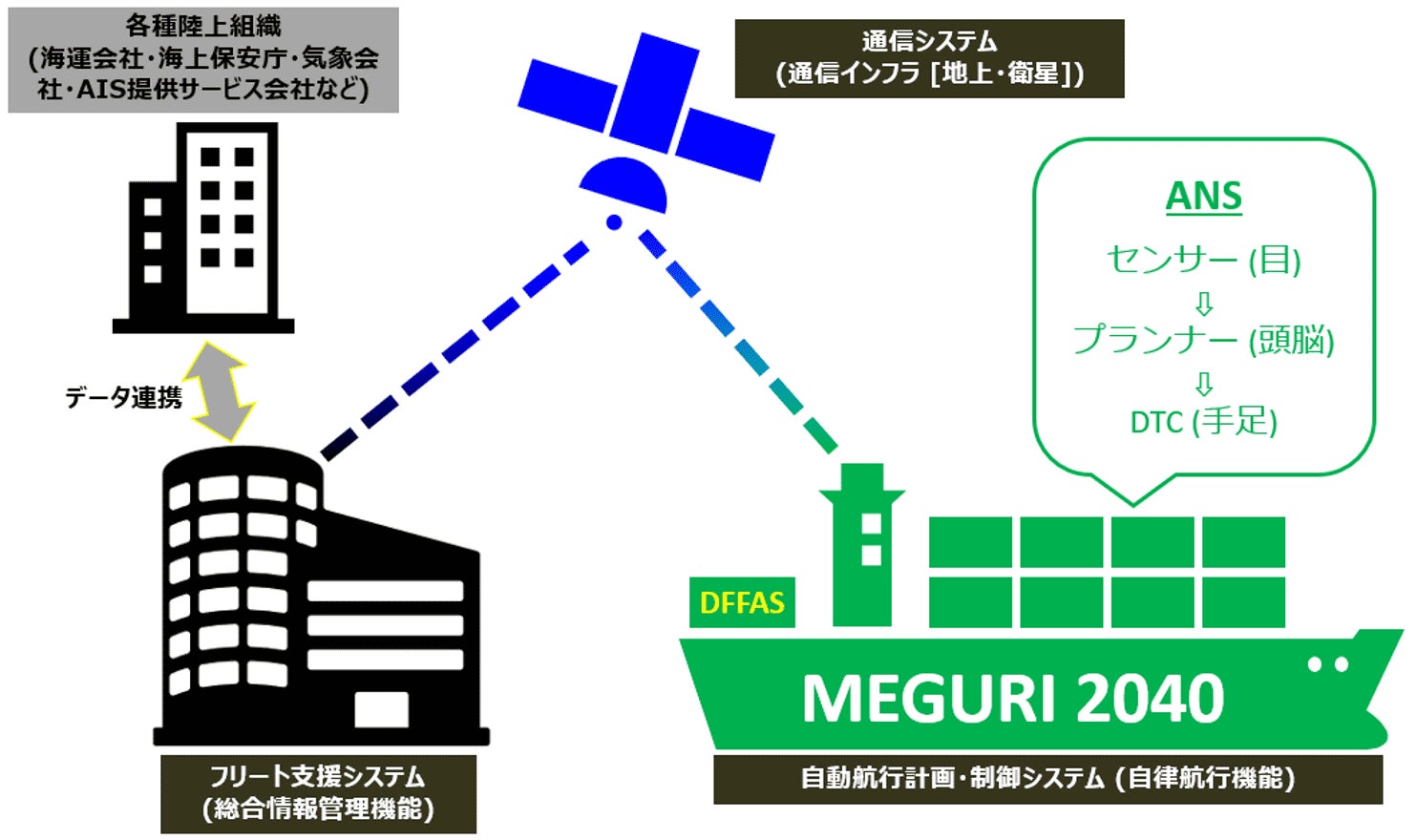
The DFFAS+ consortium designed and developed autonomous ships not as standalone technologies, but as an integrated operational system comprising onboard systems, communication systems, and shore support systems.
The demonstration ships, targeting various vessels such as cargo ships and passenger ships with different uses and operating conditions, possess autonomous navigation functions equivalent to Level 4 autonomy. This was achieved through new construction and retrofitting (adding new functions to existing equipment to improve performance) of existing ships. Functions include surrounding environment recognition, integrated display of navigation status, prediction of future behavior, and avoidance/route planning. The design adopts a combination of these functions, assuming autonomous judgment and human monitoring/intervention.
These vessels ensure operational safety and redundancy by coordinating with shore support centers (a system of two bases: permanent and mobile) that can simultaneously monitor and support multiple vessels via stable communication lines using satellite and mobile communication.
2. Development and Implementation by Each Company
【Four Demonstration Ships】
In the second stage, autonomous navigation functions equivalent to Level 4 autonomy were verified under commercial operating conditions for the following four vessels, which have different uses and navigation environments. They passed the Ministry of Land, Infrastructure, Transport and Tourism's ship inspection as autonomous vessels.
New Domestic Container Ship "Genbu"
New Domestic Container Ship "Genbu"
The "Genbu" is a domestic container ship approximately 134 meters long with a capacity of 700 TEU, managed by Ecoes Inc. and operated by Suzuya Kairu Co., Ltd. It is engaged in container cargo transport on a route from Kobe to Tokyo, via Osaka, Nagoya, and Shimizu. Designed and built as a flagship equipped with all necessary functions for unmanned navigation, it passed the national ship inspection as an "Autonomous Ship" on January 28, 2026.
Passenger Ship "Olympia Dream Seto"
Passenger Ship "Olympia Dream Seto"
The "Olympia Dream Seto" is a passenger ferry for island routes, approximately 66 meters long with a passenger capacity of 500, operated by Kokusai Ryobi Ferry Co., Ltd. It connects Shin-Okayama Port in Okayama Prefecture to Tono Port in Kagawa Prefecture. In the Seto Inland Sea, an area with heavy ship traffic and many islands and reefs that pose obstacles, the autonomous navigation functions were evaluated for their proper operation and safety. It passed the national ship inspection as the first "Autonomous Ship" in Japan on December 5, 2025.
Existing RORO Ship "Dai-ni Hokuren Maru"
Existing RORO Ship "Dai-ni Hokuren Maru"
The "Dai-ni Hokuren Maru" is a domestic RORO ship (Roll-on/Roll-off ship, where trucks and trailers loaded with cargo can drive on and off) operated by Kawasaki Kinkai Kisen Kaisha, Ltd. It is approximately 173 meters long with a gross tonnage of 11,413 tons. It transports agricultural products, including raw milk from Hokkaido, on a route from Kushiro Port in Hokkaido to Hitachi Port in Ibaraki Prefecture. It passed the national ship inspection as an "Autonomous Ship" on February 9, 2026.
Existing Domestic Container Ship "Mikage"
Existing Domestic Container Ship "Mikage"
The "Mikage" is a domestic container ship, 96.81 meters long with a capacity of 245 TEU, operated by Imoto Lines, Ltd. It is the most common type of 749 gross ton domestic container ship in Japan. It supports domestic logistics by connecting various ports across Japan. Aiming to promote the spread of automation in the most common domestic ship type and contribute significantly to maintaining the soundness of domestic logistics, it passed the national ship inspection as an "Autonomous Ship" on March 25, 2026.
Note) The target area for autonomous navigation is Kobe to Nagoya.
3. Two Land-Based Support Centers Supporting Autonomous Ships
In addition to onboard systems, these autonomous ships are supported by monitoring and assistance functions from land-based support centers. The land-based support centers collect and visualize information in real-time, such as the navigation status, engine status, and surrounding environment of multiple autonomous ships, and provide navigation and decision-making support as needed to improve safety and reduce crew workload. At the press conference, a demonstration was shown of the world's first(※5) real-time connection with multiple autonomous ships under commercial operation and a land-based support center, demonstrating simultaneous support for multiple vessels.
Permanent Land-Based Support Center
Permanent Land-Based Support Center
Located within the Furuno Electric Co., Ltd. building in Nishinomiya City, Hyogo Prefecture. It is the first in the world to establish a system for simultaneously providing navigation support to multiple vessels of different types and operating environments from land. In addition to reducing crew workload and improving ship safety, it contributes to establishing an operational model for the future widespread adoption of unmanned ships.
Mobile Land-Based Support Center
Mobile Land-Based Support Center
The mobile land-based support center is a cargo trailer-type land-based support base primarily developed by Japan Radio Co., Ltd. It is towable and can be moved to a safe location even in emergencies such as disasters or power outages, allowing for the continuation of remote navigation support for multiple autonomous ships. This compact space, approximately 7 meters long, consolidates the systems necessary for navigation monitoring and decision support, positioning it as a realistic operational form for future widespread adoption.
4. Gaining "Social Acceptance" for Autonomous Navigation Technology
When socially implementing new technologies like autonomous ships, it is important to be "understood" and further "accepted" by users and stakeholders. Especially since the autonomous ship "Olympia Dream Seto" carries general passengers and involves a wide range of parties, MRI has been continuously holding workshops since 2023 for residents of Shodoshima (Kagawa Prefecture) and users of the ferry to enhance understanding and acceptance. At the end of February 2026, an experience ride was conducted for residents of Shodoshima and tourists from outside the island. A survey of 77 passengers (excluding children) out of a total of 100 participants found that 97% felt that autonomous ships are equipped with mechanisms and technologies for safe operation after actually riding them. Furthermore, 95% responded positively regarding the social significance, feeling that the transition of crew duties to land-based work accompanying the introduction of autonomous ships leads to a reduction in crew workload.
There are no prior examples of evaluating the acceptance of general passengers on commercial autonomous ships. MRI has designed a program to enhance the understanding and acceptance of autonomous ships, accurately and clearly conveying the development details of the autonomous navigation system and ensuring the socio-economic significance is understood by stakeholders. This case is considered a model for introducing autonomous ships to other island routes in the future.
Content of the "Olympia Dream Seto" Autonomous Ship Acceptance Improvement Program
Scene from Bridge Tour during the "Olympia Dream Seto" Autonomous Ship Acceptance Improvement Program
5. Future Development
In this project, operational data will be acquired from April to September during commercial operations to evaluate the safety aspects of autonomous navigation and assess the reduction of crew workload. Subsequently, they will promote the development of rules and regulations for autonomous navigation, enhance social acceptance, and spread the adoption of autonomous ships, aiming for 50% of domestic ships to be autonomously navigated by 2040. MRI will continue to work on the social implementation and popularization of autonomous ships to solve social issues such as labor shortages and workload reduction in Japan's domestic shipping industry, prevent maritime accidents, and maintain island routes, thereby supporting stable domestic logistics and transportation infrastructure.
※1: Refers to the stage of fully autonomous navigation technology that is possible without human intervention in specific areas and under certain conditions. (Definitions of autonomous ship navigation are currently being discussed by the International Maritime Organization (IMO), etc. The definition for automobiles is used for convenience.)
Reference: https://www.mlit.go.jp/common/001226541.pdf
※2: "MEGURI2040" Unmanned Ship Project "Subsidy Program for Technology Development for Social Implementation of Unmanned Ships." A subsidy system to support technology development that promotes the realization of unmanned ships, thereby fostering further momentum for technology development in this field and consequently promoting transformation of Japan's logistics, economy, and social infrastructure.
※3: The Nippon Foundation Press Release (March 27, 2026) "Successful Simultaneous Monitoring and Operation Support of Multiple Autonomous Ships, First in the World"
Link: https://www.nippon-foundation.or.jp/who/news/pr/2026/20260327-120768.html
※4: DFFAS+ (Designing the Future of Full Autonomous Ships Plus) Consortium Participating Companies: Japan Marine Science (Representative), Akasaka Iron Works, Ecoes, Imoto Lines, Weathernews, Ueno Transtech, EIZO, SK Winch, MTI, NX Kisen, NTT Docomo Business, Kawasaki Kisen Kaisha, Kawasaki Kinkai Kisen Kaisha, Kawasaki Heavy Industries, Asahi Dockyard, Kinai Yusen, Kokusai Ryobi Ferry, Sanfrem, Sanwa Dock, JRCS, Japan Hamworthy, Japan Marine United, Mitsui O.S.K. Lines, SKY Perfect JSAT, Suzuya Kairu, Space Compass, Hitachi Zosen Corporation, Hitachi Zosen Solutions Tokyo Bay, Terasaki Electric Co., Ltd., Tokio Marine & Nichido Fire Insurance, Tokyo Keiki, Toyo Signal Corp., General Incorporated Association Naiko Mirai Kenkyukai, Nakashima Propeller, Nabtesco, Japan Shipyard, Japan Radio, Nippon Yusen Kaisha, Hanshin Diesel Engine Co., Ltd., BEMAC, pluszero, Fujiwara Shipyard, Furuno Electric Co., Ltd., Honda Motor Co., Ltd., Honda Heavy Industries, Marindows, Marubeni Corporation, Miura Co., Ltd., Mitsui Sumitomo Insurance Co., Ltd., Mitsubishi Research Institute, Inc., Mitsubishi Shipbuilding, Mukishima Dock, YDK Technologies.
※5: According to The Nippon Foundation (as of March 2026). Simultaneous operational support for multiple autonomous ships under commercial operation from land is a world first.
FACT BOX
- Source: PR TIMES
- Category: product_launch|award