How to Change "Requirements Definition" in the MCU EOL Era: Miraxia Edge Technology Explains the Forefront of "MCU Replacement" Utilizing Generative AI at Japan IT Week Spring
Miraxia Edge Technology Corporation will speak at the Japan IT Week Spring Conference to introduce the latest trends in using generative AI for MCU EOL response. The session will detail the impact of MCU EOL on embedded software development and explain how to redesign the "requirements definition" phase to address this challenge.
📋 Article Processing Timeline
- 📰 Published: March 28, 2026 at 00:54
- 🔍 Collected: March 28, 2026 at 21:59 (21h 4m after Published)
- 🤖 AI Analyzed: April 15, 2026 at 04:01 (414h 1m after Collected)
Miraxia Edge Technology Corporation (Headquarters: Nagaokakyo City, Kyoto Prefecture; President: Shogo Nakazawa) will speak at the "Japan IT Week Spring Conference" to be held at Tokyo Big Sight from April 8 (Wednesday) to 10 (Friday), 2026, to introduce the latest trends in utilizing generative AI in response to MCU EOL (End of Life).
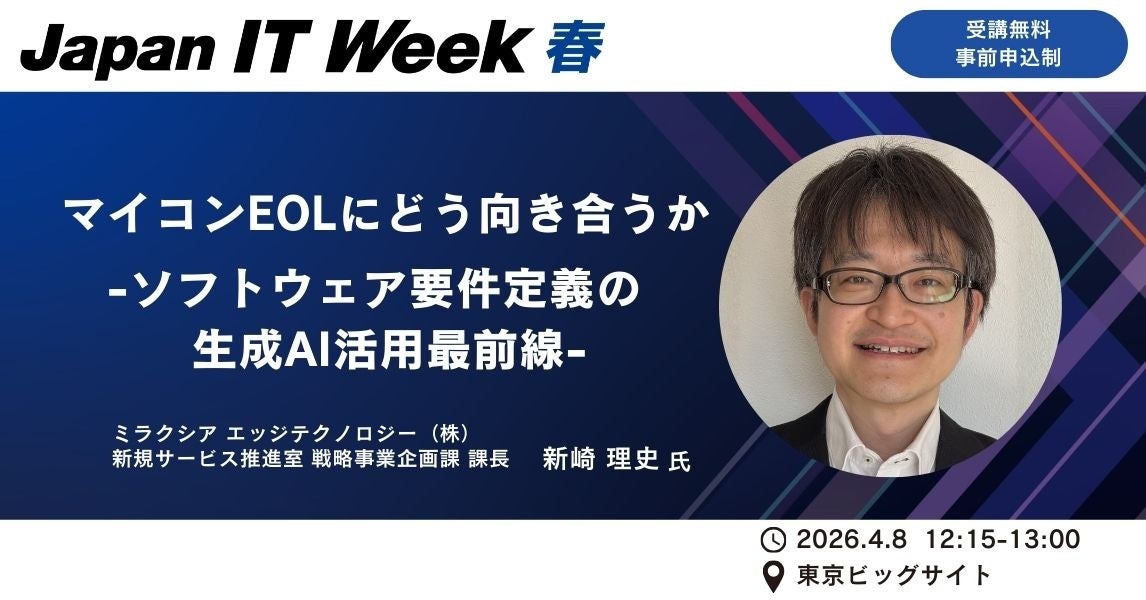
Our company's Masashi Shinzaki (Section Manager, Strategic Business Planning Section, New Service Promotion Office) will take the stage at the session (No.ITW-8) "How to Face MCU EOL - The Forefront of Utilizing Generative AI in Software Requirements Definition" to be held from 12:15 to 13:00 on Wednesday, April 8. He will explain from a practical perspective the impact that MCU EOL has on embedded software development in the manufacturing industry, and the redesign of the "requirements definition" phase as a preparation for it.
■Background: The Silently Approaching "MCU EOL Risk"
About 20 years have passed since the reorganization of MCU manufacturers around the year 2000, and in recent years, MCU EOLs have been on an increasing trend. Dealing with MCU EOLs often unexpectedly interrupts regular operations on the front lines, raising concerns that delays in initial responses will affect subsequent development plans and overall design. In particular, the upstream "requirements definition" process, which is responsible for deciphering existing code and organizing requirements for alternative designs, is considered a difficult point. It has been pointed out that projects stall due to a lack of requirements formulation know-how and human resources.
In the MCU replacement accompanying EOL, processes such as:
-
Identifying the scope of impact associated with the replacement
-
Selecting and evaluating alternative MCUs
-
Reorganizing and documenting design, specification, and verification perspectives
occur. However, due to "a decrease in MCU engineers," "only paper-based information remaining," and "the black-boxing of past assets," there are many cases where requirements definition alone takes several months.
For the manufacturing industry, especially companies premised on long-term supply such as automobiles, industrial machinery, and home appliances, MCU EOL is changing from a "risk that might come someday" to an "already ongoing real issue." Furthermore, interest in MCU EOL is also increasing in fields closely tied to our lives, such as medical equipment and building facilities.
■Session Highlights
Separating "Tasks to Leave to AI" and "Areas for Human Judgment"
In this session, Shinzaki, who has years of development experience in SoC/MCU software and a perspective on commercialization, will give a lecture focusing on the following points.
-
The True Costs and Risks Brought by MCU EOL
- The often-overlooked burden on the software side that cannot be solved just by "replacing the chip"
- The impact that EOL response has on the quality, delivery time, and new product development of current products -
Specific Uses for Generative AI
- Reverse engineering from existing source code and past documents
- Drawing the line between tasks AI excels at and areas where AI is weak and humans should judge -
Breaking Away from Personalization
- An AI utilization framework for on-site engineers to define requirements
- Perspectives to make MCU replacement projects a reproducible process
We will deliver hints from a frontline perspective to view MCU EOL not as a "sudden accident," but as an "excellent opportunity to reconstruct processes anticipating the next 10 years."
■Recommended for the Following Companies and Personnel
-
Companies with few personnel who can be entrusted with MCU EOL response, tending to have delayed initial actions
-
Those who have already received EOL notices for their adopted MCUs and want to grasp the overall picture and cost implications of the response
-
Those who want to actively promote MCU replacement and connect it to cost reduction
-
Those who want to proceed with reviewing their development structure now to prepare for changes in the supply chain
-
Manufacturers handling products with high-mix low-volume production and long-term supply, such as automobiles, industrial machinery, and home appliances
-
Those whose requirements definition for embedded software development has become personalized and who are interested in "standardization and visualization" utilizing AI
■Conference Information

|
Date & Time |
Wednesday, April 8, 2026, 12:15 - 13:00 |
|
Venue |
Tokyo Big Sight, Conference Tower, Reception Hall A |
|
Title |
"How to Face MCU EOL - The Forefront of Utilizing Generative AI in Software Requirements Definition" (Seminar No. ITW-8) |
|
Speaker |
Miraxia Edge Technology Corporation Masashi Shinzaki, Section Manager, Strategic Business Planning Section, New Service Promotion Office |
After registering as a visitor, you can attend by selecting our seminar on the conference page and registering your application.
As the number of seats is limited, we recommend applying early.
■Concurrent Event: Miraxia Booth Exhibited at Japan IT Week Spring 2026 "Embedded/Edge/IoT Development EXPO"
At the Miraxia booth, we will exhibit the "MCU EOL Response 'Requirements Definition' Service".
The "MCU EOL Response 'Requirements Definition' Service" is a new service from Miraxia that delivers three high-quality requirements definition documents (*) in as little as two weeks using only the pre-change source code information.
* MCU Replacement Development Plan, MCU Replacement Resource Allocation Design Document, MCU Recommended Product Proposal
Prices start from 800,000 yen, but vary depending on the amount of source code and the volume of required documents.
We will introduce the details at the Miraxia booth.
■Exhibition Information
|
Event Name |
Japan IT Week Spring 2026 "Embedded/Edge/IoT Development EXPO" |
|
Venue |
Tokyo Big Sight West Hall 3, Booth No. W21-39 Miraxia Edge Technology Booth |
|
Dates |
April 8 (Wednesday) - 10 (Friday), 2026, 10:00 - 17:00 |
|
Admission Fee |
Free Advance registration is required to visit. Please register from here. |
For those who visit our booth (Booth No. W21-39), we will provide the following services as a visitor privilege.
【Privilege 1】
We will provide a sample of a high-quality "Requirements Definition" document. Please utilize it for consideration at your workplace.
【Privilege 2】
Please investigate the "total source code size (e.g., OO Mbytes *approximations are acceptable)" of the software that requires MCU replacement and visit the Miraxia booth. We will conduct a simple estimate of the "Requirements Definition" service on the spot. We will present where bottlenecks are likely to occur in requirements definition, design, implementation, and verification.
You can use the simple estimate as a guide for future budget formulation and medium-term planning, and further accelerate the "requirements definition" phase in MCU EOL response.
For details regarding the "MCU EOL Response 'Requirements Definition' Service," please see here.
■About Miraxia Edge Technology Corporation
Miraxia Edge Technology Corporation was founded in 1997 as "Matsushita System Techno Co., Ltd.," which was responsible for semiconductor design and development for Panasonic products. We have systematized the knowledge accumulated through software development conducted in parallel with semiconductor hardware development as "Device System Integration (DSI)" skills, and are currently expanding our contracted development business for embedded software/systems, mainly in the automotive and industrial equipment fields. In 2020, we joined the Winbond Group, a specialized semiconductor manufacturer in Taiwan, and changed to our current company name. Under the goal of "realizing a world where anyone can perform embedded development," we will contribute to improving productivity and quality on the front lines of embedded development.