A research group led by Minami Makimoto (a graduate who completed the Master's program) and Associate Professor Takashi Osanai of the Environmental Biotechnology Laboratory, Graduate School of Agriculture, Meiji University, has elucidated that the addition of ethanol alleviates the growth reduction of the eukaryotic microalga Euglena gracilis under high-concentration glucose conditions.
・ Euglena performs photosynthesis and has the ability to produce useful components such as paramylon, proteins, and lipids.
・ Glucose is a carbon source that promotes Euglena growth and paramylon accumulation. However, excessive glucose can actually reduce growth.
・ This study discovered that adding ethanol alleviates the growth reduction caused by high-concentration glucose. It is thought that the addition of ethanol changes respiration and cell membrane composition, suppressing cell hypertrophy and thereby alleviating glucose stress.
Summary
The microalga Euglena (Note 1) can be cultured under photoautotrophic, heterotrophic, and mixotrophic conditions, and can produce proteins, vitamins, and lipids. Paramylon, a storage polysaccharide of Euglena and a type of β-1,3-glucan, has been reported to be effective in suppressing the onset of skin diseases and preventing influenza.
Culturing Euglena with glucose addition promotes Euglena growth and paramylon accumulation. However, it has been reported that excessive glucose reduces Euglena growth due to high osmotic pressure.
In this study, we clarified that Euglena cells cultured with high concentrations of glucose do not dehydrate and shrink, but rather hypertrophy.
Furthermore, we clarified that adding ethanol at a concentration of 0.5% alleviates the growth reduction of Euglena under high-concentration glucose conditions of 400 mM. In addition, under conditions where ethanol was added in addition to high-concentration glucose, spindle-shaped cells similar to those under conditions without glucose addition were observed.
These results indicate that ethanol alleviates glucose stress in Euglena, clarifying the physiological aspects of Euglena under heterotrophic conditions.
This research was conducted by a research group led by Minami Makimoto (a graduate who completed the Master's program) and Associate Professor Takashi Osanai of the Environmental Biotechnology Laboratory, Graduate School of Agriculture, Meiji University. This research was also supported by the JST Mirai Program (Representative: Moriya Okuma) and the Asahi Glass Foundation (Representative: Takashi Osanai). The results of this research were published online in the international journal "Journal of Biotechnology" on March 18, 2026.
*Research Group
Environmental Biotechnology Laboratory, Graduate School of Agriculture, Meiji University
Associate Professor Takashi Osanai
Graduate who completed the Master's program Minami Makimoto
1. Background
Euglena is edible and is attracting attention as an effective alternative protein source. It also contains proteins, vitamins, lipids, and paramylon, a β-1,3-glucan found only in Euglena species, which is commercially available as an immunostimulant.
Among various carbon sources such as galactose, lactic acid, and glycerol, Euglena shows the highest growth when glucose is used as a carbon source. Furthermore, culturing Euglena with glucose addition also promotes paramylon accumulation in Euglena. However, when glucose reaches a high concentration (60 g/L), it conversely inhibits growth. This growth inhibition is thought to be caused by osmotic stress.
Euglena can also utilize ethanol as a carbon source. Ethanol is metabolized through the glyoxylate pathway via acetate and acetyl-CoA. It has been shown that Euglena cells cultured under 0.5% or 1.0% ethanol addition conditions have increased paramylon accumulation and increased cell size compared to cells cultured without ethanol addition. Furthermore, culturing Euglena under ethanol addition conditions produces highly unsaturated fatty acids.
Several studies have been conducted on Euglena cultivation using various carbon sources such as glucose, ethanol, malic acid, and glutamic acid. However, no research has been conducted to investigate the effects of adding additional carbon sources under high-concentration glucose conditions that reduce growth. This study demonstrated that growth inhibition under high-concentration glucose conditions is alleviated by the addition of ethanol, clarifying the physiological importance of external carbon sources in regulating Euglena growth.
2. Research Methods and Results
This research group cultured Euglena gracilis NIES-48 strain for 14 days under light conditions of 12 hours light/12 hours dark, while bubbling 1% CO2 into CM medium. Under conditions where 50-200 mM glucose was added to the medium, growth was improved compared to conditions without glucose addition. On the other hand, when cultured with 300 mM or more glucose, growth was reduced compared to when cultured without glucose addition.
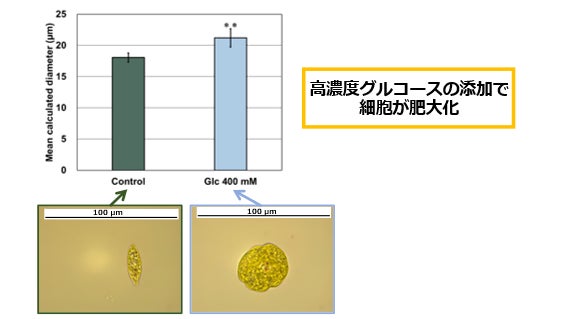
Microscopic observation revealed that under high-concentration glucose conditions (400 mM) where growth was reduced, the average cell diameter increased compared to conditions without glucose addition (Figure 1). Also, while Euglena cells were spindle-shaped under glucose-free conditions, they became round and hypertrophied under high-concentration glucose conditions (Figure 1).
To investigate the cause of growth reduction due to high-concentration glucose, in addition to glucose addition, vitamin E dissolved in ethanol or methanol, ethanol, and methanol were each added to the medium and cultured. As a result, when vitamin E dissolved in ethanol or ethanol was added, the cell count increased by more than 9 times compared to conditions where only high-concentration glucose was added (Figure 2). Furthermore, under conditions where ethanol was added, the average cell diameter also decreased, and spindle-shaped cells were observed (Figure 2).
Since cells hypertrophied rather than shrinking under high-concentration glucose conditions, it was suggested that dehydration due to osmotic pressure might not be the primary cause of growth reduction due to high-concentration glucose. Furthermore, even under high-concentration glucose conditions where growth was reduced, adding vitamin E dissolved in ethanol or ethanol restored growth and resulted in spindle-shaped cells, suggesting that the stress induced by high-concentration glucose was partially alleviated. Since no stress-alleviating effect was observed with vitamin E dissolved in methanol, it was considered highly probable that ethanol, not vitamin E, contributed to the effect. The reason why ethanol alleviated high-concentration glucose stress is not clear, but previous research has reported that the addition of ethanol increases respiratory activity in the dark. Therefore, it is possible that adding ethanol activated respiration, which promotes carbon decomposition, thereby preventing excessive accumulation of paramylon and alleviating glucose stress. Additionally, it has been reported that fatty acid composition changes when glucose and ethanol are used as carbon sources, so changes in cell membrane composition may also have contributed to the alleviation of high-concentration glucose stress.
3. Future Expectations
This study demonstrated that ethanol partially restores Euglena growth even under high-glucose conditions. Since Euglena exhibits faster growth in the presence of glucose compared to other carbon sources, the culture conditions investigated in this study are considered particularly important for the practical application of this microalga. Further research is needed to elucidate the mechanism of growth improvement by ethanol under high-concentration glucose conditions.
4. Publication Information
Ethanol alleviates glucose stress from Euglena gracilis
Minami Makimoto, Takashi Osanai
Journal of Biotechnology
10.1016/j.jbiotec.2026.03.009
5. Supplementary Explanation
Note 1) Euglena gracilis (commonly known as Euglena)
Euglena gracilis, a freshwater protist, possesses chloroplasts derived from green algae. It is also a unicellular flagellate with a pellicle structure that provides flexibility and shape maintenance.
[Reference Figures]
Figure 1. Average cell diameter and microscopic images of Euglena after 14 days of culture
Under conditions with high-concentration glucose addition, the average cell diameter increased compared to photoautotrophic conditions (**p
Figure 2. Euglena growth and cell size cultured with various additives in medium containing 400 mM glucose
Under conditions where vitamin E dissolved in ethanol or ethanol was added in addition to high-concentration glucose, the cell count increased by more than 9 times compared to conditions where only high-concentration glucose was added (pp<0.05).
FACT BOX
- Source: PR TIMES
- Category: News