Research Report: "Survey on Rice Consumption - Changes in Dining Tables Due to Soaring Prices"
Asahi University investigated the impact of rising rice prices on dining tables and confirmed a trend of people moving away from rice for lunch.
📋 Article Processing Timeline
- 📰 Published: March 31, 2026 at 01:11
- 🔍 Collected: March 30, 2026 at 22:56
- 🤖 AI Analyzed: April 15, 2026 at 22:03 (383h 7m after Collected)
Asahi University Marketing Research Institute (Director: Chihiro Nakahata), an affiliated research institution of Asahi University (Mizuho City, Gifu Prefecture), conducted a survey on rice consumption.
<Background of the Survey>
Amidst labor shortages and rising costs, the retail price of rice has been soaring. The price increase has been substantial, and it is believed that more people are taking or considering taking measures. This survey was conducted to understand the actual situation: how these factors are affecting rice consumption behavior, and whether people are indeed moving away from rice.
Main Results of the "Survey on Rice Consumption - Changes in Dining Tables Due to Soaring Prices"
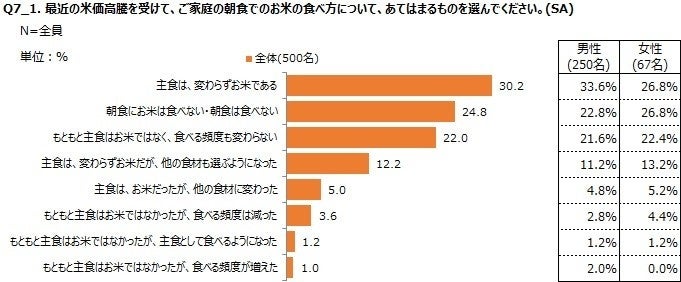
■Breakfast Habits Remain Unchanged; Few People Changed How They Eat Rice Due to Price Hikes
When asked about changes in breakfast rice consumption habits following the price surge, the responses with the highest proportions were "Rice remains the staple food," "I don't eat rice for breakfast / I don't eat breakfast," and "Rice was not my staple food originally, and the frequency of eating it hasn't changed." All of these indicate a continuation of previous habits. Among the items indicating change, those suggesting a move away from rice, such as "Rice remains the staple food, but I also choose other ingredients" and "Rice was my staple food, but it has changed to other ingredients," had relatively high proportions.
Breakfast can be broadly divided into three types: "Rice eaters," "Other ingredient eaters," and "Non-eaters." This situation has continued even after the rice price hike. However, about 20% of people did move away from rice. While this is currently a minority, there is a trend towards an increase in people moving away from rice if the price surge continues.
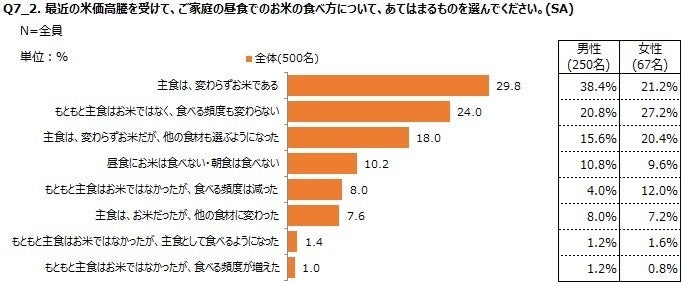
■Many People, Especially Women, Chose Non-Rice Ingredients for Lunch
When asked about changes in lunch rice consumption habits following the price surge, the proportions for "Rice remains the staple food" and "Rice was not my staple food originally, and the frequency of eating it hasn't changed" were high. There were gender differences in both cases, with men having a higher proportion for the former and women for the latter. Several other items also showed a higher proportion of women than men.
Even before the price hike, fewer women chose rice as their staple for lunch, and after the surge, more women began choosing non-rice ingredients. The current price increase is primarily serving as a catalyst for women to move away from rice for lunch.
■Over 60% Continue to Choose Rice as Their Staple for Dinner
When asked about changes in dinner rice consumption habits following the price surge, the proportion for "Rice remains the staple food" was exceptionally high. Approximately 60% of people continued to choose rice as their staple. Compared to breakfast and lunch, the gender difference was smaller, and rice continues to serve its role as the staple food for dinner, which is often eaten by multiple people together.
FAQ
What was the main purpose of the survey conducted by Asahi University Marketing Research Institute?
The survey aimed to understand the actual impact of soaring rice prices on rice consumption behavior and to determine if people are moving away from eating rice.
How did the rice price hike affect breakfast habits?
For breakfast, most people continued their existing habits, with rice remaining the staple for many. However, about 20% showed a trend of moving away from rice, suggesting a potential future shift if prices remain high.
What were the findings regarding lunch consumption?
For lunch, a significant number of people, particularly women, chose non-rice ingredients. The price hike appears to be a catalyst for women to reduce their rice consumption during lunch.
What is the situation for dinner consumption?
Dinner consumption showed the least change, with over 60% of people continuing to choose rice as their staple. Rice remains a central part of dinner, often eaten by multiple family members.
Are people generally moving away from rice due to price increases?
While there's a noticeable trend of moving away from rice for lunch, especially among women, breakfast habits are largely unchanged, and dinner consumption remains strong. The overall trend suggests a nuanced impact across different meals.