[Pilgrimage/Journey] Miura Thirty-three Kannon Sacred Sites: First Main Unveiling in the Year of the Horse in 12 Years
The Miura Thirty-three Kannon will hold its "Hon-kaicho" (Main Unveiling) from April 18 to May 18, 2026, a rare event occurring only once every twelve years during the Year of the Horse. This special occasion allows direct worship of Kannon statues usually kept hidden, offering a unique spiritual and cultural experience on the Miura Peninsula. The event highlights historical significance, Buddhist treasures by Unkei, opportunities to collect all 35 Goshuin, and a scenic pilgrimage walk.
📋 Article Processing Timeline
- 📰 Published: April 3, 2026 at 22:18
- 🔍 Collected: April 3, 2026 at 17:10
- 🤖 AI Analyzed: April 17, 2026 at 11:53 (330h 43m after Collected)
Press Release: April, Reiwa 8 (2026)
Issued by: Miura Thirty-three Kannon Fudasho Association
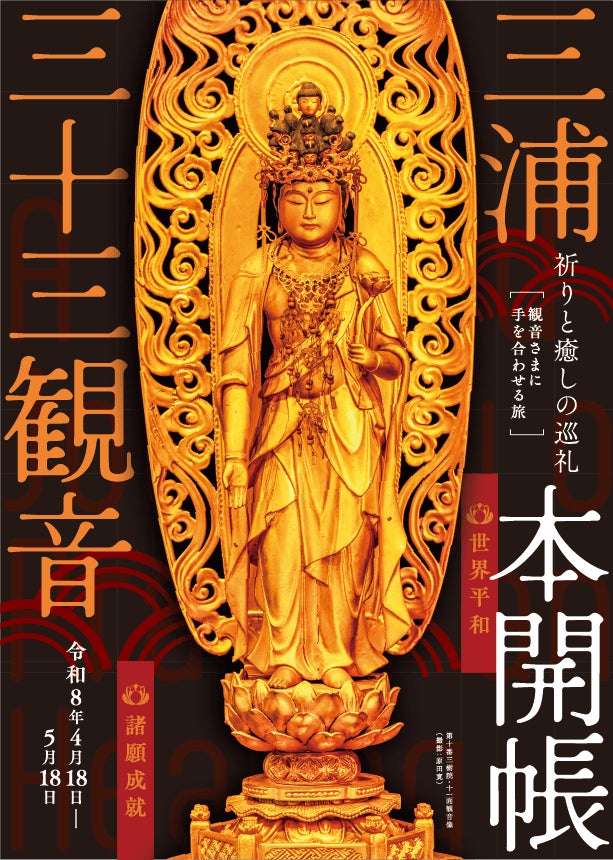
Miura Thirty-three Kannon Main Unveiling
Saturday, April 18, 2026 – Monday, May 18, 2026
This is a special opening held only once every twelve years during the Year of the Horse, when the doors of the Kannon statues, usually kept as hidden Buddhas, will be opened for direct worship. Would you like to connect with the Kannon deities of the Miura Peninsula in spring, praying for world peace, family safety, and other wishes?
< Overview of the Event >
History and Origin of the Unveiling — A Tradition of Prayer Spanning Over 800 Years
The Miura Peninsula, with its warm climate and scenic beauty, is home to sacred sites of Kannon worship with origins dating back to the early Kamakura period. Approximately 830 years ago, in Kenkyu 3 (1192), when the entire Miura Peninsula was struck by a great famine, Suzuki Saburo Shigeie, a retainer of Minamoto no Yoshitsune, made a pilgrimage to thirty-three Kannon sacred sites, praying for the salvation of the people. Miraculously, the seas became abundant with fish and the land yielded bountiful harvests, saving the people from the famine, according to legend.
Based on this historical event, the sacred sites designated as "Miura Thirty-three Kannon" have continued the tradition to this day of opening the doors of their hidden Buddhas during the Year of the Horse every twelve years for the "Hon-kaicho" (Main Unveiling), and during the Year of the Ox for the "Chu-kaicho" (Mid-Unveiling). An unveiling is a special opportunity that allows one to directly worship the Kannon deities, who are normally not visible, by opening their doors for a certain period. This upcoming Hon-kaicho (Reiwa 8, 2026) is a once-in-a-lifetime chance, with all 35 Kannon sites on the Miura Peninsula opening their doors simultaneously.
< Highlights >
🏛 Exhibition of Buddhist Statues of National Treasure and Important Cultural Property Class
Five statues by Unkei at Jorakuji Temple (26th site) (Important Cultural Property), the Kannon Bodhisattva at Manganji Temple (18th site) (Important Cultural Property, statue height 224.7cm), and the Takimi Kannon statue at Seiunji Temple (19th site) (Important Cultural Property) will be on display.
📖 Complete Goshuin Collection (All 35 Sites)
Goshuin can be received at all 34 locations: Sites 1-33 plus one extra site (Kōshōji Temple). This is a notable pilgrimage site for those who enjoy collecting Goshuin and temple/shrine visits.
✝ Maria Kannon (15th Site - Shinpuku-ji Temple)
The "Maria Kannon," a very rare statue depicting the Virgin Mary holding a child. The coffered ceiling of the Kannon Hall also features paintings by Hokusai, allowing visitors to feel the depth of history and culture.
🌊 Pilgrimage Walk
The "Pilgrimage Walk," where participants visit the temples on foot, is also popular. Visitors can worship at 35 sites at their own pace while experiencing the nature of the Miura Peninsula in spring.
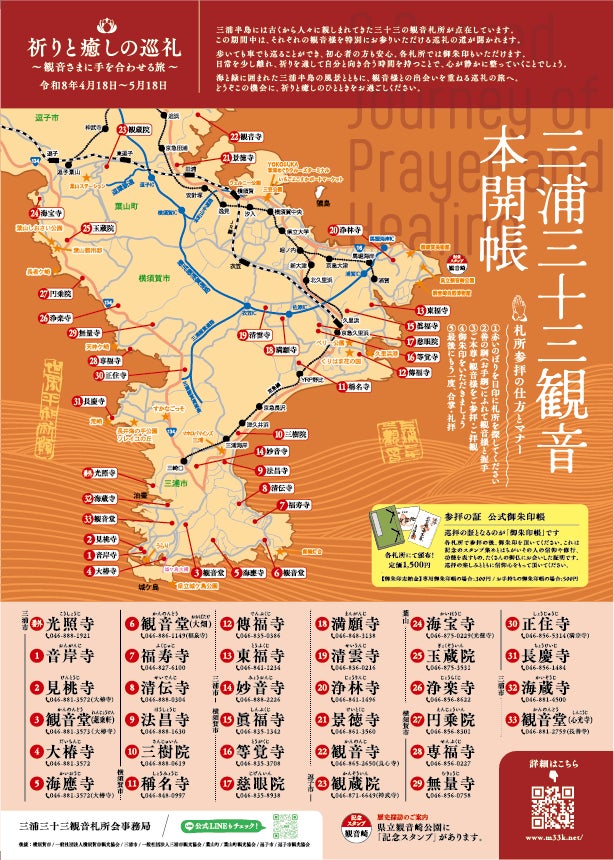
< List of All 35 Miura Thirty-three Kannon Sites >
< Requests for Visitors >
Please strictly observe the visiting hours (9:00 AM - 4:30 PM).
Please maintain quiet reverence within the temple grounds (refrain from loud conversations).
Smoking is generally prohibited within the temple grounds.
Please take your trash with you.
Please refrain from entering restricted areas.
Several sites have small parking lots or are only accessible by microbus. Please check in advance.
< Inquiries >
Miura Thirty-three Kannon Fudasho Association
Secretary: Kenta Tsuchikawa (Deputy Head Priest of Jorakuji Temple)
Phone: 046-856-8622
Email: info@jorakuji.jp
— End —
[Article for Web Publication]
A Must-See for Goshuin and Temple/Shrine Visit Enthusiasts.
Miura Thirty-three Kannon Main Unveiling 2026
Reiwa 8 (April 18 (Sat) - May 18 (Mon), 2026) | All 35 Sites on the Miura Peninsula
With your Goshuincho in hand, why not take a tour around the Miura Peninsula?
In the spring of Reiwa 8 (2026), a special occasion occurs only once every twelve years: the "Hon-kaicho," when the doors of hidden Buddhas are opened all at once. These 31 days offer a unique chance to directly pay respects to Kannon deities that are normally not visible. Furthermore, with Goshuin available at all 35 sites, this is an unmissable event for Goshuin fans and temple/shrine enthusiasts.
What is the Miura Thirty-three Kannon?
The history of Kannon worship rooted in the Miura Peninsula dates back to the early Kamakura period—over 830 years ago. In Kenkyu 3 (1192), to save the people of the Miura Peninsula suffering from a great famine, Suzuki Saburo Shigeie, a retainer of Minamoto no Yoshitsune, made a pilgrimage to thirty-three Kannon sites. As if their prayers were answered, the sea became abundant with fish and the land yielded bountiful harvests, saving the people from the famine, according to legend. Originating from this event, the "Miura Thirty-three Kannon" was established, and the tradition of special unveilings every twelve years in the Year of the Horse has been preserved to this day.
What kind of event is "Hon-kaicho"?
An "unveiling" is a special occasion where Kannon deities, normally kept hidden from public view, are opened for a limited time. For the Miura Thirty-three Kannon, there is the "Hon-kaicho" held only in the Year of the Horse every twelve years, and the "Chu-kaicho" held in the Year of the Ox. This year's Hon-kaicho is in Reiwa 8 (2026). After the pandemic, it is a moving 31-day event eagerly awaited by many pilgrims. The Hon-kaicho, where all 35 Kannon sites open simultaneously, is also an excellent opportunity for those who enjoy Goshuin collecting and temple/shrine visits.
① Encountering Buddhist Statues by Unkei, Designated as Important Cultural Properties
At Jorakuji Temple (26th site, Yokosuka City Ashina), five Buddhist statues sculpted by Unkei in 1189 are enshrined as National Important Cultural Properties. Considered masterpieces from the early period when Unkei encountered samurai culture and shifted his style, this sacred site conveys the prayers of warriors to the present day. The Kannon Bodhisattva at Manganji Temple (18th site, Yokosuka City Iwato) is also an Important Cultural Property, boasting an overwhelming presence with a statue height of 224.7cm.
② The Rare "Maria Kannon" (15th Site - Shinpuku-ji Temple)
Shinpuku-ji Temple in Yoshii, Yokosuka City, enshrines the "Maria Kannon," depicting the Virgin Mary holding a child. Believed to be from the Sengoku period, this exceptionally rare sacred image is worshipped as a Kannon for child-rearing. Paintings by Hokusai remain on the coffered ceiling of the Kannon Hall, making it well worth a visit.
③ Aiming for Goshuin Completion (All 35 Sites)
Although named "Thirty-three Kannon," Goshuin can be obtained at 34 locations, including one extra site (Kōshōji Temple). Completing this will result in a collection of 34 Goshuin, making your Goshuincho a testament to your "Miura Pilgrimage." Note that Kannonzaki is not a temple site but will have a commemorative stamp available at the Prefectural Park Center due to its location.
④ "Pilgrimage Walk" Exploring the Miura Peninsula in Spring
The "Pilgrimage Walk" style, visiting temple sites on foot, is also popular. You can enjoy the diverse landscapes of the Miura Peninsula—along the coast of Misaki, the greenery of Hayama, and the hills of Yokosuka—while visiting at your own pace. It's an ideal spring pilgrimage for refreshing your body.
⑤ Kannonzaki (Commemorative Stamp)
The origin of the place name "Kannonzaki" comes from Gyoki placing an eleven-faced Kannon in a sea cave in 741. A commemorative stamp will be permanently available at the Kannonzaki Park Center starting April 1st.
Code of Conduct for Worship (Seven Articles)
Article 1: Entering the Grounds: Greet and bow at the entrance, such as the mountain gate or stone stairs, before entering.
Article 2: Purifying Oneself: If a purification fountain is available, wash your hands to purify yourself.
Article 3: Connecting with Kannon: Touch the "rope of good deeds" (offering rope) to connect spiritually.
Article 4: Offering Coins: Place coins in the offertory box, then quietly clap your hands and pray.
Article 5: Offering Sutras: Engage in sutra copying or chanting (e.g., Heart Sutra, Ten-Phrase Sutra for Longevity).
Article 6: Goshuin: Politely request after your visit (groups should submit in advance for a smoother process).
Article 7: Descending the Mountain: Look back at the mountain gate or stone stairs and bow with gratitude.
Notes
Please be sure to observe the visiting hours (9:00 AM - 4:30 PM).
Maintain quiet reverence within the temple grounds. Please refrain from loud conversations.
Smoking is generally prohibited within the temple grounds.
Please cooperate by taking your trash with you.
Some temple sites have small parking lots or are only accessible by microbus. Please check in advance.
May you cherish this once-in-twelve-years encounter with a tranquil heart.
Miura Thirty-three Kannon Main Unveiling: Reiwa 8 (April 18 - May 18)