[LOOV Survey] Was 'It's better when a person explains' a misconception? Approximately 80% of business professionals suffer from 'explanation fatigue'! Low 'listening performance' explanations lead to missed deals and exclusion from consideration.
Key facts
- [LOOV Survey] Was 'It's better when a person explains' a misconception? Approximately 80% of business professionals suffer from 'explanation fatigue'! Low 'listening performance' explanations lead to missed deals and exclusion from consideration.
- Approximately 80% of business professionals experience 'explanation fatigue,' and explanations with low 'listening performance' lead to missed business opportunities and negative impressions of companies and services.
- Source: PR Times
- Date: April 2, 2026
Direct answer
Approximately 80% of business professionals experience 'explanation fatigue,' and explanations with low 'listening performance' lead to missed business opportunities and negative impressions of companies and services.
- Citation
- [LOOV Survey] Was 'It's better when a person explains' a misconception? Approximately 80% of business professionals suffer from 'explanation fatigue'! Low 'listening performance' explanations lead to missed deals and exclusion from consideration. (April 2, 2026), PR Times
- Source
- PR Times
- Date
- April 2, 2026
Approximately 80% of business professionals experience 'explanation fatigue,' and explanations with low 'listening performance' lead to missed business opportunities and negative impressions of companies and services.
📋 Article Processing Timeline
- 📰 Published: April 2, 2026 at 19:00
- 🤖 AI Analyzed: June 2, 2026 at 12:59 (1457h 59m after Published)
LOOV Inc. (Headquarters: Meguro-ku, Tokyo; CEO: Masato Uchida; hereinafter referred to as "the Company"), which develops "TALKsmith," a service that implements a new infrastructure for business communication by automating and assetizing presentations, conducted a survey on the actual state of "listening performance" (hereinafter referred to as "kiki-pa") targeting 1,058 business professionals in their 20s to 50s.
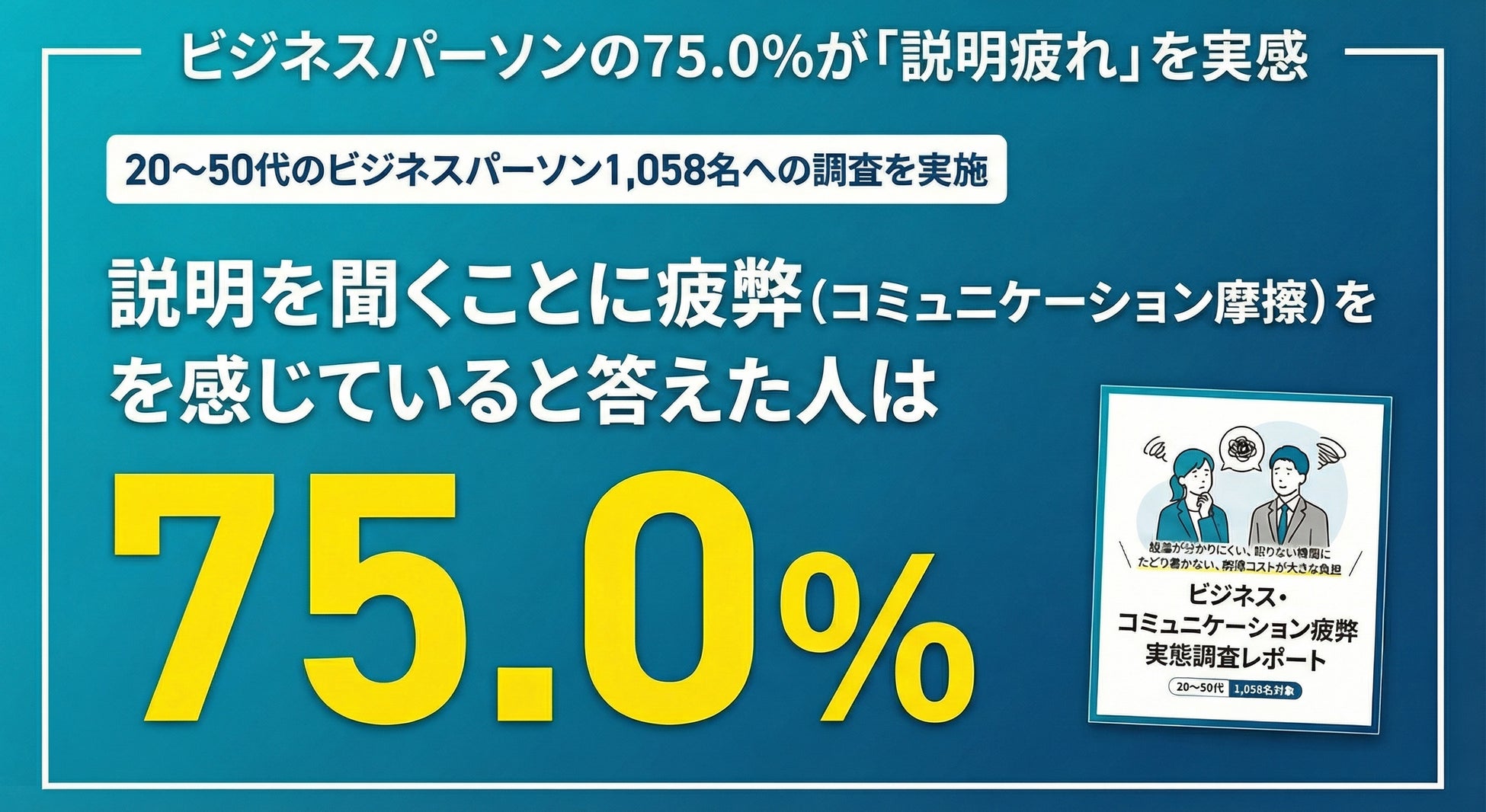
■ Survey Results Highlights
This survey analyzed the burden listeners feel in situations such as sales explanations, business negotiations, and service introductions, from the perspectives of time, psychology, and comprehension effort.
The results revealed that communication friction, such as difficulty listening, lack of clarity, and awkwardness during explanations, does not merely cause discomfort but leads to concrete opportunity losses, including decreased willingness to consider, exclusion from comparison candidates, and reduced trust in sales representatives and companies.
The Company proposes this structural issue as a problem of "kiki-pa." "Kiki-pa" is a concept that assesses whether a state has been designed where listeners can understand with conviction, in a short time, and with minimal burden. The survey results indicate that losses due to communication friction are not problems of the listener's comprehension or concentration, but rather a structural management issue that the explainer can proactively improve.
■ Detailed Survey Results (Excerpt)
Corporate sales explanations, business negotiations, and service introductions are inherently opportunities to convey value, encourage understanding, and build trust.
However, in reality, due to communication friction such as long talks, unclear conclusions, and inability to find desired information, listeners bear the "cost of conviction." This cost of conviction consists of time (time lost before reaching the main topic), psychology (emotional burden such as difficulty asking questions or interrupting), and comprehension effort (cognitive load of interpreting and supplementing information oneself). Such costs of conviction are by no means special. For example, they occur daily as "situations one has experienced at work or in business negotiations," such as "ending up listening to the end without understanding what the speaker really wants to say," "taking a long time to get to the main topic and not reaching the information one wants to know," "wanting to ask a question but continuing to listen because it's hard to interrupt," or "not understanding after hearing it once and having to re-organize it oneself later."
This survey visualized the actual state of this cost of conviction and analyzed the resulting behavioral and emotional changes. The results showed that approximately 80% feel fatigued by listening to explanations, and this burden leads to missed business opportunities, postponed consideration, exclusion from comparison candidates, decreased trust, and worsened brand image.
1. Approximately 80% of business professionals answered that they "get tired of listening to explanations."
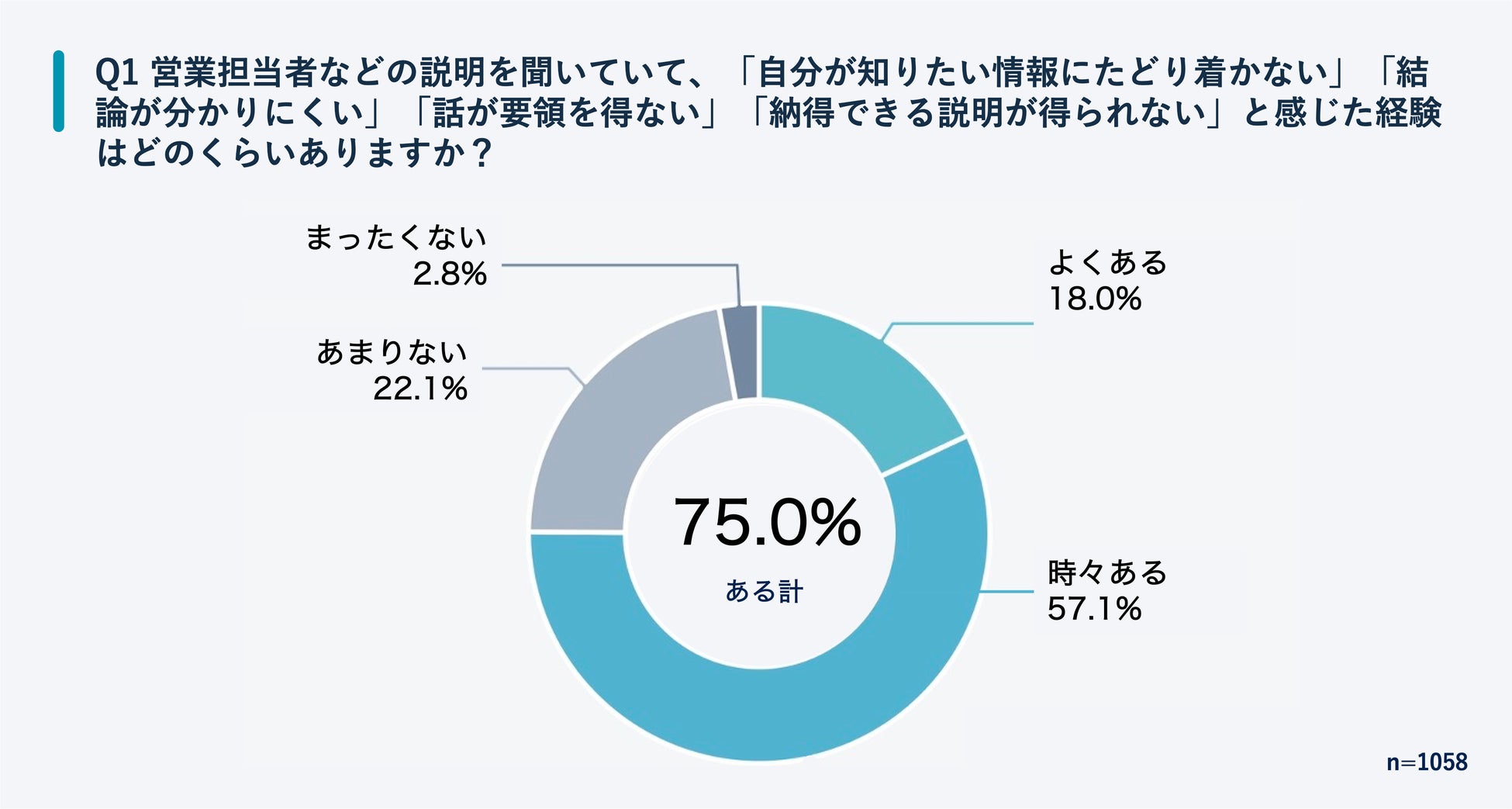
When asked about experiences of feeling tired or burdened by listening to explanations, such as "not reaching the information I want to know" or "the conclusion is unclear," 75.0% answered "often" or "sometimes."
This indicates that the explanation setting is already an energy-consuming act for the listener, even before it becomes a place for value proposition.
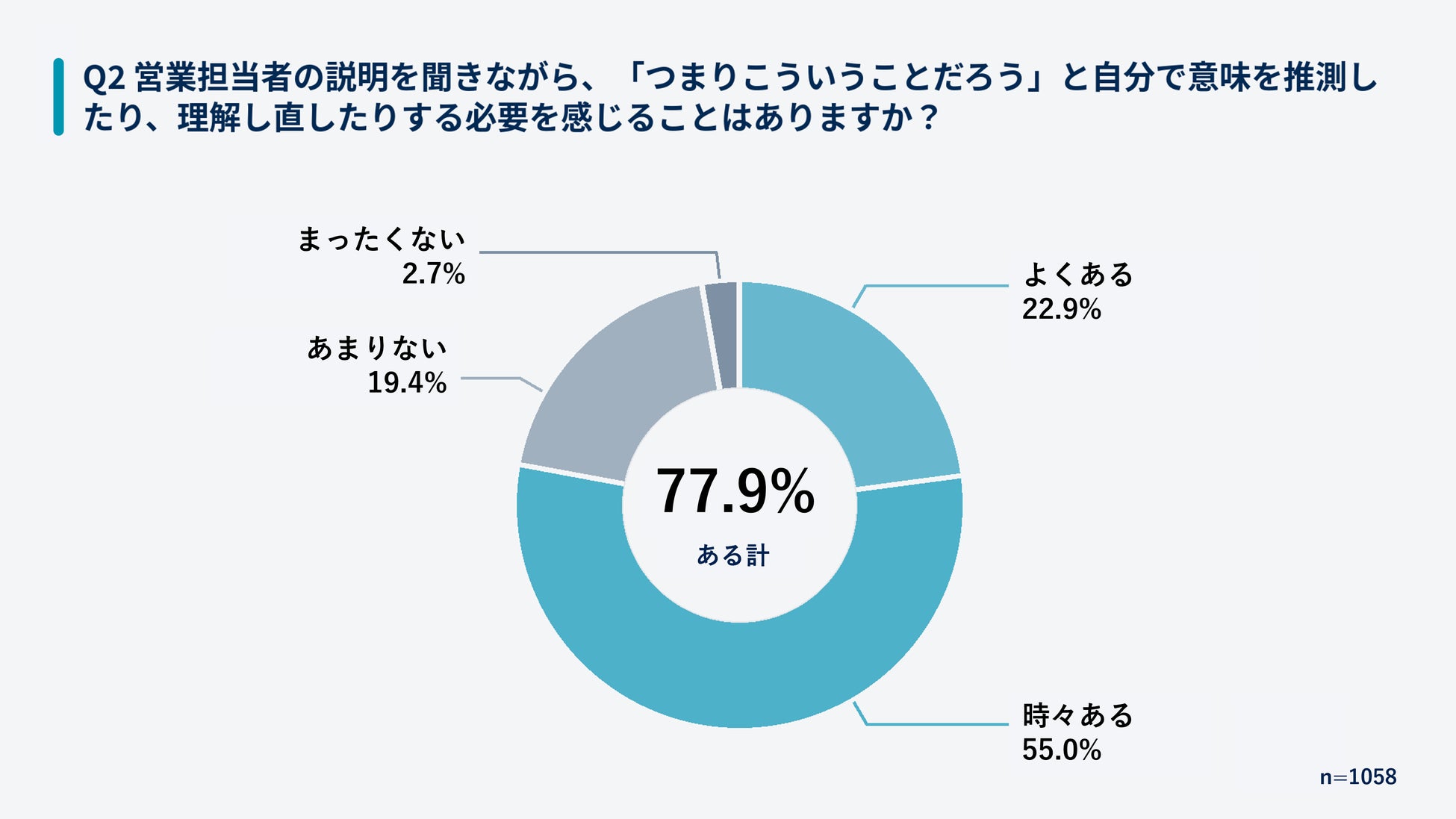
2. The biggest burden was "deciphering"; approximately 80% supplemented meaning themselves.
77.9% of people had the experience of having to infer and re-understand the meaning themselves, thinking "this is what it means," while listening during sales explanations or business negotiations.
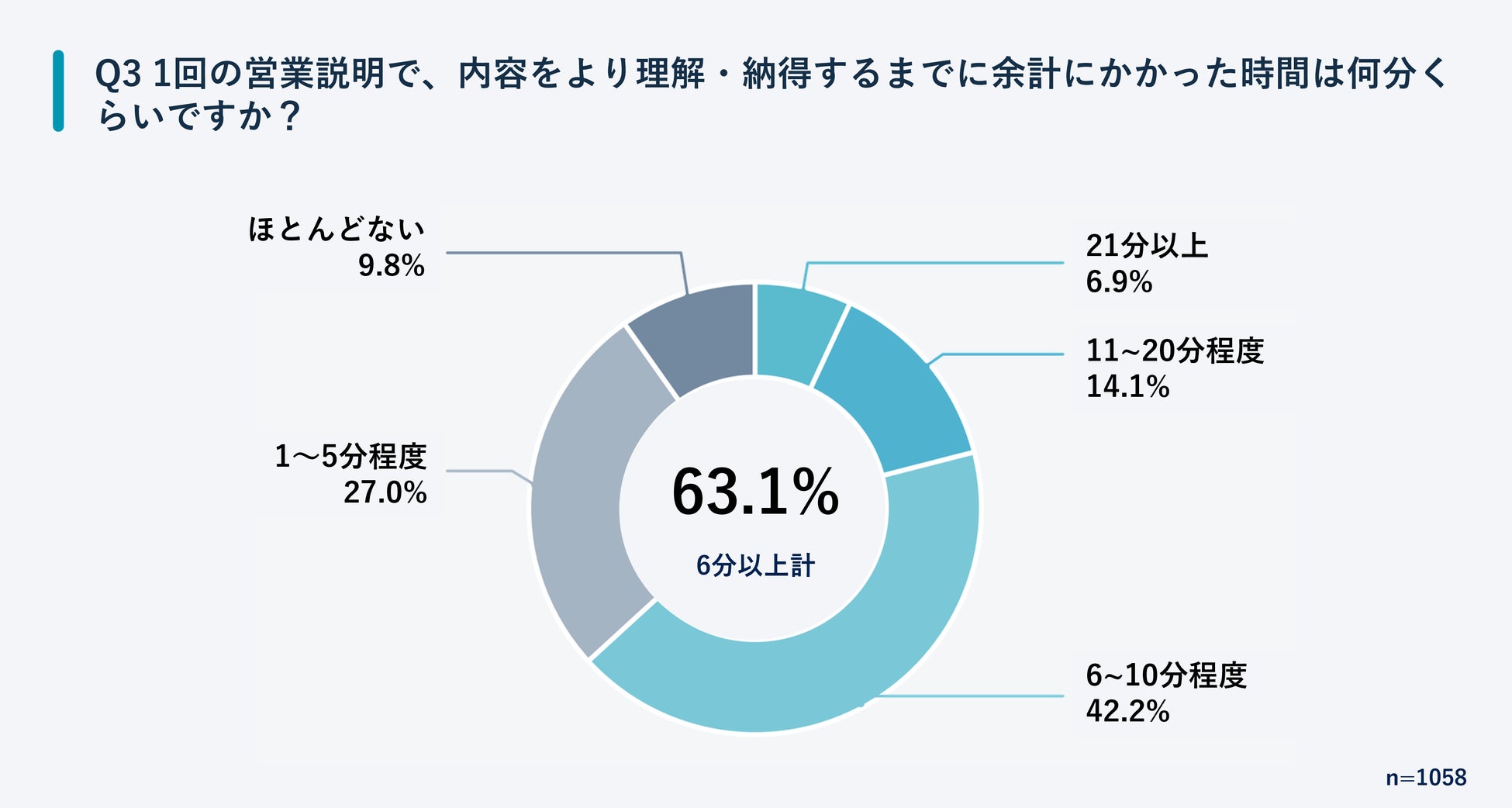
Furthermore, the "lost time to conviction" that listeners spent on "self-re-understanding," such as organizing information or supplementing missing key points, during a single explanation, was most frequently "6-10 minutes" at 42.2%, with 63.2% of the total taking 6 minutes or more.
This indicates that listeners are forced into a "deciphering process" of re-editing information in their own minds to match the speaker's pace and structure, and are not reaching conviction at their original speed.
3. Factors lowering "listening performance" are three types of noise: "time," "cognition," and "emotion."
From the survey results, the main factors that lower listening performance were categorized into the following three:
Time Cost
This is a state where it takes a long time to reach a conclusion, or scheduling and introductions are lengthy, meaning time costs other than the main topic are large. In fact, 69.3% of people felt stress from time costs such as scheduling and ice-breaking.
For example, situations like "being told the conclusion will come later and listening to a long introduction" or "what should have been a simple confirmation turns into time lost to meeting setup and small talk" are common experiences for many business professionals.
Comprehension Cost
This is a state where explanations are not given from the listener's perspective, and the listener has to infer, supplement, and re-edit key points themselves, resulting in additional effort for comprehension. 77.9% of respondents answered that they "need to infer and re-understand the meaning themselves," a particularly high level (refer to Q2).
For example, situations like "interpreting specialized terms or abstract explanations in my own way" or "listening while translating in my head, 'Does this mean...?'" are typical examples where the listener is supplementing the cost of conviction.
Psychological Cost
This is a state where emotional burdens accumulate, such as difficulty interrupting, difficulty asking questions, difficulty refusing, or irritation due to a mismatch between what the speaker wants to say and what the listener wants to hear. 68.4% of people had "experienced continuing to listen without interrupting despite having questions," and 70.9% were "irritated by the mismatch between what they wanted to know and what the other person wanted to talk about." For example, situations like "feeling awkward interrupting a conversation and just listening to the end" or "swallowing questions due to the atmosphere, even if there's a discrepancy" also contribute to increasing the cost of conviction.
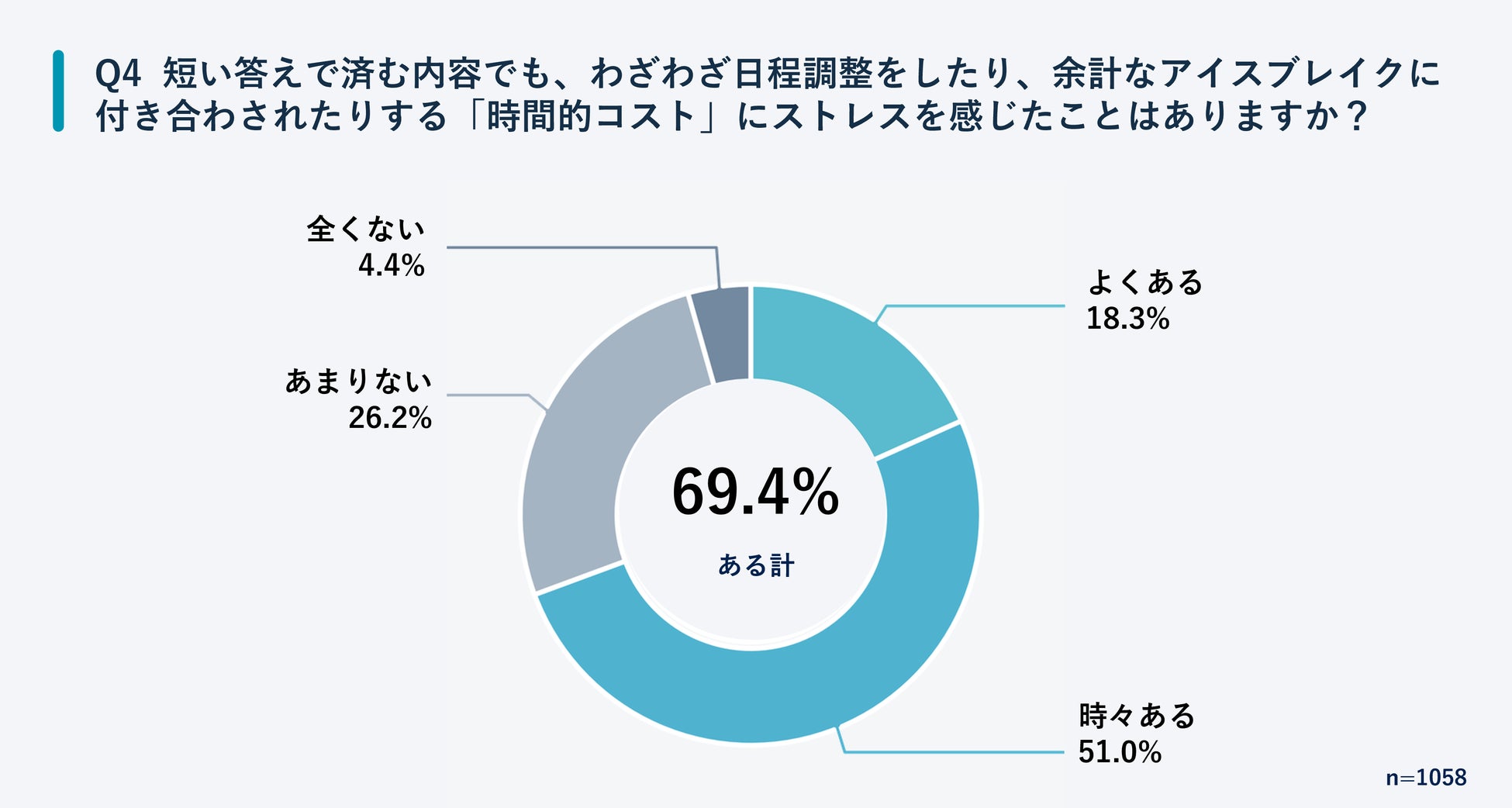

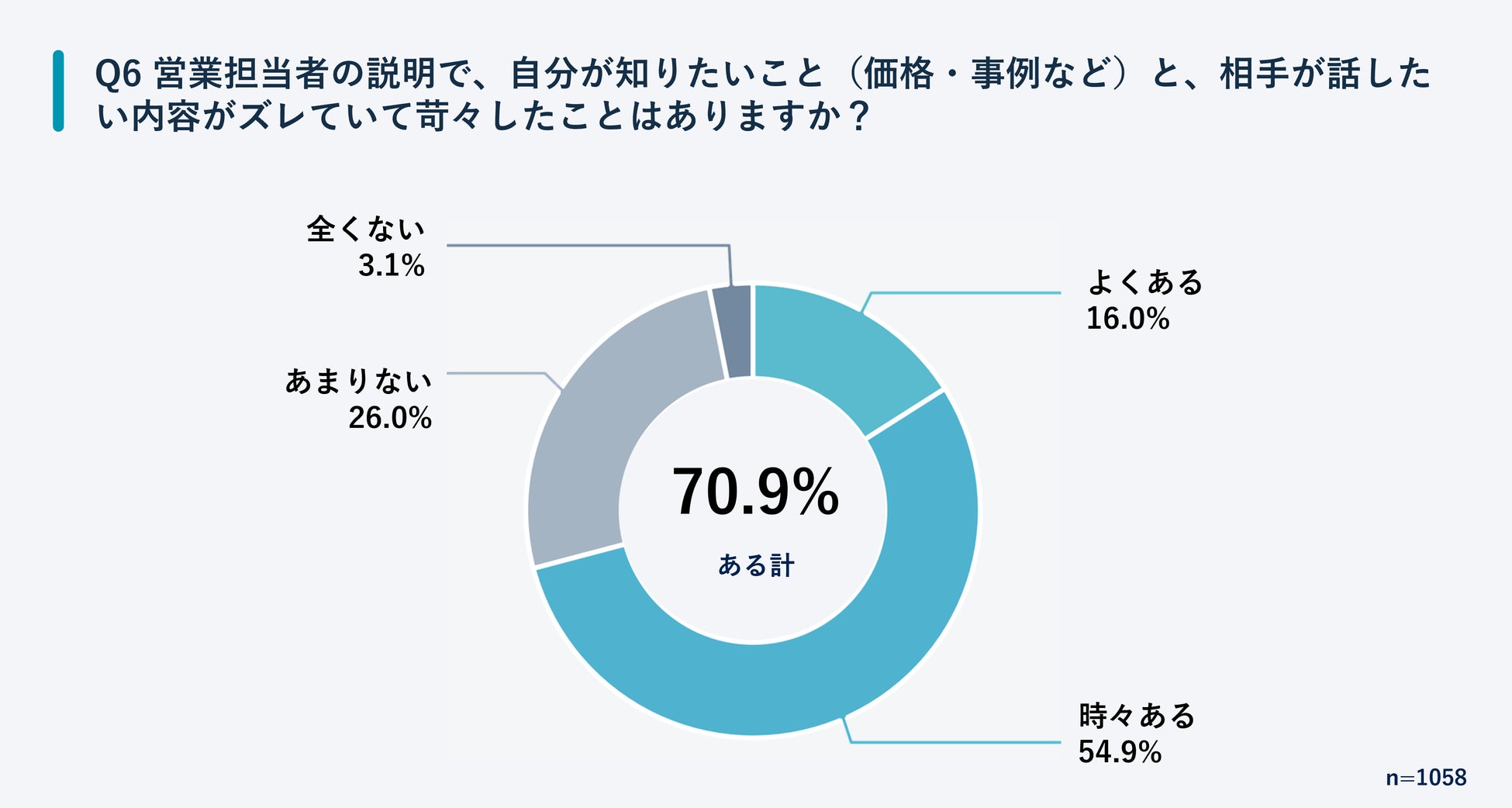
4. The source of stress is not just "length," but "inability to reach necessary information in the shortest time."
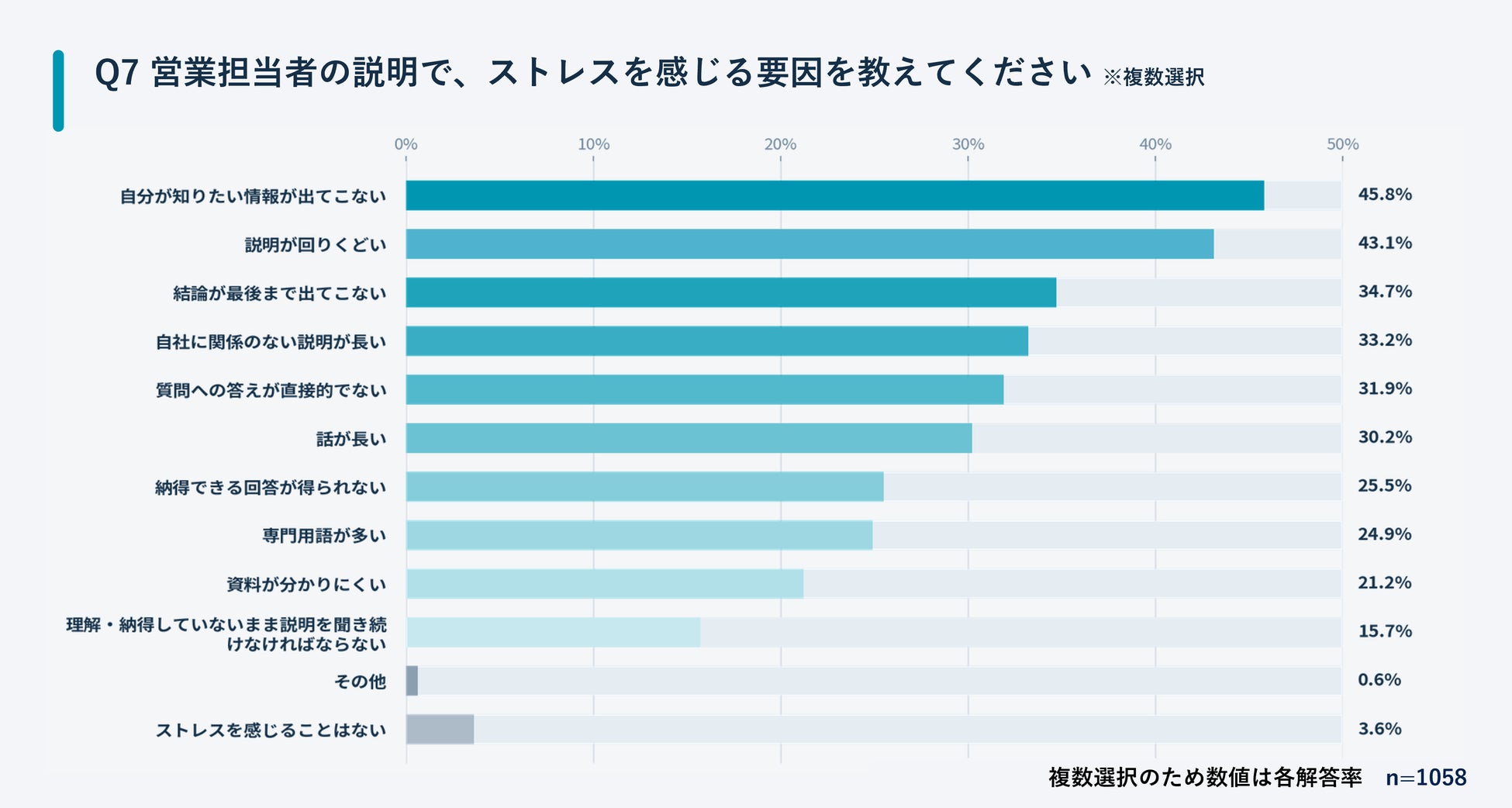
Factors of stress felt regarding corporate explanations included:
"Information I want to know doesn't appear" (45.8%),
"Explanation is roundabout" (43.1%),
"Conclusion doesn't appear until the very end" (34.7%),
"Long explanations unrelated to my company" (33.2%),
"Answers to questions are not direct" (31.9%)
These were among the top.
This means the problem is not simply the "length of explanation time," but rather the poor guidance for listeners to reach the necessary answers.
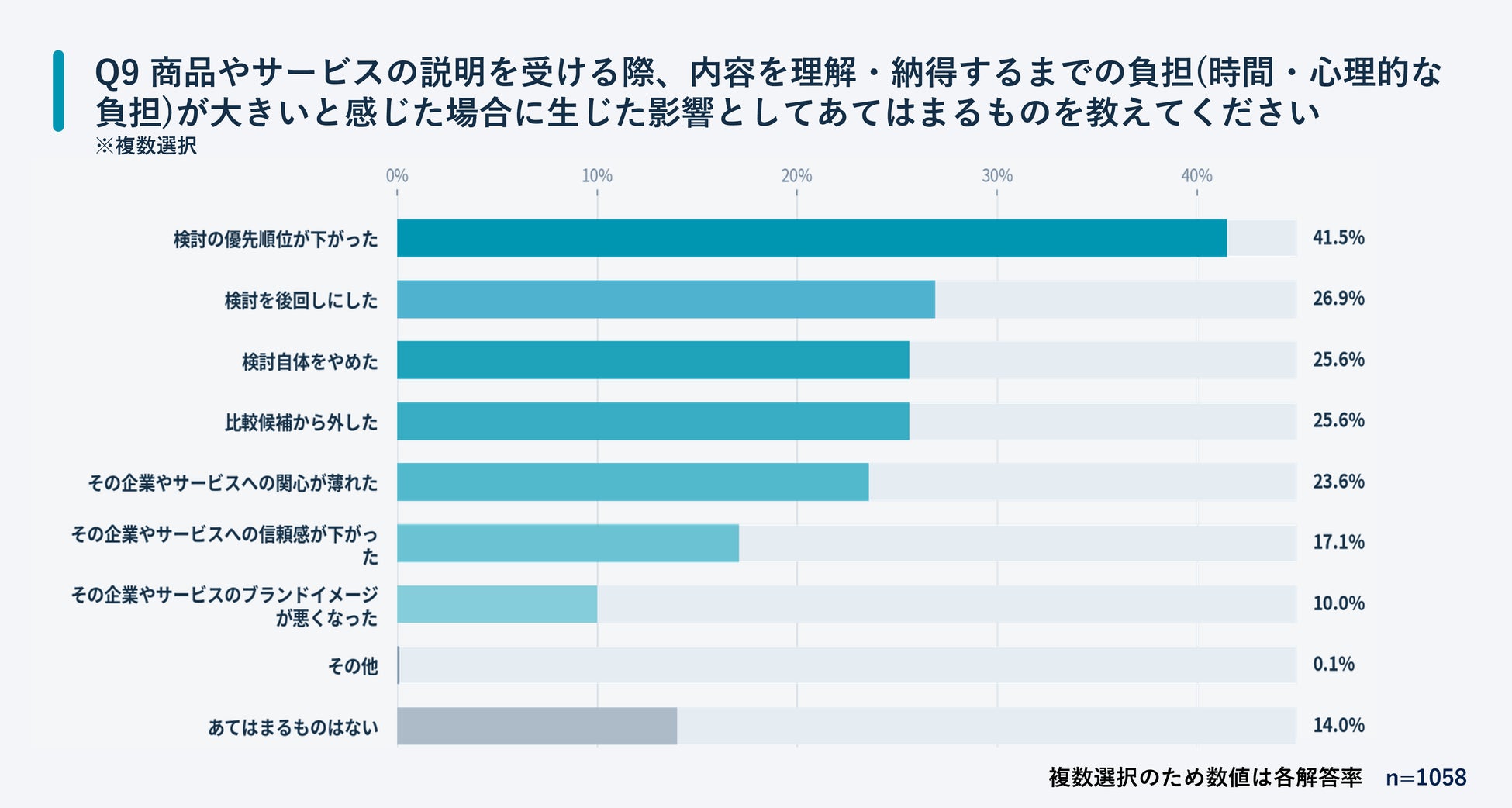
5. Low "listening performance" directly leads to missed deals, postponed consideration, and exclusion from candidates.
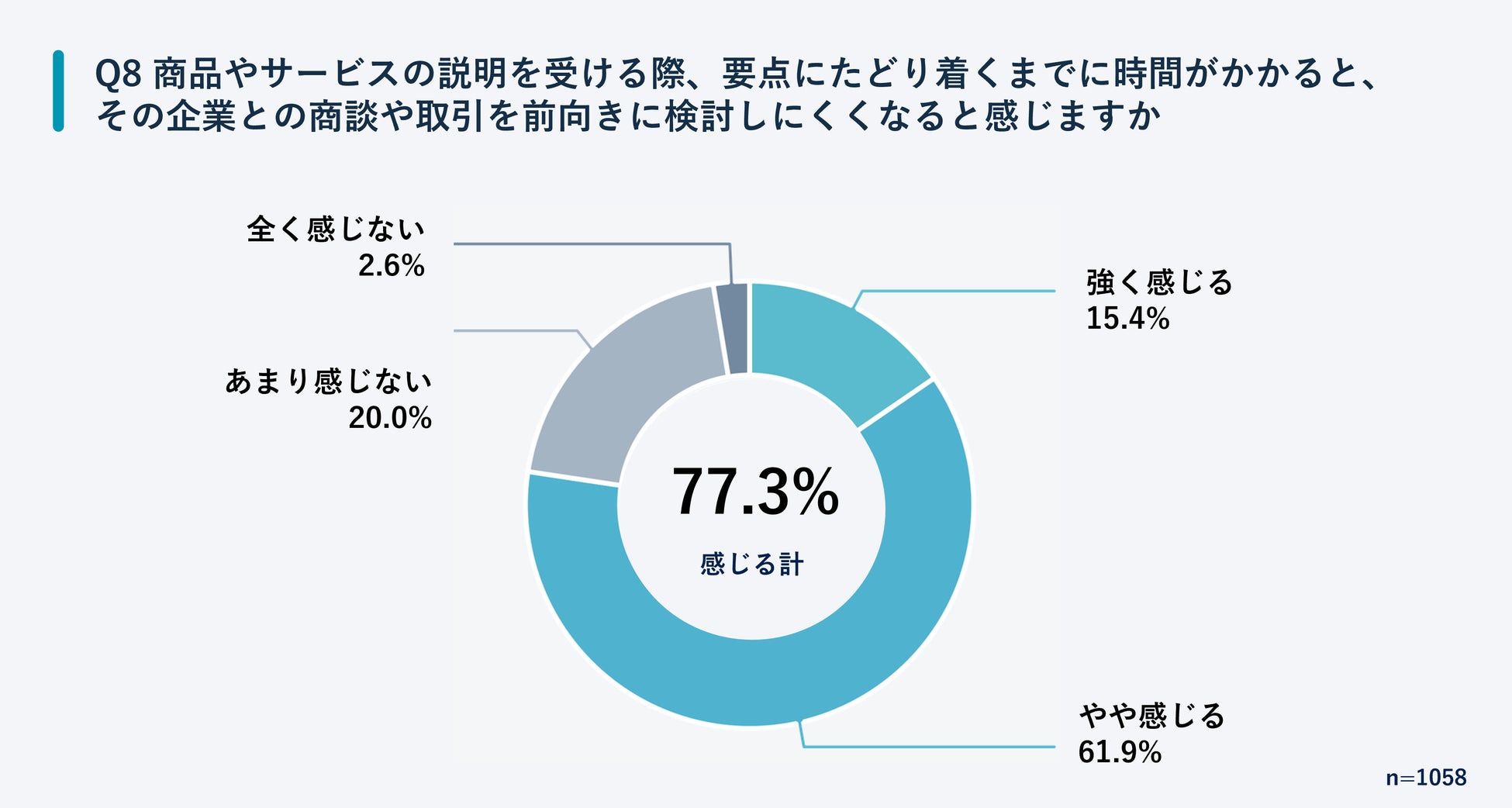
77.3% of people answered that "if it takes a long time to get to the main points, it becomes difficult to positively consider that service or product."
Furthermore, actual actions taken included:
"Priority of consideration decreased" 41.5%,
"Consideration postponed" 26.9%,
"Consideration itself stopped" 25.6%,
"Excluded from comparison candidates" 25.6%
These were the results.
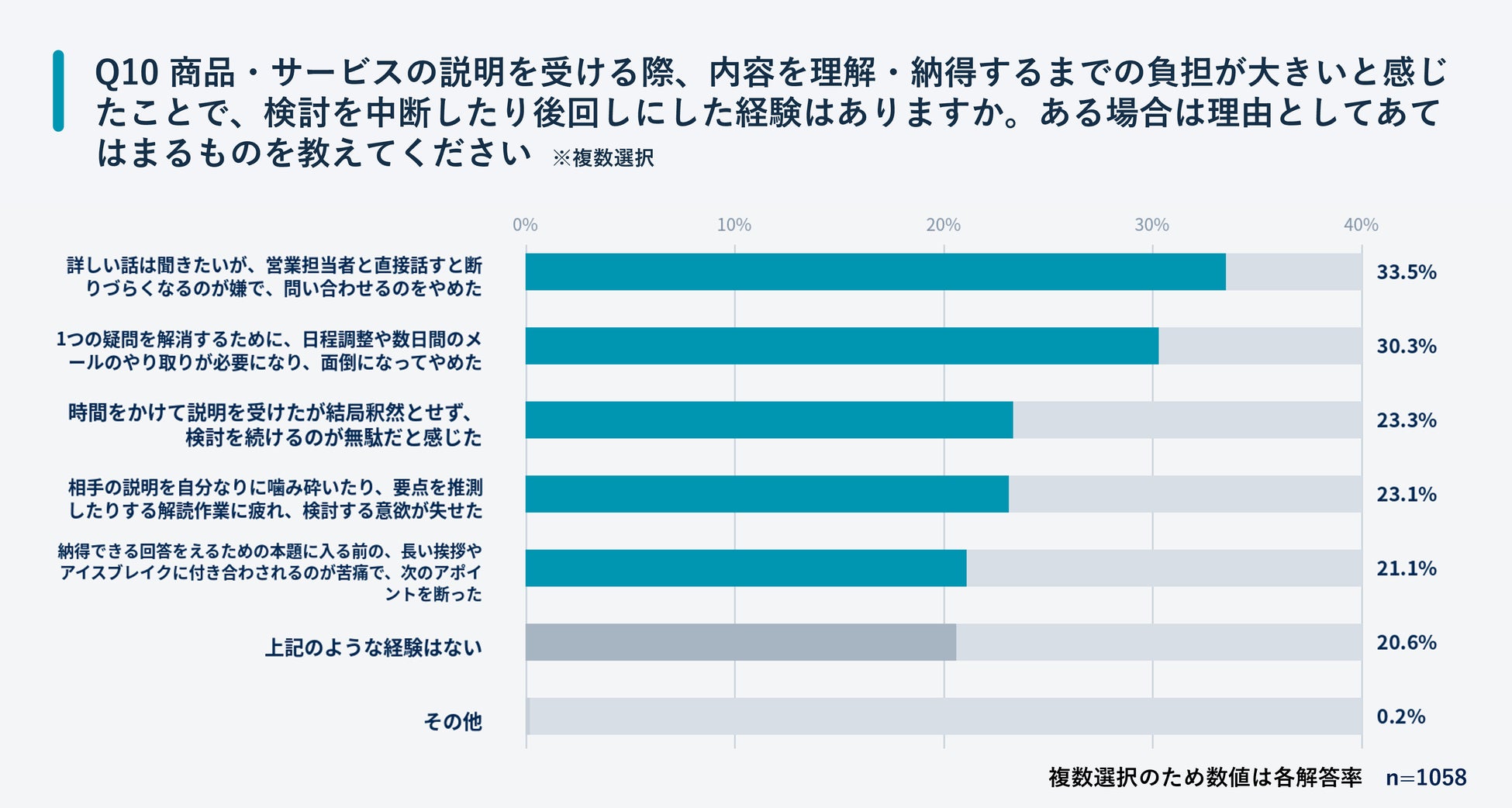
Also, responses included:
"Stopped inquiring because I didn't want to feel awkward refusing if I spoke directly" 33.5%,
"Stopped because scheduling and several days of communication were troublesome" 30.3%
This shows that communication friction is not a problem that occurs in the middle of a business negotiation, but rather already arises as a factor for dropout before or in the initial stages of contact.
FAQ
What is "listening performance"?
It is a concept that measures whether a state has been designed where listeners can understand with conviction, in a short time, and with minimal burden.
What percentage of business professionals experience 'explanation fatigue'?
Approximately 80% (75.0%) of business professionals reported experiencing fatigue or burden when listening to explanations.
What are the consequences of low "listening performance"?
It leads to missed business opportunities, delayed consideration, exclusion from comparison, and decreased trust and brand image for companies and services.