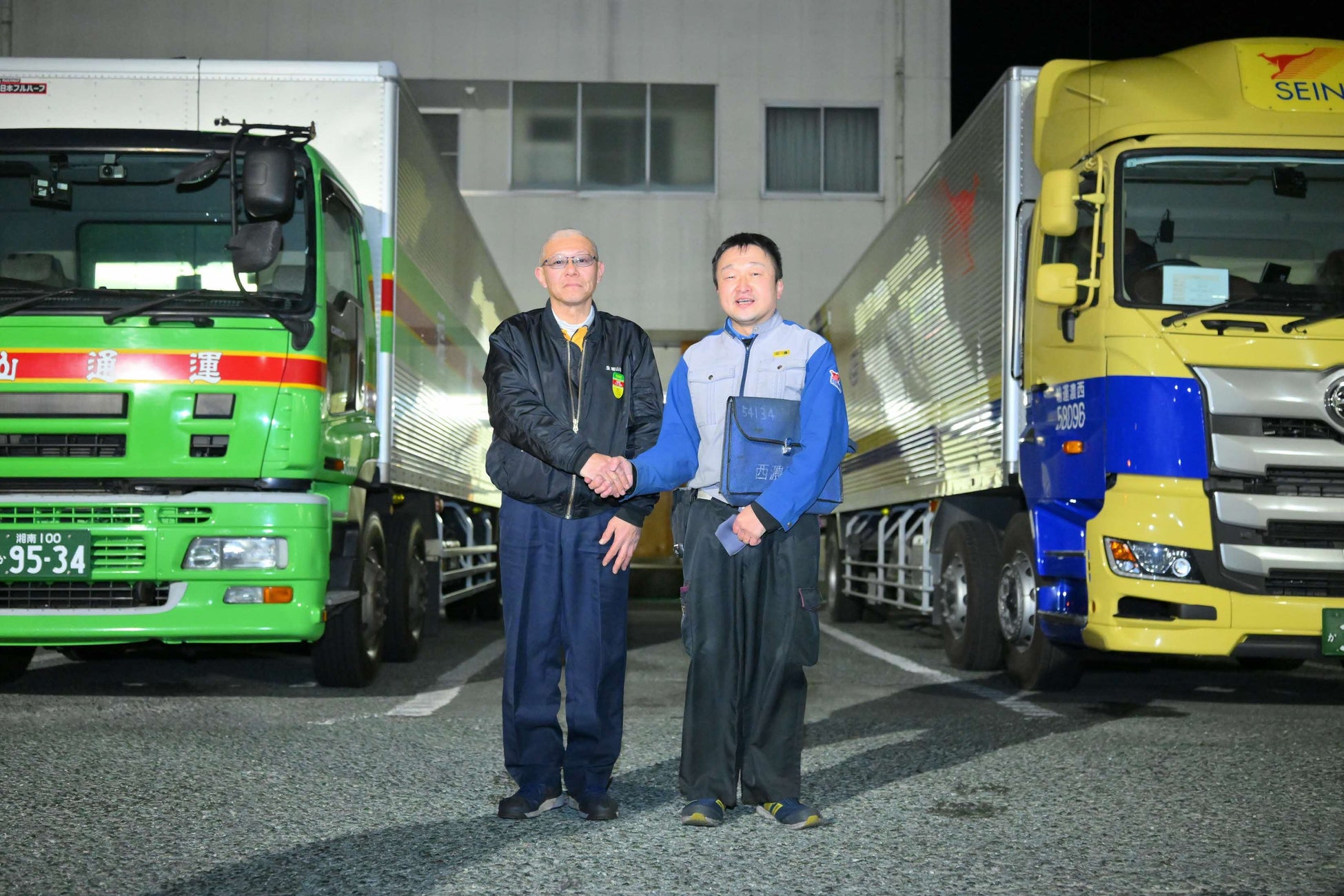
Logistics Consortium baton conducted trial operations of an inter-company relay transportation system using a driver relay method for trunk line parcel transportation between Kanto and Kansai from January 30-31 and February 6-7, 2026. Four companies participating in baton—Seino Transportation Co., Ltd., Fukuyama Transporting Co., Ltd., Meitetsu NX Transport Co., Ltd., and Tonami Transportation Co., Ltd.—participated in these trial operations.
The scheme involved drivers from different companies mutually swapping vehicles at a relay point, verifying the feasibility of same-day long-haul operations. Furthermore, challenges to be overcome in terms of operations, hardware specifications (such as vehicles), systems, and labor management for practical implementation were re-organized.
Background and Objectives of the Trial Experiment
The logistics industry urgently needs to address regulations on long-haul drivers' working hours and maintain its transportation network by securing future drivers in the medium term. As this is a challenge difficult for a single company to solve, Logistics Consortium baton has been working on cross-company co-creation. The objectives of this trial experiment are as follows:
① Improve working environment: Convert overnight long-haul operations to same-day operations to reduce driver burden.
② Maintain transportation efficiency: Complete round-trip operations without changing transportation lead times through a driver relay system.
③ Identify challenges for social implementation: Clarify practical hurdles such as operational and specification differences, methods for roll call and labor management, and demarcation points for responsibility in case of trouble.
If drivers from inherently competing operators can exchange trucks at an intermediate point and return to their starting areas, it would enable same-day long-haul operations on some routes, creating new work style options free from long-standing customs. This trial identified operational and systemic challenges for practical implementation of a schedule that achieves same-day long-haul driver operations.
Overview of the Trial Experiment
The inter-company relay transportation, which is baton's first initiative, adopts a driver relay system. Targeting large trucks, which constitute a large proportion of vehicles used for trunk line transportation in Japan, and aiming for implementation with a driver relay system that does not require cargo handling at relay points, the goal is to quickly create new work styles in long-haul trunk line transportation.
Team 1: Seino Transportation × Fukuyama Transporting
Date: January 30 (Fri) - January 31 (Sat), 2026
Relay Point: Seino Transportation Hamamatsu Branch (Chuo-ku, Hamamatsu City, Shizuoka Prefecture)
Team 2: Meitetsu NX Transport × Tonami Transportation
Date: February 6 (Fri) - February 7 (Sat), 2026
Relay Point: Meitetsu NX Transport Hamamatsu Hub Terminal (Nishi-ku, Hamamatsu City, Shizuoka Prefecture)
Detailed Operation Time Schedule
Trucks departing from bases approximately 500km apart in Kanto and Kansai converged at a temporary relay point in Hamamatsu City, Shizuoka Prefecture. Drivers then swapped vehicles and returned to their respective departure points. Normally, there is no way to know where another company's truck is. This time, a common dynamic management platform was introduced to create an environment where operation managers could check the location and operating status of both vehicles as needed. Considering the special nature of relay operations, safe and smooth operation management was carried out while constantly checking for troubles and estimated arrival times.
Team 1: January 30-31 Operation (Seino Transportation - Fukuyama Transporting)
19:00-20:00: Preparation for Departure
Around 19:00, loading operations completed at each base. Pre-departure roll call, including alcohol checks, conducted.
Around 20:00, Seino Transportation vehicles departed from Sakai Branch, and Fukuyama Transporting vehicles departed from Fujisawa Branch. Simultaneously, location information sharing began on the dynamic management platform.
20:00-24:00: Outbound Journey
Each vehicle traveled to the relay point using expressways.
Operation managers monitored the approach of both vehicles on the system, checking for any discrepancies in estimated arrival times.
24:00-25:00: Relay Exchange
Around 24:00, vehicles from both companies arrived at Seino Transportation Hamamatsu Branch, and the following tasks related to driver exchange were performed:
Intermediate roll call and health status confirmation (e.g., reporting to the affiliated sales office by phone)
Vehicle inspection (e.g., mutual check of tires, lights, and exterior of the vehicle)
Operation confirmation (e.g., manual switching settings for digital tachograph, communication of vehicle-specific operating methods)
25:00-05:00: Return Journey and Return to Base
Around 25:00, drivers boarded the other company's vehicle and began the return journey towards their departure points.
Between 4:30-5:00, they returned to their respective truck's base. Vehicle and slip handover completed, concluding the operation.
Team 2: February 6-7 Operation (Meitetsu NX Transport - Tonami Transportation)
19:00-20:30: Preparation for Departure
Around 19:00, loading operations completed at each base. Pre-departure roll call, including alcohol checks, conducted.
Around 20:30, Meitetsu NX Transport vehicles departed from Kasai Branch and Yodogawa Branch, and Tonami Transportation vehicles departed from Osaka Chuo Branch and Kasai Branch.
20:30-24:30: Outbound Journey and Rendezvous Adjustment
Each vehicle traveled to the relay point using expressways.
Movement was monitored to adjust arrival times at Hamamatsu Hub Terminal.
24:30-25:00: Relay Exchange
Around 24:30, vehicles from both companies arrived at Meitetsu NX Transport's Hamamatsu Hub Terminal, and the following handover tasks were performed in 30 minutes:
Vehicle inspection (e.g., mutual check of tires, lights, and exterior of the vehicle)
Operation confirmation (e.g., manual switching settings for digital tachograph, communication of vehicle-specific operating methods)
25:00-04:30: Return Journey and Return to Base
Around 25:00, drivers boarded the other company's vehicle, began the return journey towards their departure points, and departed from the relay point.
Between 4:00-4:30, they returned to their respective bases. Unloading operations and end-of-shift roll call completed the entire process.
Innovations in this Trial Operation
In this trial, the following measures were taken to achieve smooth inter-company collaboration, anticipating the full-scale deployment of inter-company relay transportation.
Standardization of Dynamic Management: The common dynamic management platform "Traevo" was used. In addition to each company's existing systems, a system was established to visualize the real-time location of vehicles from different operators and collectively grasp and manage the operating status, including after driver exchange at the relay point, until the final destination.
Formulation of Emergency Response Flow: An "Assumed Incident Sheet" defining communication channels was created to prepare for troubles such as accidents or vehicle breakdowns. The escalation flow was standardized to ensure appropriate information sharing with both the company's own operation managers and the vehicle-owning company.
Standardization of Inspection Items: Inspection items for each company were unified, and a checklist was prepared, based on each company's existing check items and referencing the Ministry of Land, Infrastructure, Transport and Tourism's standard format, to ensure reliable checks at relay points. Procedures for inspecting vehicle exteriors and equipment were clarified.
Verification Results and Challenges
The achievements obtained through the trial experiment and the challenges to be solved in the future are as follows:
【Achievements】
Establishment of Same-Day Operations: The relay transportation scheme is expected to reduce driver working hours in long-haul operations.
FACT BOX
- Source: PR TIMES
- Category: News