The Secret to Stress Adaptation Lies in the Brain "One Hour Later"!
Researchers at Kochi University of Technology have discovered that brain activity related to psychological resilience peaks approximately 60 minutes after experiencing acute stress, rather than immediately. Using simultaneous fMRI and EEG measurements, the study revealed that the transition from a stress-induced alarm state to an introspective mode is key to recovery. This finding provides new insights into optimal timing for mental health interventions.
📋 Article Processing Timeline
- 📰 Published: March 26, 2026 at 23:45
- 🔍 Collected: March 28, 2026 at 21:59 (46h 14m after Published)
- 🤖 AI Analyzed: April 14, 2026 at 23:58 (409h 58m after Collected)
[Points]
-
For the first time in the world, simultaneous measurement using fMRI (functional magnetic resonance imaging) and EEG (electroencephalography) has revealed that brain activity related to psychological resilience (the mind's ability to adapt to stress) appears most strongly "about 60 minutes" after experiencing stress, rather than immediately after.
-
The study identified that the key to recovery is the quieting down of the brain's alarm system (salience network) and the switch to an introspective mode (default mode network).
-
By substantiating the optimal state and intervention timing for enhancing resilience, these findings are expected to lead to more effective stress countermeasures in mental health and educational settings.
[Summary]
A research group led by Assistant Professor Noriya Watanabe (currently Associate Professor at the Faculty of Informatics, Shizuoka Institute of Science and Technology) and Professor Masaki Takeda at the Brain Communication Research Center, Research Institute, Kochi University of Technology, has become the first in the world to elucidate the brain mechanism behind the exertion of human psychological resilience (*1), the ability to adapt to stressful environments.
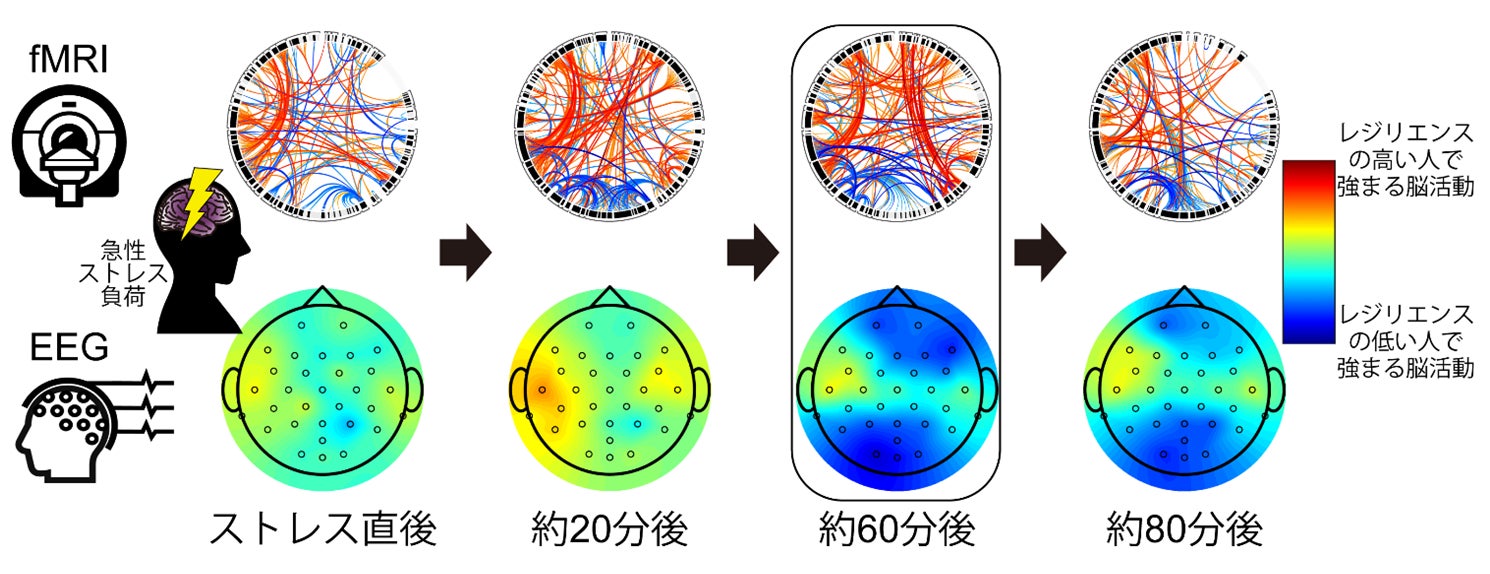
The research group used an advanced measurement method simultaneously employing fMRI (functional magnetic resonance imaging) (*2), which has excellent spatial resolution, and EEG (electroencephalography) (*3), which has excellent temporal resolution, to meticulously record long-term brain activity starting immediately after acute stress exposure. As a result, while conventional resilience research mainly focused on reactions immediately following stress, this study discovered that human-specific resilience appears in the brain after a significant time lag of approximately 60 minutes following stress (see Figure 1).
The results of this research propose a new intervention timing (time window) for mental health care and educational support in our stressful society, and have been published in the internationally influential comprehensive scientific journal PNAS (Proceedings of the National Academy of Sciences of the United States of America).
[Research Content and Results]
Previous resilience research has primarily centered on animal experiments, evaluating simple behavioral indicators such as whether animals "exhibit depressive-like behavior" under severe stress. However, human resilience is not merely an insensitivity to stress; it involves a complex interplay of highly advanced psychological processes, including past experiences, self-efficacy, and a positive attitude. This research group delved into this "human-specific stress adaptation mechanism," which had previously been a black box.
In this study, involving approximately 100 participants, changes over about 90 minutes were precisely tracked after acute stress was induced by cold stimulation.
-
Multifaceted Measurement: In addition to fMRI and EEG, heart rate, respiration, pupillary responses, and even stress hormones (salivary cortisol) were measured simultaneously, comprehensively recording the dynamics of the brain and body.
-
Utilization of Psychological Scales: Using the internationally recognized resilience assessment scale (CD-RISC) (*4), the individual's "mental flexibility" was quantified and compared with brain activity.
The analysis revealed that brain activity related to resilience does not emerge immediately after stress, but instead appears as a distinct characteristic about 60 minutes after the stress load. This is a discovery that overturns the conventional theory that "the brain's stress response peaks within 30 minutes."
Specifically, fMRI observations showed that in highly resilient individuals, the salience network (SaN) (*5), which controls stress responses and tension, clearly calmed down 60 minutes later, while the default mode network (DMN) (*6), involved in introspection and self-referential processing, became more active. Furthermore, at the same "approximately 60 minutes later" mark, EEG showed a significant decrease in brainwaves in the high beta band (high β) (*7), which is associated with stress and tension states. Conversely, individuals with low resilience exhibited the opposite pattern (see Figure 2).
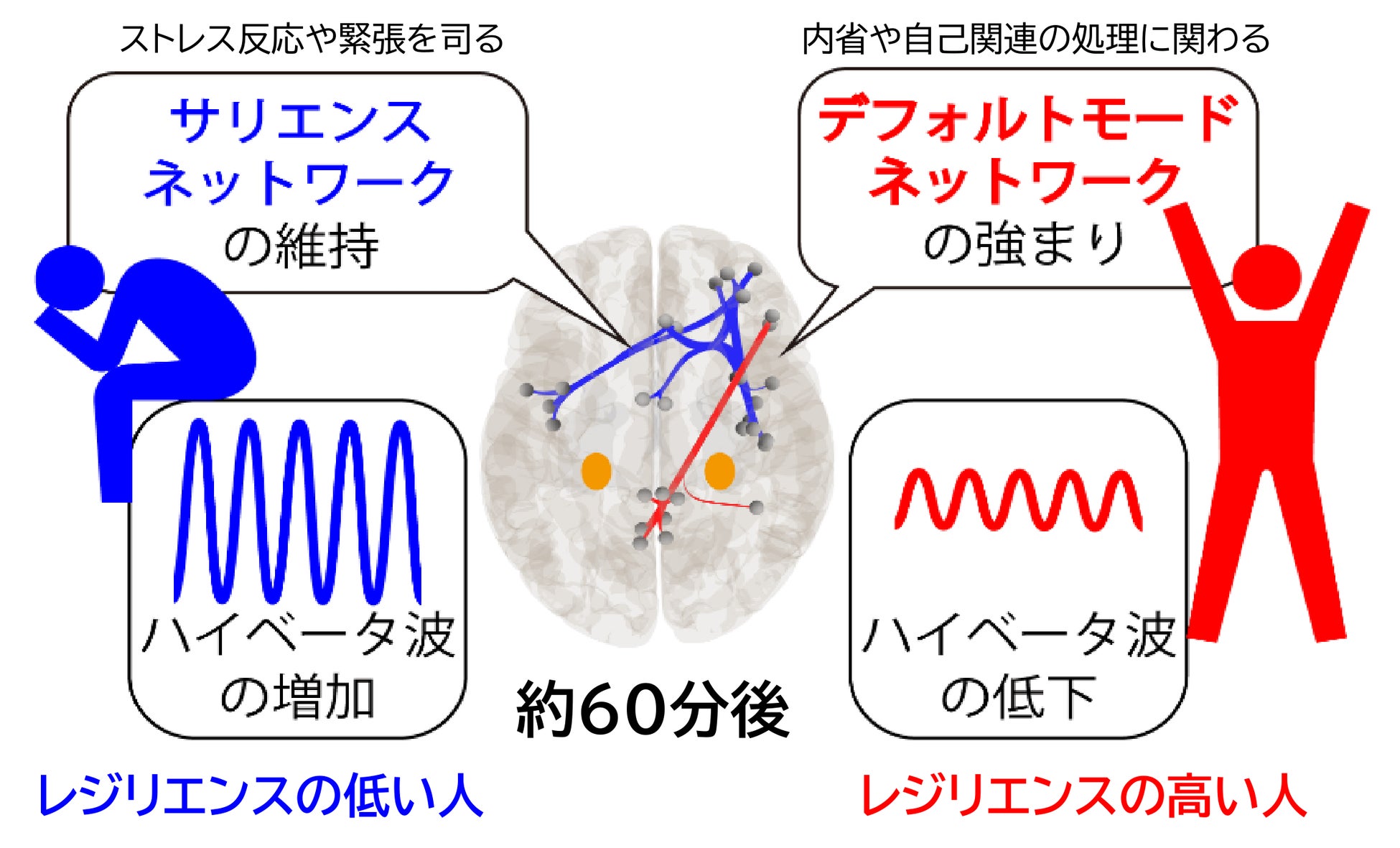
The fact that two measurement methods with different characteristics, fMRI and EEG, consistently pointed to the exact same timeframe of "60 minutes later" strongly corroborates the extremely high reliability of these results. This research can be said to have yielded highly significant findings by identifying a "temporal window" for humans to regulate their own minds, something that cannot be fully captured in animal models.
[Future Prospects]
The "decrease in the high beta band" and "activation of the default mode network" revealed in this study are considered crucial keys for the recovery of a mind and body damaged by stress. In the future, it is expected that research will verify whether an individual's resilience can be artificially enhanced by suppressively controlling high beta band activity using brain stimulation, targeting the "60 minutes later" time window following stress load.
Furthermore, the indicators of brain activity identified this time are expected to be utilized as new biomarkers to evaluate "how easy it is to cure (ease of remission)" and the "course of the disease (prognosis)" in stress-related disorders such as PTSD (post-traumatic stress disorder) and depression. Enabling evaluation through objective numerical values will lead to early risk detection and "tailor-made" mental health interventions that provide support at the optimal timing for each individual. Through such developments, the optimal brain states and intervention timings for enhancing resilience will be scientifically substantiated, and it is expected to achieve more effective stress countermeasures across a wide range of fields, including medicine, education, and industry.
[Glossary]
*1) Psychological Resilience
The ability to appropriately adapt to stressful environments and flexibly regulate mental functions according to the situation. It does not simply mean being "strong/weak" against stress, but rather the ability to successfully confront and recover from it.
*2) fMRI (Functional Magnetic Resonance Imaging)
A method of visualizing which parts of the brain are active by using changes in blood flow as a clue. It is suitable for observing "where" in the brain activity occurred.
*3) EEG (Electroencephalography)
A method of recording the brain's electrical activity using electrodes on the scalp. It is suitable for capturing changes in the brain's "rhythm (frequency bands)" and observing rapid brain responses on a millisecond scale.
*4) CD-RISC (Connor–Davidson Resilience Scale)
An internationally widely used resilience scale. It is a questionnaire that quantifies human psychological resilience, such as "confidence," "tenacity," and "positivity."
*5) Salience Network (SaN)
A functional brain network centered around the dorsal anterior cingulate cortex (dACC) and the anterior insula. It detects "currently important stimuli" and becomes particularly strong during stress or tension.
*6) Default Mode Network (DMN)
A functional brain network centered around the posterior cingulate cortex (PCC) and other areas. It is active when attention to the external world is weakened and consciousness is directed inward, such as during introspection, memory recall, thinking, and self-referential thoughts. It is involved in internal processing such as regulating the mind and meaning-making.
*7) High Beta Band (high β)
One of the frequency bands in EEG (21.5–29.5 Hz). It is a brain rhythm associated with tension, arousal, and stress responses; reports suggest it tends to rise when stressed and fall when calm.
[Funding]
This research was conducted with support from the following multiple grants from the Japan Society for the Promotion of Science (JSPS) Grants-in-Aid for Scientific Research (KAKENHI) and public interest incorporated foundations.
-
Grant-in-Aid for Scientific Research (A) (JP20H00521)
-
Grant-in-Aid for Challenging Research (Pioneering) (JP21K18267)
-
Grant-in-Aid for Transformative Research Areas (A): Science of Human Behavior regarding "Tojisha-ka" (JP22H05219, JP24H00914)
-
Grant-in-Aid for Scientific Research on Innovative Areas: Constructive Understanding of Multi-scale Psychiatric Disorders (JP21H00211)
-
Grant-in-Aid for Scientific Research (C) (JP21K07262, JP22K12786)
-
Takeda Science Foundation
-
The Naito Foundation
-
Public Health Research Foundation
[Paper Information]
Title: Neural signatures of human psychological resilience driven by acute stress.
Authors: Noriya Watanabe, Shinichi Yoshida, Ruedeerat Keerativittayayut, and Masaki Takeda
Journal: Proceedings of the National Academy of Sciences of the United States of America (PNAS)
Publication Date: March 26, 2026