"Is that Saitama's craft?" - A hypothesis that began there. An industrial model redefining traditional crafts as "future vintage"
KARMA et CARINA proposes a slow fashion model that redefines Saitama's traditional crafts as "future vintage," aiming to connect artisan skills with modern demand.
📋 Article Processing Timeline
- 📰 Published: April 1, 2026 at 19:10
- 🔍 Collected: April 1, 2026 at 16:47
- 🤖 AI Analyzed: April 17, 2026 at 05:07 (372h 19m after Collected)
Our company supports April Dream, which aims to make April 1st a day to announce dreams. This press release is the dream of "KARMA et CARINA".
Traditional crafts in Saitama Prefecture, despite possessing high levels of skill, are disconnected from modern daily life.
KARMA et CARINA views this disconnection as a "starting point for value creation,"
and by layering the skills of artisans with the aesthetics of designers,
aims to transmit clothes that retain their value even after 10 or 20 years—
"future vintage"—from Saitama to the world.
This project is an attempt to re-edit Saitama Prefecture's traditional crafts from the material and technique level
and implement them in the market as "slow fashion" suitable for modern life.

■ "Is that Saitama's craft?" - The hypothesis that began there.
Whenever I talk about this initiative to people, I always get the same reaction.
"Is that Saitama's traditional craft?"
Within Saitama Prefecture, traditional crafts with long histories and advanced techniques are scattered throughout various regions. However, many of them remain known only to those who are already aware, and are not sufficiently functioning as "chosen products" in modern consumption. Each time we receive this question, we become more convinced:
This disconnection is the margin for creating new industrial value.
■ What emerged from dialogues with 20 workshops
Currently, we have been engaging in dialogues with approximately 20 workshops and businesses within Saitama Prefecture.
What repeatedly emerged was a common structure:
The techniques exist. However, there is insufficient design to connect them with modern consumption.
The challenge faced by traditional crafts is not a problem with the artisans' skills.
It is that the design for connecting with demand has not yet been sufficiently established.
In this project, we are tackling this design from the entry point of consumption: fashion.
By deconstructing materials and techniques and reconstructing them as "clothes suitable for modern life," we transform traditional crafts from "cultural assets to be preserved" into "values that are continuously updated in the market."
■ The reason for daring to disclose its unfinished state
This project is not an announcement of a finished product.
We are currently in the midst of implementing an industrial reconstruction model, continuing dialogues and verifications.
Not just the completed products, but this process of trial and error and verification itself is the core of the project. What kind of design is needed for traditional crafts to become products that are continuously chosen, rather than "bought once and that's it"? We are addressing this question through the medium of fashion.

■ Designer's background and design philosophy
Designer Hideaki Kitazako is from Saitama City, Saitama Prefecture. He studied fashion at Esmod Paris headquarters
After returning to Japan, he was involved in costume production for performing arts, including the Shiki Theatre Company.
His experience in clothing design, premised on body movement and structure, forms the backbone of this project's design philosophy. Instead of simply repurposing existing craft items into clothing, the approach is to deconstruct materials and techniques and redesign them as clothes suitable for modern life. The goal is not to preserve crafts, but to establish them as an option for daily life.
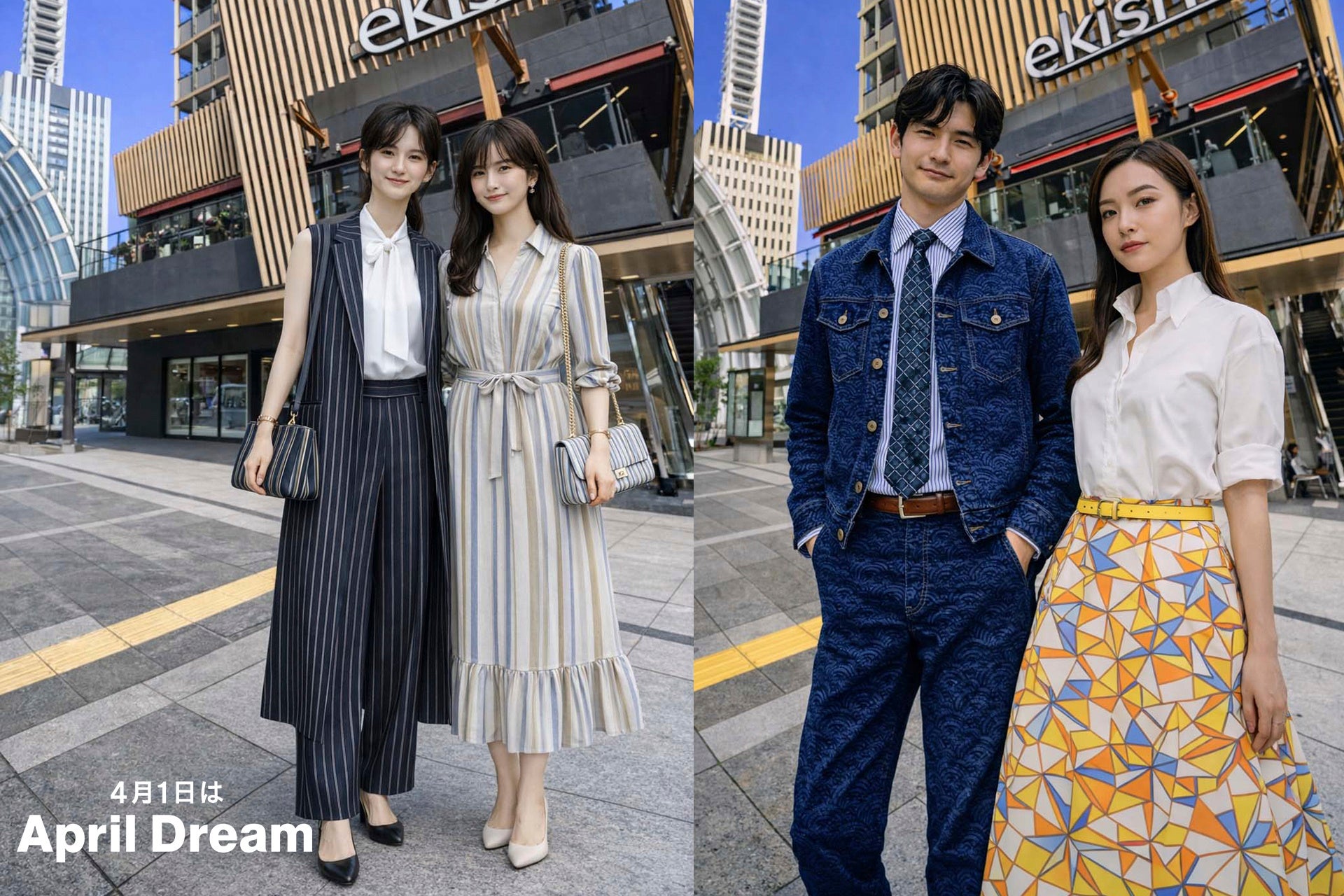
■ Slow fashion is the next generation of luxury
The structure of the fashion market, premised on mass production and mass consumption, has long been based on "short-term value." However, consumer behavior is now beginning to change.
Choosing items that can be used for a long time. Valuing the background and philosophy itself. Judging by meaning and context, not by price—
This change is not a temporary trend, but a transformation in the quality of consumption itself.
Our April Dream is a future where, in 10 years, Saitama's traditional crafts are not "special occasion attire," but "the most trusted everyday wear" in someone's closet.
Tradition creates demand, skills are fairly evaluated, and the next generation naturally enters the industry.
KARMA et CARINA presents this initiative to the world as an ongoing project that establishes slow fashion as both a cultural value and a sustainable business model.
■ About KARMA et CARINA
A slow fashion brand that creates products based on "essential value" and "permanence."
We propose clothes that are not influenced by trends, but are chosen based on one's own values and deepen in value over time.
Representative/Designer: Hideaki Kitazako
Location: Saitama City, Saitama Prefecture
Official website: https://www.karmacarina.com/
Contact: info@karmacarina.com

KARMA et CARINA
KARMA et CARINA is a slow fashion brand that creates products based on "essential value" and "permanence." We propose clothes that are not temporary trends, but rather items that one can continue to use, valuing them for their inherent worth, and whose value deepens over time.
FAQ
What exactly are "future vintage" clothes?
They are garments made using Saitama's traditional craft materials and techniques, designed to retain value and be cherished in daily life for 10 or 20 years.
Why is the project being announced in an "unfinished" state?
Because the core of the project is not just the finished product, but the process of trial and error in redesigning the demand for traditional crafts.
Which traditional crafts from Saitama Prefecture are being utilized?
A wide range, including Nagaita Chugata, Chichibu Meisen, Warabi Futakoji, leather, Kumagaya Zome, Bushu Shōaizome, Kawagoe Tozan, and Ogawa Washi.