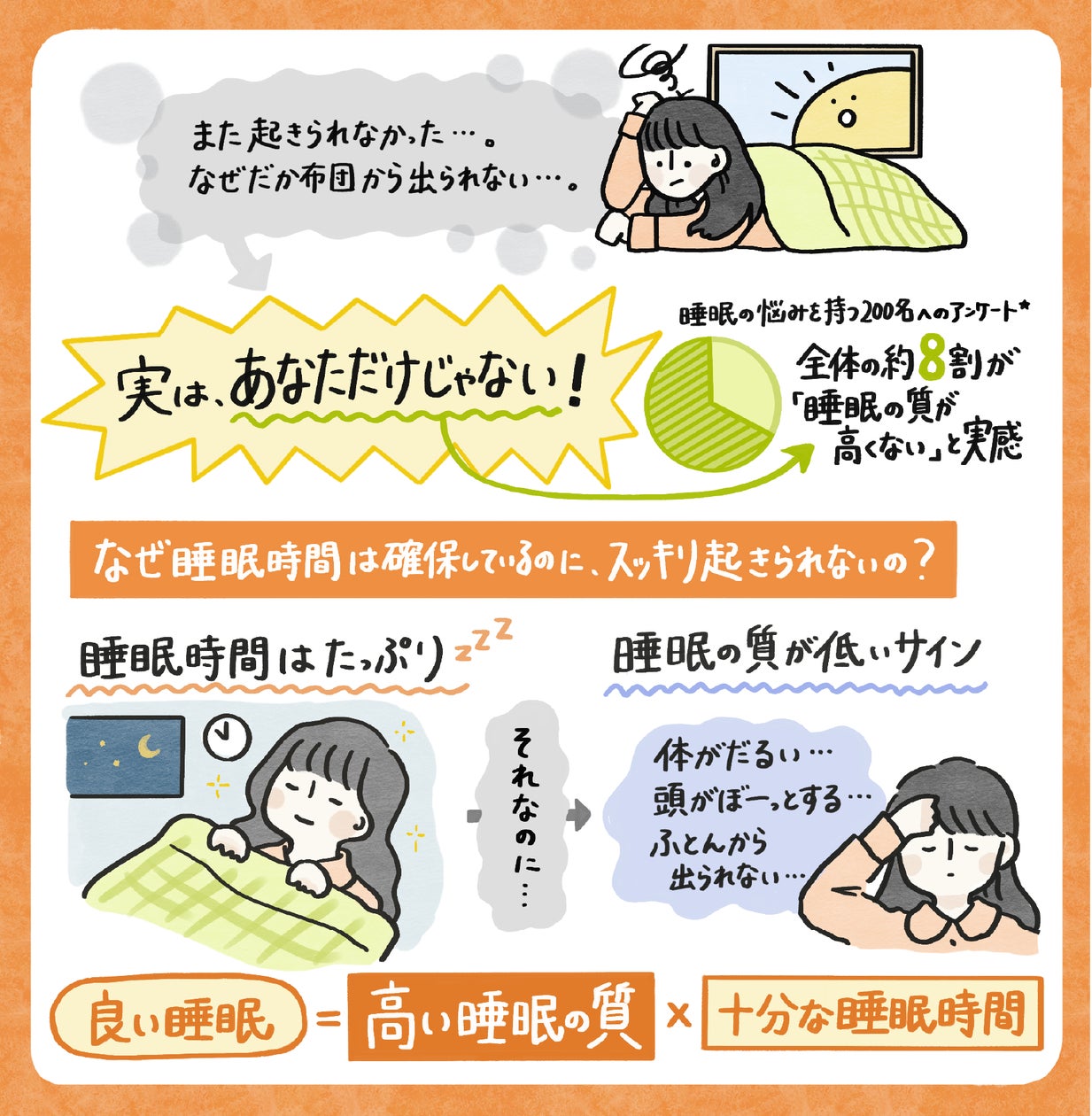
The information site "GRAPHIC ABSTRACT by Kao" (※1), operated by Kao Corporation, clearly communicates reliable life care information. Sleep is an important habit that supports health, and its deficiency is known to cause daytime sleepiness, fatigue, and decreased concentration. According to the "Healthy Sleep Guide 2023" (partially revised on September 18, 2024, by the Ministry of Health, Labour and Welfare), approximately 40% of people in Japan sleep less than 6 hours, and the average sleep duration is the shortest among OECD member countries. Furthermore, it is suggested that not only the quantity of sleep but also the improvement of "sleep recovery feeling" is important, and it is influenced by lifestyle habits and sleep environment. Against this backdrop, a survey was conducted targeting 200 individuals with sleep concerns, revealing that about 70% feel they "cannot wake up refreshed in the morning" and about 80% feel their "sleep quality is not high." Based on these results, "GRAPHIC ABSTRACT by Kao" will publish an article on June 30, 2026, that organizes the causes of not being able to wake up refreshed and explains easy-to-implement measures starting today.
"I couldn't wake up again," or "I should have slept enough, but I can't get out of bed." Many people mistakenly believe that such morning discomfort is a matter of weak will or lack of effort. However, morning awakenings are influenced by various factors, not just sleep duration, but also sleep quality, accumulated fatigue, and physical discomfort.
In a survey targeting 200 individuals with sleep concerns, about 70% responded that they "cannot wake up refreshed in the morning." Furthermore, it was found that about 80% feel that their "sleep quality is not high." The most common morning complaint was "feeling tired or sluggish even though I slept enough" (58.5%).
This article organizes the causes of not being able to wake up in the morning from three perspectives: "sleep quality," "accumulated fatigue," and "physical discomfort or illness." It introduces easy-to-implement measures starting today, such as getting light exposure during the day, avoiding smartphones and bright lights at night, warming the body through bathing, and assessing fatigue levels, with the help of illustrations and diagrams.
【Main Points】
● About 70% of people with sleep concerns cannot wake up refreshed, and about 80% are dissatisfied with sleep quality.
● The causes of not being able to wake up in the morning include not only lifestyle habits but also "factors that are difficult to control on one's own."
● Measures tried for waking up refreshed in the morning and measures that are being continued.
● Advice based on the causes of "not being able to wake up in the morning."
【Survey Overview】
"Survey on Sleep"
◎ March 2026 / Internet Survey / Ages 20-65, individuals with sleep concerns / 200 people
● About 70% of people with sleep concerns cannot wake up refreshed, and about 80% are dissatisfied with sleep quality.
In the survey, about 70% of individuals with sleep concerns responded that they "cannot wake up refreshed in the morning." Furthermore, it was found that about 80% feel that their sleep quality is an issue, combining responses of "not very high" and "not high at all."
Sleep is not simply about sleeping for a long time. Whether you feel refreshed upon waking is called "sleep recovery feeling" and is an important indicator when considering sleep quality. In this survey as well, the most common morning complaint was "feeling tired or sluggish even though I slept enough" (58.5%). The problem of not being able to wake up in the morning cannot be solved by willpower alone and can be considered a sign to re-examine daily sleep and fatigue status.
● The causes of not being able to wake up in the morning include not only lifestyle habits but also "factors that are difficult to control on one's own."
The top causes cited by respondents for not being able to wake up refreshed in the morning were "changes in physical condition due to aging" (52.5%), "using smartphones, computers, or watching TV right before bed" (42%), "stress and worries from work or relationships" (35.5%), "lack of exercise" (29.5%), and "feeling cold" (21%).
While there are factors like smartphone use before bed and lack of exercise that can be reviewed as lifestyle habits, factors that are perceived as difficult to control on one's own, such as aging, stress, and feeling cold, were also ranked high. In particular, stress and feeling cold tended to be higher among women, and when considering morning awakenings, measures tailored to each individual's living environment and physical condition are important.
● Bathing and stretching are sleep measures that those who try them tend to continue.
The survey asked about "measures tried for waking up refreshed in the morning" and "measures that were felt to be effective and are being continued." As a result, the top measures tried were "warming the body through bathing" (43.5%), "stretching or light exercise" (37.5%), and "changing bedding to one that suits me" (25.5%). Many of those who tried these measures continue them, suggesting that they are easy to incorporate into daily life and lead to noticeable results.
● Advice based on the causes of "not being able to wake up in the morning."
This article divides the factors affecting sleep recovery feeling and morning awakenings into three categories: "sleep quality," "accumulated fatigue," and "physical discomfort or illness," and introduces measures for each. For "sleep quality," one of these categories, in addition to methods like getting light exposure during the day and bathing, it also introduces the perspective of choosing ingredients that support sleep according to one's concerns.
For more details, please check the URL below.
▶ Graphic Abstract by Kao
"Why Can't You Wake Up Refreshed in the Morning? The Cause is Not Just Sleep "Duration," but Also Its "Quality"
https://my.kao-kirei.com/kirei-science/graphic-abstract/posture/006/
※1 Explanation of "GRAPHIC ABSTRACT by Kao"
This is a life care information site within the "Kirei Science Lab" of "My Kao," an interactive digital platform operated by Kao. It delivers clear and reliable life care information for those nagging, everyday uncertainties. To make it easy to read, we also provide illustrations (GRAPHIC) that summarize the main text of the articles (ABSTRACT). For those who want to quickly grasp reliable information, illustrations alone are sufficient. For those who want to understand everything, please read the full article. We provide information for your own good conditioning.
GRAPHIC ABSTRACT by Kao
https://my.kao-kirei.com/kirei-science/graphic-abstract/
FACT BOX
- Source: PR TIMES
- Category: Survey結果
- Organizations: GRAPHIC ABSTRACT by Kao / OECD