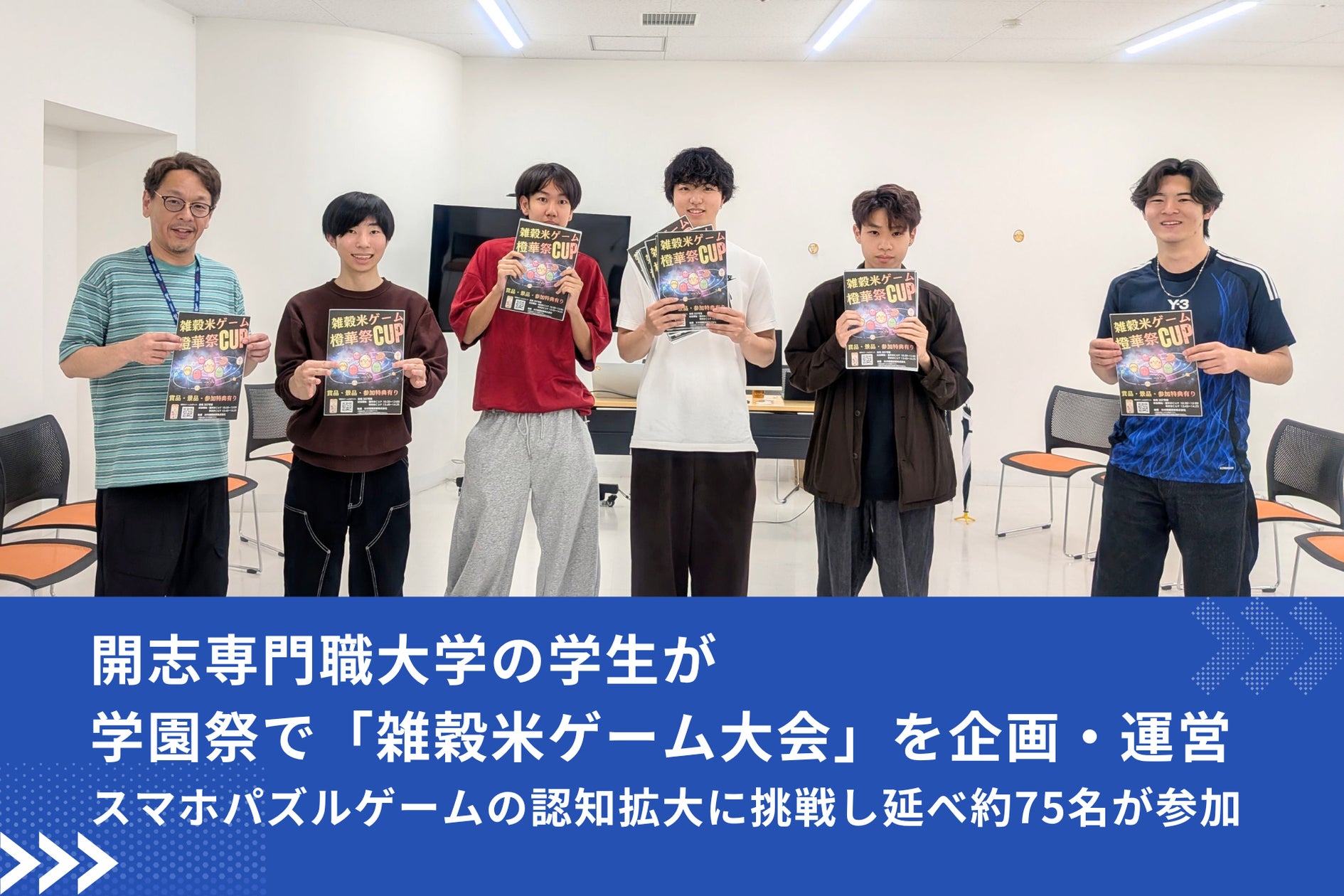
Students from Kaishi Professional University (Niigata City, Niigata Prefecture) planned and operated a game tournament for the smartphone puzzle app 'Jukkōmai Game' during the campus festival 'Tōkasai,' held on Sunday, June 21, 2026. This extracurricular project, designed as a practical marketing initiative, attracted approximately 75 participants in total.
'Jukkōmai Game' is a smartphone puzzle game app developed by Kimura Information Technology Co., Ltd. (headquartered in Saga City, Saga Prefecture; President: Takao Kimura) and released in February 2026. The app allows parents and children to enjoyably learn about 'shokuiku' (food education) through gameplay.
Launch of a Practical Marketing Learning Project
The project originated when Yoshimura, a director at Kimura Information Technology, delivered a lecture titled 'Mindset of Venture Companies' at the university in October 2025. During post-lecture discussions with students, it was shared that the company developed 'Jukkōmai Game' and was exploring strategies to increase its visibility.
In response, Professor Ogasawara from the Faculty of Business Creation and his students saw an opportunity to gain hands-on marketing experience by tackling the challenge of promoting a relatively unknown game. Thus, they launched an extracurricular project to plan and operate a tournament aimed at popularizing 'Jukkōmai Game.'
Two-Session Tournament Held at 'Tōkasai' Campus Festival
The tournament was conducted in a simple format: participants downloaded and played 'Jukkōmai Game' on their smartphones and submitted their scores, with prizes offered to boost engagement.
Students employed various promotional methods—including posters, social media, on-campus digital signage, and flyer distribution—and applied improvements learned from a preliminary event held in May. As a result, participation exceeded initial targets, providing valuable practical marketing experience. However, challenges such as network connectivity and score submission rates were also identified for future improvement.
(1) Morning Session 'Kamado Cooking Cup' / Approximately 50 participants
Held over a relaxed 90-minute period, allowing multiple attempts. The session attracted many families, as well as current students and their friends.
(2) Afternoon Session 'Quick Cooking Cup' / Approximately 25 participants
A shorter, 30-minute timed competition. Primarily attended by male students from the university, often in groups of friends.
Survey Results: 80% Satisfaction Rate, All Respondents Express Interest in Playing Again
Fifteen participants responded to a post-event survey, with results showing 'Very Satisfied' (7), 'Satisfied' (5), and 'Neutral' (3). Satisfaction or higher accounted for 80% of responses, indicating high event satisfaction. Additionally, 'Definitely want to play again' (4) and 'Would play again if given the chance' (11) meant all respondents expressed willingness to continue playing.
The organizing students realized that even lesser-known games can convey their appeal through direct player experience. Features such as 'higher difficulty and deeper gameplay than Watermelon Game' were particularly praised. They also sensed the potential advantage of the game’s food education theme and the freshness associated with its lower recognition.
Comments from Organizing Students
Executive Committee Members
Yoshi Y. Sato: 'I’m not typically a gamer, but “Jukkōmai Game” has a charm that makes me play during spare moments, and even influenced my family to start playing. This project taught me that games can attract people not just through popularity, but through the appeal of their content, and that events can succeed based on that.'
Kenngo Watanabe: '“Jukkōmai Game” features uniquely irregular grain shapes and unpredictable movements, creating a perfect balance of challenge and depth. Before starting this project, I thought promoting an obscure game would be difficult. But I realized that being less known means people don’t have preconceptions like “it’s already outdated,” which can actually make it feel fresh and attractive.'
Shumma Takeda: '“Jukkōmai Game” is a simple “falling block” puzzle like Watermelon Game, making it easy for newcomers to understand and get into. I feel its simple rules are precisely what make it addictive after just one play.
On the day of the event, many stayed for about an hour during the morning session, and participants in the afternoon session enjoyed it until the end. It was impressive how engaged people became.'
Comment from Faculty Advisor | Professor Motoya Ogasawara, Faculty of Business Creation, Kaishi Professional University
'The students actively promoted the event and attracted more participants than expected, despite heavy rain and competing events on the same day.
However, we also identified areas for improvement, such as event flow, participant movement, and award ceremony execution. Moving forward, we aim to refine these aspects, incorporate student feedback, and develop more advanced, cross-year and cross-campus initiatives.'
Comment from Development Lead | Makoto Yoshimura, Director and Head of Business Innovation Division, Kimura Information Technology Co., Ltd.
'Thank you to all the students who took on this project. Using our relatively unknown “Jukkōmai Game” as a case study, you planned and operated an event through trial and error—an experience I believe was highly valuable.
In real business, spreading awareness of new products is always a major challenge. I hope this experience leads to future challenges. I would be delighted if such initiatives continue and expand to involve even more people.'
About 'Jukkōmai Game'
'Jukkōmai Game' is a smartphone puzzle app designed to teach 'shokuiku' (food education) in a fun way for parents and children. Featuring cute multigrain rice characters, it is a simple growth puzzle game enjoyable for all ages. Released on February 12, 2026, it is available for free on the App Store and Google Play.
FACT BOX
- Source: PR TIMES
- Category: Event