Two New e-Learning Courses to Launch in April 2026: "Practical Data Analysis Skills" and "DX Case Studies in Retail"
Japan Management Association Management Center (JMAM) will launch two new e-learning courses in April 2026: 'DX Trends to Keep in Mind: Retail Edition' and 'Practical Data Analysis through Questionnaire Creation'. These courses aim to enhance practical skills in data analysis and understanding DX in the retail sector, addressing challenges like labor shortages and the need for new value creation. They are designed to help organizations connect DX understanding with practical application, leading to problem-solving and productivity improvements.
📋 Article Processing Timeline
- 📰 Published: April 2, 2026 at 22:00
- 🔍 Collected: April 2, 2026 at 13:35
- 🤖 AI Analyzed: April 17, 2026 at 18:59 (365h 23m after Collected)
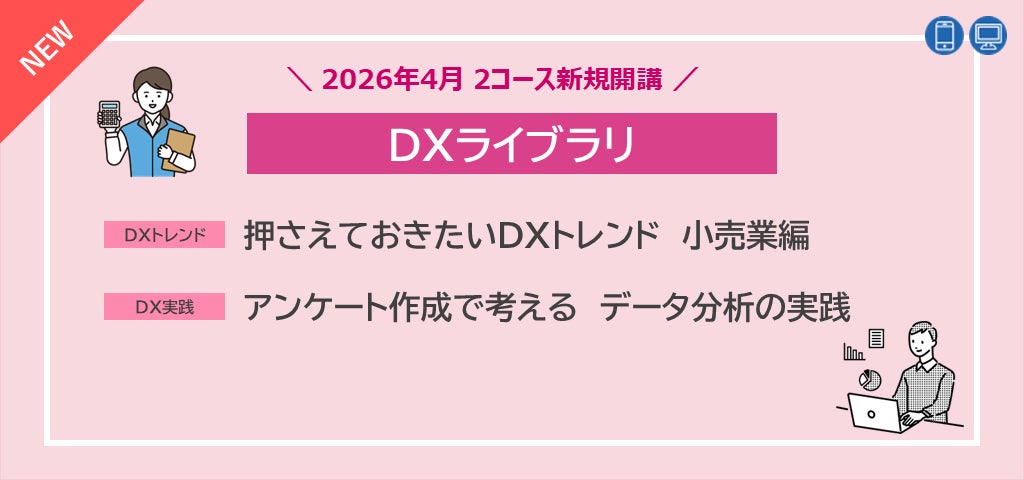
Japan Management Association Management Center (Representative Director and President: Shiro Cho, Chuo-ku, Tokyo, hereinafter JMAM), which operates human resource development support services offering educational and training programs for corporations and individuals, will launch two new courses in April 2026 within its corporate e-learning tool, "e-Learning Library® (※1)": "DX Trends to Keep in Mind: Retail Edition" and "Practical Data Analysis through Questionnaire Creation."
■Background to the Launch of New DX-Related e-Learning Courses
The DX Library, one of the contract plans for "e-Learning Library®," is an e-learning material that systematically teaches everything from the basics of DX that all employees should possess, based on the "DX Literacy Standard" set by the Ministry of Economy, Trade and Industry, to practical skills that can be utilized in business.
By adding the two new courses, "DX Trends to Keep in Mind: Retail Edition" and "Practical Data Analysis through Questionnaire Creation," we will strengthen both the understanding of DX tailored to the characteristics of the retail industry and practical skills applicable to questionnaire analysis. This will further enhance learning opportunities that connect DX understanding with practical application across the entire organization, leading to problem-solving and productivity improvements on the ground.
1. "DX Trends to Keep in Mind: Retail Edition"
In the retail industry, there is a demand for addressing labor shortages, improving productivity, responding quickly to consumer needs, and creating new value. On the other hand, DX promotion departments face the challenge of "not having opportunities to systematically learn about industry DX trends." Especially with the shortage of DX human resources limiting internal initiatives, it is difficult to assess the compatibility between business operations and digital technologies. Furthermore, a lack of common language and shared understanding becomes a barrier in building cooperative relationships with IT vendors.
If important issues remain fragmented across "human resources," "operations," and "collaboration," it becomes difficult to draw a comprehensive picture of policy priorities and implementation methods, often resulting in initiatives being limited to individually optimized scopes.
Therefore, JMAM has developed "DX Trends to Keep in Mind: Retail Edition," which allows participants to quickly grasp the current state, necessity, technologies, and success stories of DX specific to the retail industry. This course systematically organizes DX trends in the retail industry and provides perspectives for considering "what kind of DX approach can be applied to which of our company's challenges" based on concrete examples.
2. "Practical Data Analysis through Questionnaire Creation"
Mastering this course enables individuals to acquire data that contributes to improving corporate performance and gain valuable skills as business professionals.
For business professionals who are required to collect data from various media and link it to sales, this is one of the skills that should be acquired now. However, there are many key points to grasp in questionnaire analysis methods and question creation, posing a high initial hurdle for learning.
Therefore, JMAM has developed a new course, "Practical Data Analysis through Questionnaire Creation," to support the acquisition of practical data analysis skills. Using questionnaires utilized in business practice as a theme, participants can learn the entire process from objective setting to question design, aggregation/visualization, and interpretation of results. This single course clearly explains the basics of data analysis useful in the field.
Through the new courses, by providing knowledge on DX trends specific to the retail industry and how to more effectively analyze and utilize questionnaire data, participants will acquire "DX perspectives that support the retail industry" and "knowledge and skills related to data analysis, such as questionnaires, that can be used in the field," thereby contributing to accelerating internal DX promotion.
■Course Details
1. "DX Trends to Keep in Mind: Retail Edition"
This course aims to understand the current state and challenges of DX in the retail industry, advanced case studies, and the overall picture of supporting technologies. Through the latest DX trends and success stories in retail, participants will learn about the direction of DX promotion and the status of initiatives aimed at solving challenges faced by the retail industry.
Introduction Site: https://www.jmam.co.jp/hrm/course/elearning_lib/vre.html
Course Objectives and Features:
-
Understand the environment surrounding the retail industry and current challenges
-
Learn about DX case studies in retail and grasp industry trends
-
Understand technologies specific to the retail industry
Target Audience:
All business professionals
Learning Time:
Estimated learning time: 40 minutes / Shortest execution time: 19 minutes
Curriculum:
Chapter 1: Current State of DX in the Retail Industry
Chapter 2: DX Case Studies in the Retail Industry
Chapter 3: Technologies Supporting DX in the Retail Industry
Example Learning Screen:
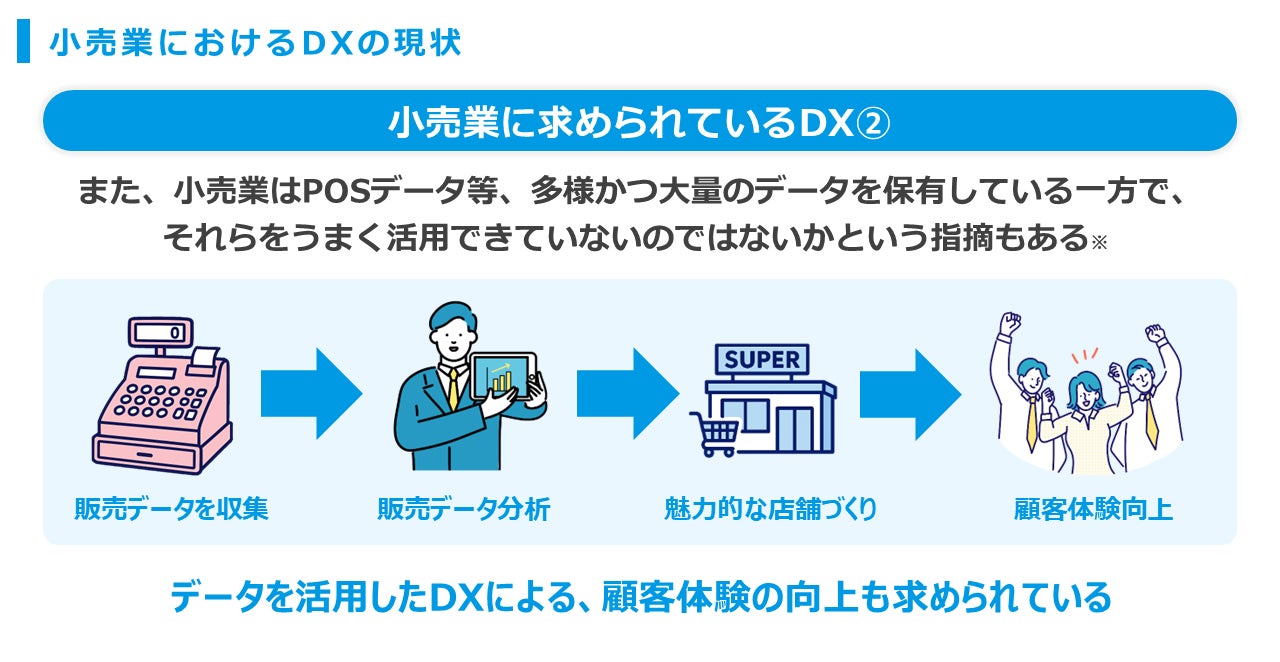
※Source/Reference: Ministry of Economy, Trade and Industry "Final Report of the Study Group on the Ideal State of the Distribution Industry Amidst Price Hikes" 2023
Masataka Hashimoto "DX Promotion and Business Reform Directions in the Retail Industry - Aiming for the Deepening of the Retail Industry Contributing to the Maintenance and Improvement of Regional Living Infrastructure" Ministry of Economy, Trade and Industry, 4th Meeting Material of the Study Group on the Ideal State of the Distribution Industry Amidst Price Hikes, October 26, 2022
2. "Practical Data Analysis through Questionnaire Creation"
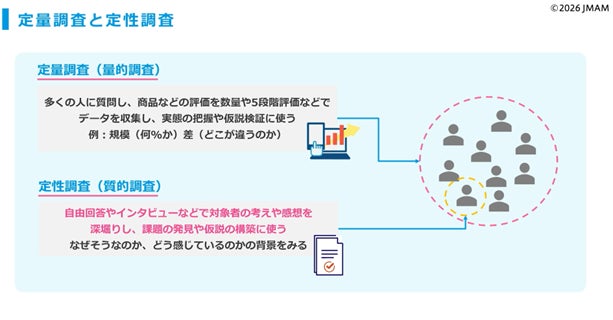
This course focuses on acquiring practical data analysis skills using questionnaire results as a theme. It clearly explains knowledge useful in practice, such as how to create choices, cross-tabulation, and precautions regarding bias, in an easy-to-understand manner for beginners.
Introduction Site: https://www.jmam.co.jp/hrm/course/elearning_lib/vrd.html
Course Objectives and Features:
-
Learn basic data analysis methods such as aggregation, visualization, and trend analysis using questionnaire data
-
Acquire practical analysis skills applicable to business and the ability to interpret results
Target Audience:
All business professionals
Learning Time:
Estimated learning time: 160 minutes / Shortest execution time: 82 minutes
Curriculum:
Chapter 1: Overview of Questionnaire Analysis
Chapter 2: Planning and Setting for Questionnaire Analysis
Chapter 3: Question Design and Response Formats
Chapter 4: Aggregation and Analysis of Questionnaires
Example Learning Screen:
■What is "e-Learning Library®"?
JMAM's "e-Learning Library®" is a corporate educational tool that supports multiple devices, allowing users to learn online, anytime, repeatedly, and easily. It offers over 530 courses (※2), including education that supports the foundation of corporate activities such as compliance and harassment prevention, basic education for different hierarchical levels like young employees and managers, and education required to respond to legal revisions. 70% of adopting companies take governance courses, and to date, it has been introduced to over 18,000 companies and organizations, with over 4.4 million cumulative participants (※3).
-
You can choose and introduce from four libraries (Management, Technology/Skills, Health Management® (※4), DX) according to your learning objectives.
-
Each course includes skit-style video content, reference materials, and report questions, implementing a mechanism to reinforce learning content.
-
For educational administrators, it provides management functions that allow for uploading self-created content, managing questionnaires, and learning history in a centralized manner, enabling its use as a "company's educational portal site" beyond just course enrollment.
URL: https://www.jmam.co.jp/hrm/service/dir/el-lib/
※1: e-Learning Library® is a registered trademark of Japan Management Association Management Center (JMAM).
https://www.jmam.co.jp/hrm/service/dir/el-lib/
※2: Includes courses under development.
※3: Cumulative service total. As of September 2025.
※4: "Health Management" is a registered trademark of the NPO Health Management Research Group.
■Japan Management Association Management Center (JMAM)
Established in 1991, spun off from the Japan Management Association (JMA), founded in 1942. It operates two business domains: "Learning Design Business," which supports human resource development through training and correspondence education, and publishes business books, qualification books, and children's educational books; and "Time Design Business," which handles planners and other items primarily under the NOLTY brand. JMAM's purpose is "Accompanying Growth," and it promises to walk alongside and partner with those who take a step forward, aiming to create a society where everyone knows the joy of growth and can enrich their lives in their own way.