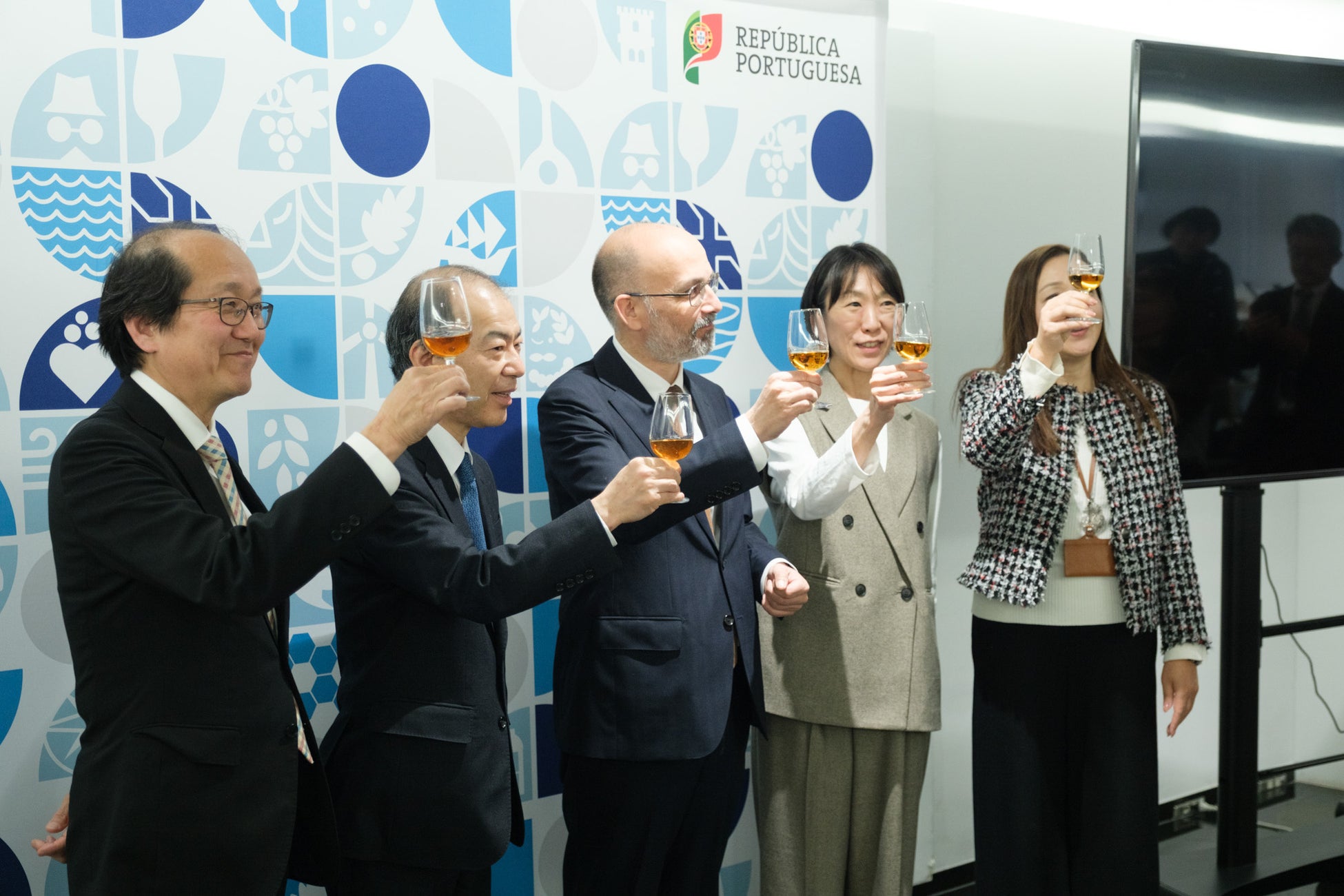
The Central Association of Japanese Sake Brewers (hereinafter referred to as the Central Association), the largest organization in the Japanese sake industry related to "traditional sake brewing" registered as a UNESCO Intangible Cultural Heritage, is working to promote the appeal of Japanese sake and sake culture both domestically and internationally.
On March 24th, the Central Association, in cooperation with the Embassy of Portugal, the Portuguese National Tourism Authority, the Portuguese Trade and Investment Agency, and Madeira Japan Co., Ltd., held the Japan-Portugal cultural exchange event "Madeira Wine and Aged Japanese Sake Seminar & Tasting Session." At this event, 10 types of Madeira wine and 10 types of Japanese sake were offered, along with Portuguese cuisine prepared by the Ambassador's chef, creating a space where the sake and food cultures of Japan and Portugal intersected.
Vice Chairman Yamana of the Central Association stated in his greeting, "We hope this event will serve as an opportunity to convey the new value of Japanese sake both domestically and internationally, and to deepen the understanding of the sake cultures of both countries."
Japan-Portugal Cultural Exchange Event "Madeira Wine and Aged Japanese Sake Seminar & Tasting Session."
100-year-old Madeira wine was also featured.
The Connection of "Aging Culture" Continuing from the Age of Discovery
The 16th century, the Age of Discovery. Madeira wine, a fortified wine perfected through heating and oxidation, was accidentally born during Portugal's pioneering maritime expansion, trading with the East beyond the equator.
Portugal was the first European nation with which Japan began trading, and it is said that the first wine Japanese people tasted was Madeira. Conversely, it is said that the first Westerners to taste Japanese sake were Portuguese. Despite being located at opposite ends of the Eurasian continent, Japan and Portugal share deep historical ties.
In recent years, with growing interest in aged beverages, an opportunity has arisen for two cultures, aged Japanese sake and Madeira wine, to meet again at the same table.
Aged Japanese Sake and Madeira Wine
"Madeira wine," accidentally born during Portugal's trade expeditions beyond the equator.
A Unique Wine Experience Created by Heating and Oxidation
In the Madeira wine seminar, Chihiro Hieda of Madeira Japan Co., Ltd., an importer and seller of Madeira wine, explained the wine's most distinctive characteristic: "heat-induced oxidative aging." Madeira wine is a fortified wine aged through a combination of heating and gradual oxidation, a method that allows for stable quality and long-term aging.
Mr. Hieda explained, "Madeira wine is aged by intentionally exposing it to heat and air, and because oxidation has already progressed, its quality remains stable even after opening, which is a major characteristic."
He also introduced Madeira's unique design philosophy, such as how the black grape variety Tinta Negra can express sweetness to dryness depending on the timing of fortification, and how white grape varieties have flavor profiles determined by their specific types. Furthermore, he emphasized that "heat" and "air," which are normally detrimental to wine, become elements that form its quality.
Madeira wine served on the day.
Seminar on Madeira wine by Chihiro Hieda of Madeira Japan.
Re-evaluation of the Value of "Aging Japanese Sake"
In the subsequent aged Japanese sake seminar, Shuzo Imada, Director of the Japan Sake and Shochu Information Center, spoke about the history and modern value of Japanese sake's aging culture. He stated, "The starting point for this project was focusing on compatibility with Portuguese food culture." He explained that while Japanese sake once had an aging culture, it shifted to a culture of drinking new sake due to institutional reasons, and that the value of aged Japanese sake is now being re-evaluated.
Regarding aged Japanese sake, he described characteristics such as its color changing to amber with aging, aromas of caramel, honey, and spices, and a tendency towards a smooth and complex taste. Furthermore, he presented diverse pairing possibilities, suggesting that sweet aged sakes pair well with desserts and cheeses, rich aged sakes pair well with Chinese and spicy dishes, and lightly aged sakes pair well with cream-based dishes.
Aged Japanese Sake Seminar by Shuzo Imada, Director of the Japan Sake and Shochu Information Center.
Aged Japanese sake served on the day.
An Endeavor of Japanese Sake Applying the Madeira Method
Mr. Osamu Suzuki, the brewer of Ichinokura brewery in Miyagi Prefecture, also attended and introduced initiatives to create Japanese sake by applying the Madeira wine method. His brewery has developed a unique aged sake by combining fermentation stoppage through alcohol addition with heating and aging using the steam heat from hot springs. This sake, born from the philosophy of "attempting to apply it to Japanese sake out of respect for European brewing culture," was presented with characteristics such as stability after opening and adaptability to both Japanese and Western cuisine.
Osamu Suzuki, brewer of Ichinokura.
New Value Brought by the Fusion of Food and Sake
At the venue, traditional Portuguese cuisine prepared by the Ambassador's chef was served, offering participants an opportunity to experience pairings with the tastings. This was highly praised by attendees as a new discovery.
Traditional Portuguese cuisine served by the Ambassador's chef.
Portuguese cuisine pairs excellently with aged Japanese sake.
Experiencing various aged Japanese sakes and Madeira wines.
Experiencing various aged Japanese sakes and Madeira wines.
[Comments from Stakeholders]
Comment from H.E. Gilberto Jeronimo, Ambassador of Portugal to Japan
I would like to express my gratitude to the Central Association of Japanese Sake Brewers for choosing the Embassy of Portugal among many embassies as a partner for this seminar. Portugal boasts renowned sake such as Madeira wine and Port wine, and I am confident that they are by no means inferior to Japanese sake. I am deeply grateful that this opportunity allows everyone to reconfirm the excellence of Japanese sake and to gain a more accurate understanding of Portugal's historic wine, Madeira wine. It is also a valuable opportunity for you to taste Portuguese cuisine, which our chef at the Ambassador's residence prepares daily and which I also enjoy immensely, and to experience firsthand how well it pairs with Japanese sake. Madeira wine is also very delicious, and while the level of aging differs from Japanese sake, I hope that the professionals gathered here today will appreciate its deliciousness and depth of flavor. I sincerely wish for the continued development of the Central Association of Japanese Sake Brewers and Madeira Japan, and for the success of today's event.
Comment from Miguel Garcia, Portuguese Trade and Investment Agency
I myself am a great fan of Japanese sake and am captivated by its charm, visiting breweries across the country. This is a special occasion collaborating with Madeira wine, so I specifically requested the Ambassador's chef to provide appetizers. Delicious food is always necessary for delicious sake, and as you all know, it enhances the taste of the alcohol. I hope you will taste the authentic Portuguese cuisine and Japanese sake provided today and experience how well they pair. Also, in my capacity as a promoter of Portuguese wines, we have prepared a selection of Madeira wines chosen by experts. I hope you will savor their deliciousness and recommend them to others. I sincerely wish for further leaps in the activities of the Central Association of Japanese Sake Brewers and for the continued prosperity of Madeira Japan.
A Bridge to the "Aging Culture" Continuing into the Future
Madeira wine and aged Japanese sake, connected by the common value of "aging" despite their different cultural backgrounds.
This event was more than just a tasting experience; it was an opportunity to present new value and possibilities at the intersection of history, technology, and culture. The relationship between Japan and Portugal, which began in the Age of Discovery, has, through trade and cultural exchange, created new connections in the modern era in the form of "sake culture."
The charm of sake, perfected over many years, connects people across eras and borders, bringing new discoveries and emotions. This initiative not only re-evaluates the traditional sake cultures of both countries but also demonstrates new possibilities for the future development of food and sake culture. Through the sharing and promotion of such cultural values, further development and deeper mutual understanding of Japanese sake and global sake culture are expected.
Overview of the Cultural Exchange Event "Madeira Wine and Aged Japanese Sake"
Date:
March 24, 2026 (Tuesday)
Venue:
Embassy of Portugal
Offerings:
Approximately 10 types of Madeira wine, approximately 10 types of aged Japanese sake, traditional Portuguese cuisine (in cooperation with the Portuguese Trade and Investment Agency)
Program:
1. Greetings from the Embassy of Portugal (Tiago Penedo, Minister Counselor, Embassy of Portugal in Japan)
2. Greetings from the Central Association of Japanese Sake Brewers (Norio Yamana, Vice Chairman, Central Association of Japanese Sake Brewers)
3. Introduction to Portugal (Chizu Takaoka, Promotion Manager, Portuguese National Tourism Authority)
4. Madeira Wine Seminar (Chihiro Hieda, Representative Director, Madeira Japan Co., Ltd.)
5. Aged Japanese Sake Seminar (Shuzo Imada, Director, Japan Sake and Shochu Information Center)
6. Toast and Photo Session
7. Tasting and Networking Reception
About the Central Association of Japanese Sake Brewers
The largest organization in the Japanese sake industry, representing approximately 1,600 traditional Japanese alcoholic beverage manufacturers (Japanese sake, authentic shochu, awamori, hon-mirin). Established in 1953 with the aim of stabilizing and promoting the healthy development of the alcoholic beverage industry. By promoting the appeal of "Kokushu" (national sake) such as Japanese sake, authentic shochu, awamori, and hon-mirin, produced through "traditional sake brewing" registered as a UNESCO Intangible Cultural Heritage, the association works to contribute to the diversity of global food culture and expand domestic and international demand.
Official Website: https://japansake.or.jp/sake/
Regarding the difference in terminology between "Seishu" and "Nihonshu"
"Seishu" (Sake) broadly refers to fermented and filtered beverages primarily made from rice, rice koji, and water, including those produced overseas. Among "Seishu," "Nihonshu" (Nihonshu / Japanese Sake) refers exclusively to products made using Japanese rice and brewed within Japan. This designation "Nihonshu" is protected as a Geographical Indication (GI).
※ It is incorrect to use the term "Nihonshu" to refer to "Seishu" or "SAKE" made with overseas rice or brewed overseas.
FACT BOX
- Source: PR TIMES
- Category: News