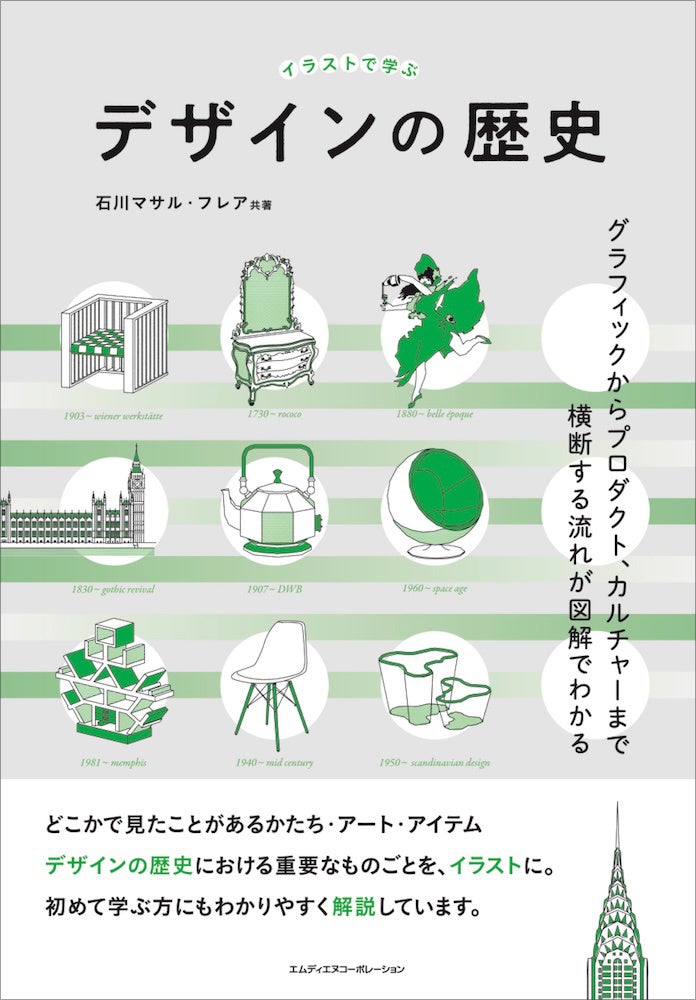
MdN Corporation (Chiyoda-ku, Tokyo, President: Toru Ogawa, hereinafter MdN), which handles media business in the design field within the Impress Group, has released 'Learning Design History Through Illustrations ,' a book that allows for intuitive, visual understanding of design history.
'Learning Design History Through Illustrations '
https://books.mdn.co.jp/books/3225303039/
This book significantly expands upon the 2015 publication 'Visualizing Design History' with the latest topics, making it easier to learn the history of design. By visualizing 80 key topics, focusing on representative works and designers, readers can quickly grasp the atmosphere and concepts visually. It's a book that allows for intuitive understanding of design history, crossing over not only graphics but also products, art, movements, and subcultures. It is ideal for beginners and those who want to re-learn design history.
Furthermore, it includes numerous design terms that have emerged since the 21st century. For IT fields and abstract concepts that are difficult to understand through text alone, the symbolized illustrations aid comprehension. It provides a broad overview of design history from ancient times to the present moment.
・Those learning design history for the first time
・Those who want to know the relationship between design and culture in each historical period
・Those who want to know about the representative works and designers of each era
80 key aspects of design history are introduced with illustrations, categorized by era.
BC to 1200s
Ancient Egyptian Style / Ancient Greek Style / Ancient Roman Style / Byzantine Style / Romanesque Style
1200s-1800s
Gothic / Renaissance / Gutenberg / Baroque / Rococo
1800s-1950s
Arts and Crafts Movement / Art Nouveau / Cubism /
Russian Avant-garde / Bauhaus / Modernism ...etc.
1950s-2000s
Organic Design / 1964 Tokyo Olympics / Eco Design /
Postmodernism / No Design / Universal Design ...etc.
2000s onwards
UI/UX Design / Social Design / Flat Design / Communication
Design / Creative Commons ...etc.
FACT BOX
- Source: PR TIMES
- Category: News