Haiko Onoda Remicon Co., Ltd. (Headquarters: Kyoto City, Kyoto Prefecture, Representative Director: Kazuhiro Yamauchi), Idemitsu Kosan Co., Ltd. (Headquarters: Chiyoda-ku, Tokyo, Representative Director and President: Noriaki Sakai), and Nippon Concrete Industries Co., Ltd. (Headquarters: Minato-ku, Tokyo, Representative Director and President: Yoshihiko Sugita) conducted trial construction using concrete blended with "Calcarbo®"*1, a synthetic calcium carbonate, at the Ane River and Gio River in Shiga Prefecture. This marks the first adoption of Calcarbo-blended concrete in a public project in Shiga Prefecture. The three companies will expand their construction track record, primarily in Shiga Prefecture, and accelerate the widespread adoption of this technology.
*1 Synthetic calcium carbonate that fixes CO2 from exhaust gas into concrete sludge (waste material remaining at the final stage of concrete product manufacturing)
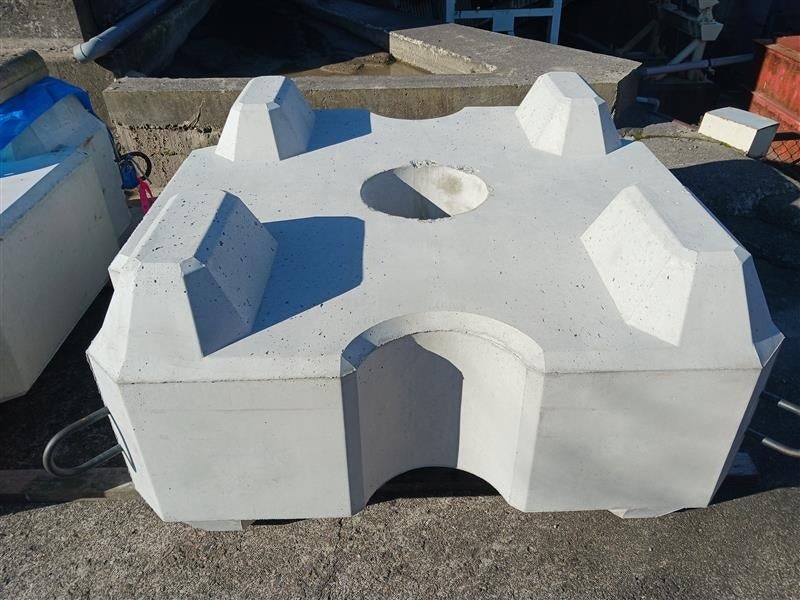
Manufactured scour protection blocks
Installation status on the Ane Riverbed (within the red frame in the photo)
Since being selected for Shiga Prefecture subsidy projects in 2024 (Shiga Prefecture Near-Future Technology Social Implementation Promotion Project Subsidy Program for FY2024 and Shiga Prefecture SME New Technology Development Project Subsidy for FY2025), the three companies have continued their efforts toward the social implementation of Calcarbo-blended concrete. As it was confirmed that Calcarbo-blended concrete possesses sufficient strength as a civil engineering and construction material, it was adopted for the first time in river improvement work.
Image of Calcarbo usage in concrete
Conventional concrete primarily consists of cement, water, and aggregates (sand, pebbles, etc.). Calcarbo can replace a portion of cement, enabling CO2 fixation in civil engineering and construction materials and effective utilization of waste. Furthermore, by replacing part of the cement with Calcarbo, cement usage can be reduced, leading to a reduction in CO2 emissions during cement manufacturing. This contributes to the overall decarbonization of the concrete manufacturing process. In this project, approximately 610 kg of CO2 reduction was achieved.
Going forward, the three companies will continue research on Calcarbo-blended concrete and accelerate the widespread adoption of this technology by obtaining material certifications from public institutions such as the General Building Research Corporation of Japan (GBRC)*2, while expanding their construction track record.
*2 A fair and neutral third-party organization that conducts testing, research, evaluation, and review of building structures, materials, and equipment
Overview of the project adopting Calcarbo-blended concrete
Project details
・Ane River
Four concrete blocks installed on the riverbed (to prevent erosion of the riverbed and the base of the revetment)
・Gio River
Concrete placed on the riverbed (to prevent riverbed scouring)
Calcarbo usage
Approximately 700 kg in total for both projects
CO2 reduction
Approximately 610 kg (total value of CO2 fixation in concrete sludge and CO2 emission reduction due to reduced cement usage)
At the Gio River, coarse aggregate (30 kg/t of CO2 fixed), developed by Haiko Onoda Remicon Co., Ltd. under a commissioned project for the Green Innovation Fund Project "CO₂-based Concrete Manufacturing Technology Development Project" by the New Energy and Industrial Technology Development Organization (NEDO), was also used.
【Reference】
Press Release: "Application Test of Synthetic Calcium Carbonate with CO₂ Fixed from Exhaust Gas Using Concrete Sludge for Civil Engineering and Construction Materials" Adopted as a Shiga Prefecture Subsidy Project (August 20, 2024)
Press Release: "CO2 Fixation Demonstration Test by Manufacturing Synthetic Calcium Carbonate Using Concrete Sludge" Adopted as a Shiga Prefecture Subsidy Project (July 26, 2023)
FACT BOX
- Source: PR TIMES
- Category: News