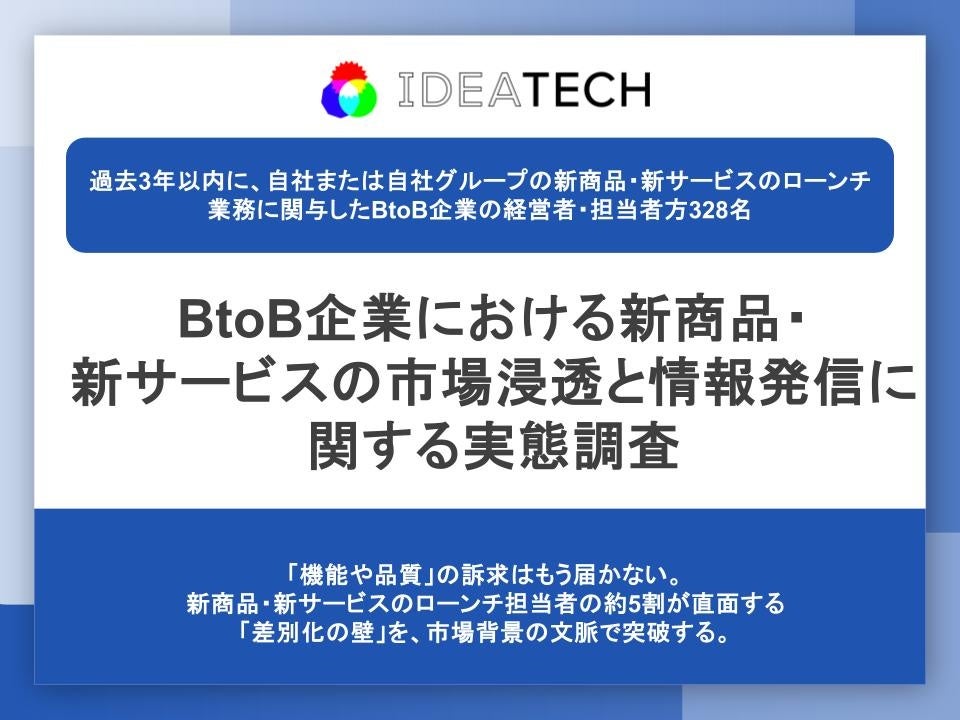
IDEATECH Inc. (Headquarters: Minato-ku, Tokyo; President and CEO: Tomoo Ishikawa; hereinafter: IDEATECH), which operates "Risapy®︎" (https://ideatech.jp/service/research-pr), a one-stop research and marketing solution, conducted a survey on the actual state of market penetration and information dissemination for new products and services in BtoB companies. The survey targeted 328 managers and staff in BtoB companies who have been involved in the launch of new products or services within the past three years. We are pleased to announce the findings.
01 | Approximately half of those involved in market penetration reported difficulty in communicating differences in features and quality, while about 40% found it easier to be compared based on price.
02 | The most significant challenge in external explanations was "understanding the difference from competing products" at 24.2%, followed closely by "understanding the difference from existing products" at 23.6%.
03 | The primary purpose for utilizing third-party information was "to explain in connection with changes in society and industry," accounting for about 60%, with "to avoid appearing to make claims solely from our company" also cited by about 40%.
Download this survey: https://ideatech.jp/download/364/?utm_source=pr_260702
Survey Overview
Survey Name: Survey on the Actual State of Market Penetration and Information Dissemination for New Products and Services in BtoB Companies
Survey Method: Internet survey conducted by IDEATECH's research marketing service "Risapy®︎"
Survey Period: June 15, 2026 - June 16, 2026
Valid Responses: 328 managers and staff in BtoB companies involved in the launch of new products or services within the past three years.
*Percentages are rounded to the second decimal place, so the total may not always be 100%.
≪Usage Conditions≫
1. Please cite "Risapy®︎" as the source of information. 2. When using on a website, please include the following link as the source.
URL: https://ideatech.jp/service/research-pr
Approximately 40% of those involved in market penetration for new products and services were responsible for "New Business Planning" in their recent work.
- New Business Planning: 36.0% - New Product/Service Planning: 22.9% - Marketing Strategy Development: 22.6% - Brand Strategy Development: 8.8% - PR Strategy Development: 5.5% - Not applicable: 4.3%
Regarding the focus of initiatives, 39.8% responded "Renewal of existing products/services," and 21.3% responded "Changes in presentation or appeal."
- Renewal of existing products/services: 39.8% - Changes in presentation or appeal of existing products/services: 21.3% - Completely new products/services: 19.7% - New businesses/brands: 13.4% - Review of existing businesses/brands: 5.4% - Other: 0.3%
"To increase sales from existing customers" was the top response at over 50%, followed by "To differentiate from competitors" at approximately 50%.
- To increase sales from existing customers: 55.4% - To differentiate from competitors: 47.1% - To develop new customer segments: 41.7% - To escape price competition: 38.5% - To expand awareness of products/services: 36.9% - To increase inquiries and business meetings: 23.9% - To change the existing brand image: 19.4% - To clearly communicate business direction internally and externally: 11.5% - Other: 3.8%
Regarding the business environment before initiatives, approximately half faced difficulty in "communicating differences in features and quality," and about 40% faced difficulty in "being compared based on price."
- Difficulty in communicating differences in features and quality: 46.5% - Being compared based on price: 44.6% - Decreased cost-effectiveness of advertising and sales promotion: 36.3% - Difficulty in achieving results solely through website and content initiatives: 31.2% - Increase in competing products/services: 30.9% - Insufficient touchpoints with new customer segments: 28.3% - Difficulty in explaining the necessity of products/services: 22.0% - Need to align business direction within the company: 16.6% - Other: 1.0% - No particularly applicable situation: 2.2% - Don't know: 1.0%
48.4% of respondents reported changing "usage scenarios or applications," while 45.9% changed "how value is communicated."
- Changed usage scenarios or applications: 48.4% - Changed how product/service value is communicated: 45.9% - Changed how the problems solved are communicated: 41.4% - Changed brand name, service name, or copy: 33.8% - Targeted different customer segments: 26.8% - Changed sales channels or proposal targets: 24.8% - Changed pricing or plans: 21.3% - Changed methods of external information dissemination: 17.2% - Other: 0.3% - No changes made: 1.6% - Don't know: 0.3%
"Understanding the difference from competing products/services" was the biggest hurdle in external explanations at about 20%, with "understanding the difference from existing products" also close at about 20%.
- Getting them to understand the difference from competing products/services: 24.2% - Getting them to understand the difference from existing products/services: 23.6% - Getting them to imagine new usage scenarios or applications: 19.7% - Getting them to understand the necessity of the product/service: 12.4% - Communicating in a way that doesn't appear to be self-serving promotion: 8.3% - Aligning explanation content with sales representatives and distributors: 6.4% - Getting media and external stakeholders interested: 2.9% - Other: 0.3% - No particular difficulties encountered: 1.9% - Don't know: 0.3%
For external explanation materials, "Data on market size and industry trends" was the most common at over half, followed by "Customer interviews and case studies" at about 40%.
- Data on market size and industry trends: 50.6% - Customer interviews and case studies: 42.0% - Survey data from customers/consumers: 36.6% - Comments from experts/specialists: 32.8% - Evaluations, certifications, and awards from third-party organizations: 30.6% - Media coverage: 24.2% - Product/service feature explanation materials: 23.2% - Sales materials/proposal documents: 22.9% - White papers/research reports: 22.3% - Other: 0.3% - Not particularly prepared: 1.9% - Don't know: 0.3%
For external communication channels, "Company website" was the top at 50.3%, followed closely by "Individual proposals to media" at 47.8%.
- Company website: 50.3% - Individual proposals to media: 47.8% - Company's owned media/blog: 37.9% - Press releases: 35.7% - White papers/research reports: 32.2% - Seminars/webinars: 26.4% - Exhibitions/events: 25.5% - Sales materials/proposal documents: 21.7% - Social media: 20.7% - Web advertising: 20.4% - Email distribution to existing customers: 17.8% - Dissemination through partner companies/distributors: 13.1% - Other: 0.0% - Not particularly disseminating information: 1.6% - Don't know: 0.6%
Among utilized third-party information, "Customer company comments and case studies" stood out at 52.9%, with "Survey data from research companies" also high at 43.9%.
Regarding the purpose of utilizing third-party information, "to explain in connection with changes in society and industry" was ranked first at about 60%, and "to avoid appearing to make claims solely from our company" was also cited by about 40%.
- To explain in connection with changes in society and industry: 59.1% - To avoid appearing to make claims solely from our company: 44.1% - To provide a sense of security to sales targets and prospective customers: 43.1% - To explain the necessity of the product/service: 41.6% - To make it easier for media coverage: 33.5% - To facilitate internal understanding and agreement: 23.8% - To explain the difference from competitors: 16.4% - Other: 2.8% - Don't know: 0.0%
46.2% reported "explaining the product/service features and characteristics first," while "explaining the challenges and market background first" was 33.4%.
- Explained the challenges and market background first: 33.4% - Explained the product/service features and characteristics first: 46.2% - Treated challenges/market background and product/service explanation equally: 13.1% - Not particularly conscious of it: 6.7% - Don't know: 0.6%
Among the understandings customers needed to gain, "understanding that conventional solutions are insufficient" was the most common at over half, followed by "understanding that new usage scenarios or applications exist" at about 40%.
- Understanding that conventional solutions are insufficient: 50.6% - Understanding that new usage scenarios or applications exist: 41.4% - Understanding that prioritizing the introduction of the product/service is high: 40.1% - Understanding that new challenges are emerging: 34.7% - Understanding that it can be considered within existing budgets and purchasing criteria: 28.3% - Understanding that management should be involved, not just specialized departments: 26.4% - Understanding that a different selection method is needed compared to competing products/services: 18.5% - Other: 0.0% - No new understanding was particularly necessary: 2.9% - Don't know: 1.0%
"Increase in business meetings" was the most frequent response at about half, with "increase in document requests and downloads" also felt by about 40%.
- Increase in business meetings: 48.7% - Increase in document requests and downloads: 43.0% - Media interviews and coverage: 35.7% - Increase in inquiries: 34.1% - Consultations from customers regarding new usage scenarios: 31.8% - Increase in seminar/event participation: 30.6% - Easier explanations in sales situations: 22.6% - Easier to share business direction within the company: 13.4% - Other: 0.3% - No particular response: 1.3% - Effectiveness not measured: 3.2% - Don't know: 0.6%
Over half of the responsible persons selected "Data on market size and industry trends" as a factor that led to results.
- Data on market size and industry trends: 53.5% - Comments from experts/specialists: 40.4% - Customer interviews and case studies: 36.6% - Survey data from customers/consumers: 33.8% - Media coverage: 29.9% - White papers/research reports: 22.3% - Seminars/webinars: 19.4% - Exhibitions/events: 18.8% - Social media: 17.5% - Web advertising: 16.6% - Sales materials/proposal documents: 14.6% - Other: 0.0% - Nothing particularly led to results: 2.9% - Don't know: 1.3%
Regarding information continuously disseminated after initiatives, "Industry trend reports" ranked first at 48.4%, followed by "Case studies" at 43.3%.
- Industry trend reports: 48.4% - Case studies: 43.3% - Content with experts/specialists: 33.8% - Regular surveys of customers/consumers: 32.8% - Seminars/webinars: 30.9% - Information provision to media: 28.3% - Information dissemination on social media: 25.2% - Articles on owned media: 21.7% - Other: 0.3% - No continuous dissemination: 4.1% - Don't know: 1.0%
For areas to strengthen in the future, approximately half cited "Creating materials to explain market background and challenges," and about 40% emphasized "Information provision to media."
- Creating materials to explain market background and challenges: 49.0% - Information provision to media: 38.9% - Collaboration with experts/specialists: 38.5% - Obtaining survey data from customers/consumers: 33.1% - Creating white papers/research reports: 31.2% - Preparing sales materials/proposal documents: 26.4% - Conducting seminars/webinars: 26.1% - Designing brand messages: 19.4% - Internal explanations and consensus building: 15.3% - Other: 0.0% - Nothing to particularly strengthen: 1.3% - Don't know: 1.6%
Summary
This survey was conducted among 328 managers and staff in BtoB companies who have been involved in the launch of new products or services within the past three years, to understand the actual state of market penetration and information dissemination for new products and services in BtoB companies.
First, regarding the business environment before initiatives, the most common issue was "difficulty in communicating differences in features and quality" (46.5%), followed by "being compared based on price" (44.6%) and "decreased cost-effectiveness of advertising and sales promotion" (36.3%). The primary objective of the initiatives was "to increase sales from existing customers" (55.4%), followed by "to differentiate from competitors" (47.1%) and "to develop new customer segments" (41.7%). The most significant challenges in external explanations were closely contested between "getting them to understand the difference from competing products/services" (24.2%) and "getting them to understand the difference from existing products/services" (23.6%). The main purpose for utilizing third-party information and perspectives was "to explain in connection with changes in society and industry" (59.1%), with "to avoid appearing to make claims solely from our company" (44.1%) and "to provide a sense of security to sales targets and prospective customers" (43.1%) following.
Among the measures that led to results, "Data on market size and industry trends" was the most frequent (53.5%), and "Creating materials to explain market background and challenges" was also ranked first for future strengthening (49.0%).
This survey reveals that in the market penetration of new products and services in BtoB companies, differentiation based solely on features and price is becoming difficult. This is likely due to the increasing difficulty in communicating differences from competitors through product specifications alone, and the standardization of customer comparison criteria. To overcome this situation, many companies are utilizing third-party information and perspectives, incorporating methods to position their value proposition within the context of societal and industry changes. In the future, the importance of "context creation"—presenting market background and challenges before product descriptions—will likely increase further. It is essential to strategically develop content from third-party perspectives, such as survey data, expert insights, and case studies, and to focus on information design that enhances the persuasiveness of company communications.
Download this survey: https://ideatech.jp/download/364/?utm_source=pr_260702
For high-quality content creation, use "Risapy®︎" and "Repopy®︎"
IDEATECH excels at creating content that customers "want to know."
By disseminating reliable content based on public opinion gathered through surveys, we enable sales that are appreciated by customers, rather than one-sided sales.
Furthermore, this leads to acquiring high-quality leads and improving conversion rates.
- You want to place content on your website but don't know what to do. - You are struggling to acquire leads. - You want to create persuasive sales materials. - You are concerned about low email newsletter open rates.
If you have any of these concerns, please contact IDEATECH!
IDEATECH will fully support your company.
BtoB Marketer's 3-Piece Document Set
https://ideatech.jp/download/087
- 10 types of "Survey" patterns perfect guide for PR/Marketing - Perfect guide to utilizing research results - Research PR White Paper
These three are delivered as a set.
Company Overview
Company Name: IDEATECH Inc. Representative: President and CEO Tomoo Ishikawa Location: 3F, Daiichi Hoki Bldg., 2-11-17 Minami-Aoyama, Minato-ku, Tokyo, 107-0062 Established: February 2010 Business Activities: 1 IDEA Content Business - Research Data Marketing "Risapy®︎" - Report Marketing "Repopy®︎" - Thought Leadership Marketing "Hakupy®︎" - Column Marketing "Colapy®︎" - Q&A Marketing "X-Questions®︎"
2 IDEA PR Business - PR Strategy Consulting "PR-GROWTH" - In-house PR Support "IDEA PR houseAI" - LLMO Strategy Consulting
3 IDEA Marketing Business 4 IDEA Design Business 5 IDEA Sales Business (Content Sales®︎) 6 IDEA Solutions Business 7 IDEA AI Business - Generative AI Introduction/Operation Support Training - Generative AI Training URL: https://ideatech.jp
FACT BOX
- Source: PR TIMES
- Category: 市場Survey