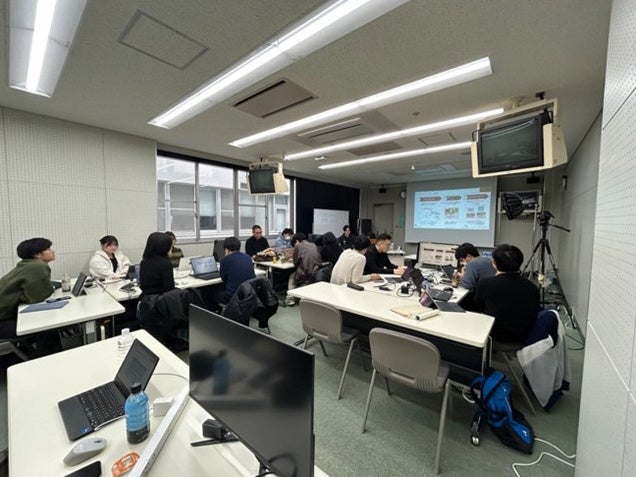
hootfolio Inc., in collaboration with NEC Corporation, implemented an educational program at Hiroshima University utilizing the causal AI "causal analysis®". This initiative was conducted as a Project Based Learning (PBL) program, focusing on learning causal decision-making rather than mere correlation. Students, acting as educational designers for the Education Development Center, challenged themselves to derive educational measures to enhance entrepreneurial confidence based on actual survey data.
Background: The Importance of EBPM and Causal Thinking in Education
In recent years, the concept of Evidence-Based Policy Making (EBPM) has gained traction in educational settings, increasing the importance of data-driven decision-making over experience or intuition. Particularly, analyzing "what causes results" from a causal perspective is considered an indispensable viewpoint for improving the quality of educational policies.
hootfolio Inc.'s causal AI "causal analysis®" is a no-code solution that can visualize cause-and-effect relationships hidden in data without specialized knowledge. In this program, this technology was utilized to allow students to analyze educational challenges using actual survey data, experiencing the process of formulating scientifically-backed policies.
Photo: Students engaged in data interpretation
Program Overview: PBL Focused on Entrepreneurial Spirit
Format: In-class PBL (group work, final presentation)
Target: Hiroshima University, Graduate Students of the Education Data Science Program
Theme: As educational designers for the Education Development Center, consider education to improve entrepreneurial confidence.
Objectives:
・ Learning scientific decision-making based on causal relationships
・ Experiencing the process of solving educational challenges using data
・ Practically understanding the perspective of EBPM
Program Content:
・ Basic understanding of causal analysis
Learning the difference between correlation and causation, and case studies in education
・ Causal analysis of student survey data
Exploring factors influencing entrepreneurial confidence
・ Formulation and presentation of educational policies
Designing concrete measures based on analysis results
Students examined the causal relationship of "why confidence is formed" based on data, constructing hypotheses. They experienced learning to verify the difference between intuition and fact.
Figure 1: Hypothesis Structure
Student Analysis Results: Different "Sources of Confidence" by Academic Level
One group's analysis showed that the motivations for building confidence differed not only by major but also by academic level.
① Students at the foundational stage
Experiences of venturing into the unknown tend to lead to confidence.
Proposed measures: Expansion of opportunities to participate in projects with responsibility, provision of entrepreneurship support information
② Students at the intermediate stage
Interest in concrete results, such as high-growth businesses, forms confidence. However, "ordinary self-perception" acts as an inhibiting factor.
Proposed measures: Practical lectures with a business focus, outcome-oriented seminars
③Students at the advanced stage
Extroversion and interaction with others contribute to confidence building.
Proposed measures: Presentation opportunities to demonstrate abilities, advanced discussion environments, exposure to cutting-edge technologies
Figure 2: Example of causal analysis results used in the workshop
Participant Feedback (Excerpt)
Participants commented, "By engaging in causal analysis in groups, I was exposed to perspectives and interpretations I wouldn't have noticed on my own, deepening my understanding of how to interpret data." The process of discussing the validity of the analysis through opinion exchange was also evaluated as contributing to the improvement of logical explanation and discussion skills.
Educational Effect: Fostering a Data-Driven Mindset
Through this program, students not only learned analytical methods but also gained experience in viewing education from the perspective of an "educational designer." The process of causally explaining the validity of policies fostered a data-driven mindset and an interest in problem-solving.
PBL utilizing causal analysis is expected to be used in future educational settings as a learning opportunity to cultivate an attitude of "understanding educational challenges with data and acting towards their solution."
About Causal AI causal analysis®
Causal AI solution that intuitively grasps the "root cause" affecting outcomes
Developed with proprietary AI technology from NEC Corporation's research laboratories, it extracts and visualizes "cause and effect" relationships from data that were difficult to see with conventional analysis. With an intuitive interface that requires no statistical expertise, it answers the question of "what produces results" and enables scientifically guided next actions for business.
In addition to marketing, its application is expanding to HR areas such as factor analysis for increasing employee engagement, and to policy formulation and community development.
About hootfolio
hootfolio is a startup spun out from NEC Corporation in January 2025. With the mission of "scientific decision-making for everyone," it provides the SaaS-based analysis service "causal analysis®" utilizing causal AI. Based on the technological capabilities cultivated as an NEC-born startup, we will collaborate with companies, government agencies, and research institutions to accelerate the social implementation of scientific decision-making.
Contact Us
hootfolio Inc.
Company Name: hootfolio Inc. Location: Charmezon Stage Tamachi, 5-32-12 Shiba, Minato-ku, Tokyo Established: August 2024 Representative: Kenta Kasahara Company Website: https://hootfolio.com/ Business Activities: Provision of causal analysis solution "causal analysis"
FACT BOX
- Source: PR TIMES
- Category: 教育,AI・データサイエンス