Hitachi Develops AI Technology to Support Pre-preparation for Expert Panels in Cancer Genomic Medicine
Key facts
- Hitachi Develops AI Technology to Support Pre-preparation for Expert Panels in Cancer Genomic Medicine
- Hitachi has developed AI technology to support the pre-preparation of expert panels for cancer genomic medicine.
- Date: March 30, 2026
Direct answer
Hitachi has developed AI technology to support the pre-preparation of expert panels for cancer genomic medicine.
- Citation
- Hitachi Develops AI Technology to Support Pre-preparation for Expert Panels in Cancer Genomic Medicine (March 30, 2026)
- Source
- PR Times
- Date
- March 30, 2026
Hitachi has developed AI technology to support the pre-preparation of expert panels for cancer genomic medicine.
📋 Article Processing Timeline
- 📰 Published: March 30, 2026 at 00:59
- 🤖 AI Analyzed: May 26, 2026 at 21:27 (1388h 27m after Published)
Tohoku University Hospital, Hitachi, and Hitachi High-Tech have developed AI technology to support the pre-preparation of "Expert Panels (EP)"*, a specialized meeting for the medical interpretation of genetic test results in cancer genomic medicine*1. This technology refers to past physician comments, related knowledge, and literature databases to present points for confirmation and discussion at the EP, including potential treatment options, along with supporting evidence*3. This is expected to facilitate smoother confirmation and discussion at the EP, reduce the time required for information gathering and organization during pre-preparation, and alleviate the workload of physicians. Furthermore, the system is designed to operate on PCs within the hospital, assuming no transmission of sensitive information externally. In an evaluation using past cases from Tohoku University Hospital, over 80% of the points presented by this technology for EP confirmation and discussion, corresponding to treatment policies, matched the EP's review results. Moving forward, we aim to contribute to the widespread adoption and quality improvement of cancer genomic medicine by continuing verification and striving for technological advancement, thereby reducing the burden on medical facilities.
*1 Cancer Genomic Medicine: A type of personalized medicine that analyzes genetic mutations in a patient's cancer cells and selects the optimal treatment based on the results.
*2 Expert Panel (EP): In cancer genomic medicine, a specialized meeting where multiple specialists (such as medical oncologists, genetic diagnosticians, clinical genetic specialists, and pharmacists) gather based on a patient's genetic mutation results to comprehensively discuss and advise on optimal treatment policies and necessary additional tests. It plays a crucial role in supporting the realization of personalized medicine.
*3 The content presented by this technology is for discussion purposes only. The final decision on diagnosis and treatment policy rests with healthcare professionals. Treatment policies will not be determined solely based on the content presented by this technology.
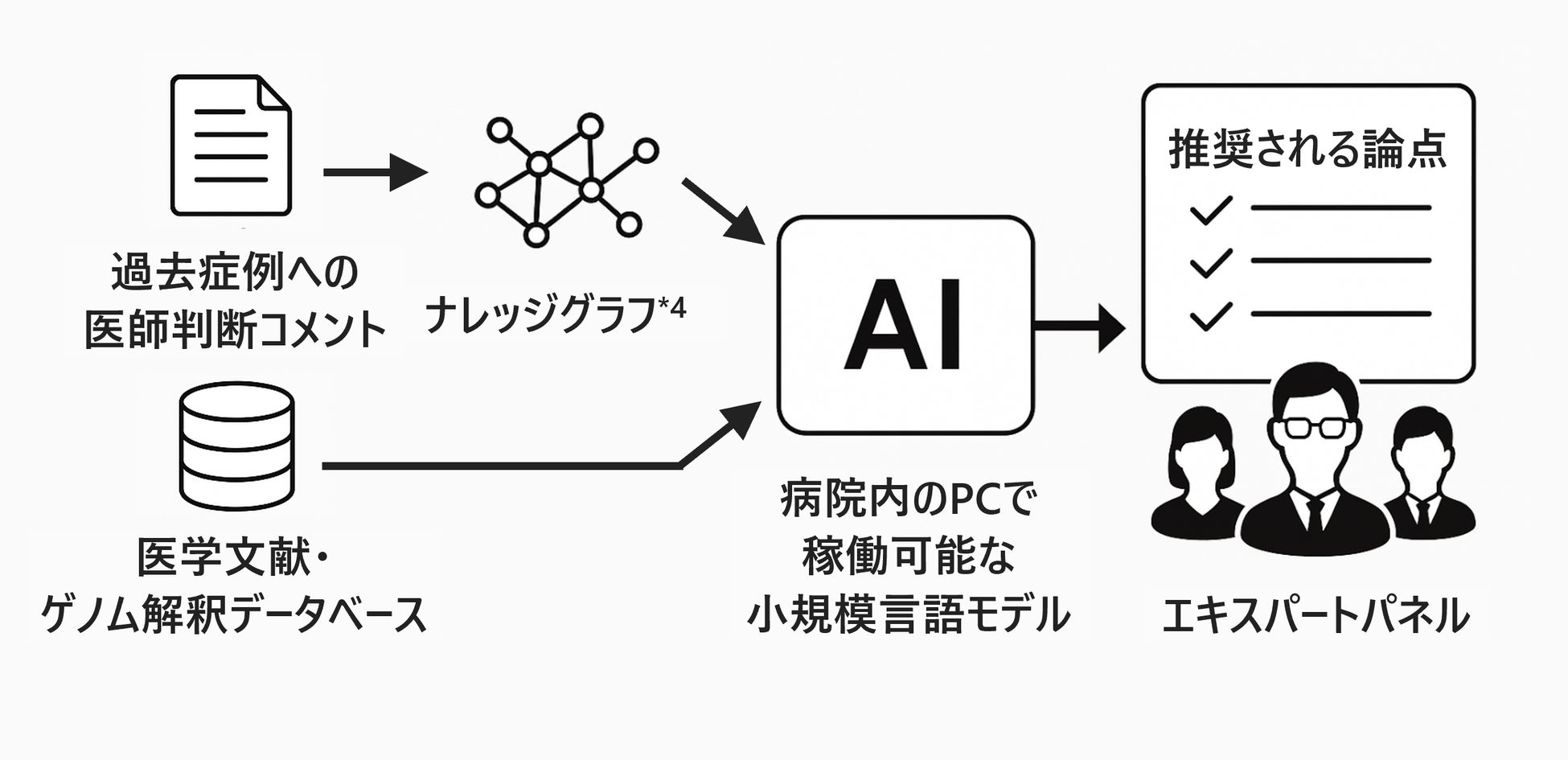
*4 Knowledge Graph: A technology that structures and systematically utilizes knowledge extracted from physician comments and other sources by linking them.
■ Background and Challenges
Cancer Gene Panel Testing (CGP)*6 has been covered by insurance since 2019 for patients with advanced or recurrent solid tumors*5 for whom standard treatment is unavailable or has been completed. Consequently, the number of patients eligible for cancer genomic medicine is expected to expand approximately 2.5-fold over the five years from 2020 to 2025*7, leading to an increase in cases to be reviewed by EPs.
However, the pre-preparation for EPs involves not only reviewing test results but also extensive tasks such as collecting related information and organizing discussion points. Depending on the facility and case, this can take up to 1-2 hours per case and is sometimes performed after regular clinical duties, posing a challenge of increased workload for physicians. Furthermore, since EPs are operated by a limited number of specialists, including experts in molecular biology, there has been a demand for a system that can facilitate the review of evidence-based information while keeping the burden of pre-preparation manageable.
*5 Solid Tumors: A general term for cancers that form lumps (tumors) in the organs or tissues of the body.
*6 Cancer Gene Panel Testing (CGP): A test that examines the DNA of cancer cells to comprehensively analyze multiple cancer-related gene mutations simultaneously.
*7 "Cancer Genomic Medicine and Cancer Gene Panel Testing" website (https://www.ncc.go.jp/jp/cancer_genome/index.html)
FAQ
What is the main purpose of the newly developed AI technology by Hitachi?
The AI technology is designed to support the pre-preparation of Expert Panels (EP) in cancer genomic medicine by presenting points for confirmation and discussion.
What kind of information does the AI technology utilize to generate its suggestions?
The AI technology refers to past physician comments, related knowledge, and literature databases to generate its suggestions for the Expert Panels.
What are the expected benefits of implementing this AI technology in cancer genomic medicine?
The technology is expected to facilitate smoother EP discussions, reduce pre-preparation time for information gathering, and alleviate the workload of physicians.
How does the AI system ensure the security of sensitive patient information?
The system is designed to operate on PCs within the hospital, ensuring that no sensitive information is transmitted externally.
What was the outcome of the evaluation conducted using past cases from Tohoku University Hospital?
In an evaluation using past cases, over 80% of the points presented by the AI technology for EP confirmation and discussion matched the EP's review results regarding treatment policies.