[For the attention of members of the press]
June 29, 2026
Henry Inc.
Masayuki-kai Hospital (Kadoma City, Osaka Prefecture; 56 beds), a medical corporation, and Henry Inc. have jointly conducted a pilot experiment to integrate generative AI into Henry, a cloud-based electronic medical record (EMR) system for hospitals, redesigning hospital documentation workflows on an "AI-first" operational basis (April 20 – June 5, 2026).
The key focus of this pilot was not merely speeding up individual tasks, but fundamentally reconfiguring the documentation workflow itself around the premise of AI, reducing the number of steps. As a result, staff can now complete documentation seamlessly while conversing, all within the EMR interface without needing to leave the screen.
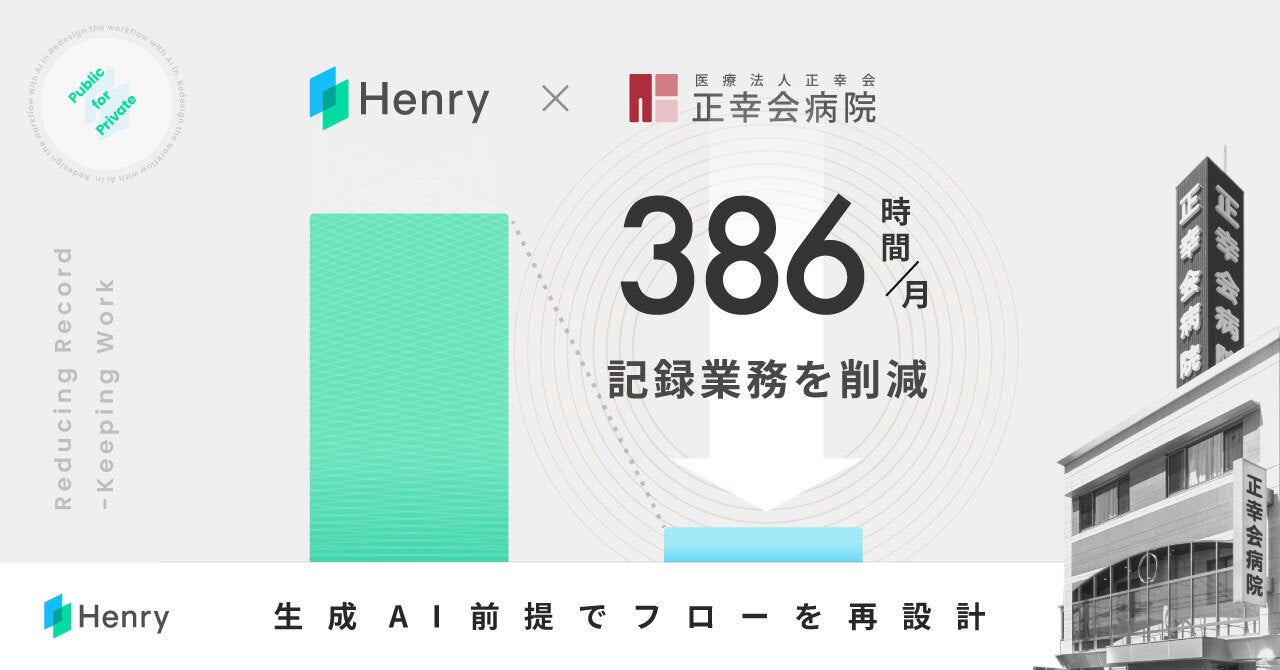
This resulted in an estimated monthly reduction of approximately 386 staff-hours across all roles—physicians, nurses, rehabilitation therapists, and administrative staff (※1). For example, the time required to create discharge summaries (by physicians) was reduced by approximately 90%, from a previous average of about 40 minutes down to just 4 minutes (measured).
Background of the Pilot: Becoming a 'Preferred Hospital' Amid Staff Shortages and Financial Challenges
Medical facilities face a dual crisis of staffing shortages and financial strain. The turnover rate among regular nursing staff is 11.3%, rising to 16.1% for mid-career (non-new graduate) hires (※2), making staff retention a critical business issue. Financially, the situation is dire: around 70% of hospitals report negative operating margins, and operating profit per 100 beds has been negative for seven consecutive years (※3).
In this context, hospitals must become places that are "chosen" by both patients and healthcare workers to survive. The key lies in building operational workflows premised on generative AI, enabling sustainable operations even with limited personnel. Efficiency is no longer just a welfare benefit—it has become a core business challenge. Particularly for Japan’s approximately 7,000 small-to-medium-sized hospitals, which face significant constraints in staffing and funding, there have been almost no prior cases of integrating generative AI directly into EMR systems to redesign workflows. This pilot marks the first instance (※4) where a mid-sized hospital has utilized generative AI embedded within a cloud-native EMR system to reconstruct workflows and publicly shared before-and-after performance data.
Pilot Overview: Transitioning to an 'AI-First Operational Workflow'
The primary objective of this pilot was not simply to replace existing tasks with generative AI, but to redesign the entire workflow with AI as a foundational element. As a result, steps previously considered standard—such as jotting notes on paper or manual transcription—became entirely unnecessary.
For example, during nursing rounds, documentation traditionally involved five steps: 1 observing the patient in the room, 2 writing nursing notes on paper, 3 writing vital signs on paper, 4 returning to the nurse station, and 5 transcribing into the EMR. With an AI-first redesign, this was reduced to just two steps: 1 recording the conversation with the patient in the room, and 2 entering vital signs during transcription. By eliminating transcription and duplicate note-taking, nurses can now complete rich, detailed records in about 1–2 minutes per patient.
This new workflow is enabled by an architecture that integrates voice input (recording) through AI-generated summarization within a single EMR system. Staff no longer need to leave the EMR screen, and AI generates documents using both clinical data and voice recordings as sources, ensuring both speed and accuracy. After AI generation, documents require only review and approval by the responsible staff, significantly reducing workload. Unlike legacy on-premise systems designed for large hospitals or add-on AI tools connected externally, this solution is natively built into a cloud-native hospital EMR. This allows access to the latest AI models and eliminates the need to pause work, switch to external apps, and copy-paste back into the EMR.
Results of the Pilot: Efficiency Gains
Combining time saved through voice input (188 hours) and document (summary) AI (198 hours), the pilot achieved an estimated total monthly reduction of approximately 386 staff-hours across all roles.
On-Site Feedback from the Pilot
Daisato Higashi, Director and Hospital Director, Masayuki-kai Hospital:
"Currently, AI is positioned as a clinical support tool, proving effective in areas such as diagnostic assistance and image interpretation.
In the future, as general artificial intelligence (AGI) advances, AI will take on an even greater role. We must shift our mindset from viewing AI as merely supportive to envisioning healthcare centered around AI.
Additionally, I anticipate accelerated progress in smart robotics, meaning medical settings will enter an unprecedented era of transformation. I feel we are now standing at the threshold of this dramatic change.
Through this pilot, I have once again realized the potential of AI in clinical settings. I look forward to Henry Inc. continuing to pioneer the integration of AI advancements and deliver new value to healthcare."
Kaori Nakamura, Project Leader for Generative AI, Masayuki-kai Hospital:
"Through this pilot, I gained firsthand insight into operational challenges across departments and reaffirmed the potential of generative AI. Particularly in terms of improving efficiency and usability within hospital operations, I believe there remain many areas yet to be explored.
We will continue to actively seek out practical applications that solve real-world challenges and promote the adoption of generative AI."
Izumi Miyagi, Deputy Head Nurse, Masayuki-kai Hospital:
"In nursing, multidisciplinary collaboration and information sharing are essential. Using AI to organize spoken content into structured documentation has helped prevent omissions and improved the quality of information sharing.
Additionally, the reduced burden of documentation allows us to dedicate more time to patient care and team coordination—activities that should be our primary focus."
Head Nurse and Nurse, Masayuki-kai Hospital Nursing Department:
"The idea of creating records while conversing with patients at the bedside now feels truly practical. When managing many patients, it’s easy to miss or forget details when documenting later. With AI, I feel we can create more accurate and higher-quality nursing records.
By freeing up time from documentation, we can focus more on direct patient care, which I believe will enhance the overall quality of nursing."
Physical Therapist, Rehabilitation Department, Masayuki-kai Hospital:
"Using AI for rehabilitation documentation has reduced our administrative burden, allowing us to focus more on patient care and therapy—the core of our work.
I hope that as AI use expands further, we can secure even more time to spend directly with patients."
Koito Sakasegawa, CEO, Henry Inc.:
"With the healthcare workforce continuing to shrink, preserving regional healthcare with limited staff requires transforming operational productivity at its core. This pilot demonstrated that small and mid-sized hospitals, especially in regional areas, have the greatest potential for reimagining workflows with AI. We aim to scale this AI-first hospital model as a standardized solution across Japan’s approximately 7,000 small-to-medium hospitals, expanding AI-native operational solutions to build AI-driven hospitals."
Commitment to Safety and Security
Data entered through this feature—including clinical data, voice recordings, and generated documents—is not used to train AI models. All data is processed in a highly encrypted environment, ensuring no external leakage and strict protection of privacy. We remain committed to strengthening our security infrastructure so healthcare providers can use our technology with confidence.
※1: Assumptions Behind the Estimates
The monthly time savings cited in this press release are estimates. Pre-AI task durations were based on actual measurements from EMR system logs and on-site interviews (April 2026). Post-AI durations reflect measurements during the pilot period (April 20 – June 5, 2026), including time for review and minor edits after AI generation. Monthly activity volumes are as follows: nursing documentation and outpatient charting—1,500 entries each (based on total inpatient days and outpatient visits); rehabilitation documentation—1,120 entries (56-bed facility, operating 5 days/week); various summaries (nursing and rehabilitation)—50 each; discharge summaries (physician and administrative)—70 each (based on discharge patient count). All figures reflect actual performance at Masayuki-kai Hospital (56 beds, Kadoma City, Osaka Prefecture). Results may vary by facility size, departments, and staffing structure.
For details, please refer to this link.
※2: Source: Japan Nursing Association, "2024 Hospital Nursing Status Survey"
※3: Source: Four Hospital Organizations Council, "2025 Hospital Management Periodic Survey (Final Report, November 2025)"
※4: As of June 2026, based on internal research, no publicly reported pilot cases were found that (1) used a cloud-native hospital EMR system, (2) targeted hospitals with fewer than 200 beds, and (3) published before-and-after measured data.
Inquiries Regarding This Announcement
Henry Inc., AI Sales Team (Kita, Matsukawa, Aoyagi): sales@henry.jp
Henry Inc., Public Relations: pr@henry.jp
About Henry
Henry is a cloud-native core hospital system that integrates electronic medical records, order entry, and claims processing. The hospital EMR market has long been dominated by major vendors offering on-premise or cloud-lifted systems, each heavily customized per hospital. This leads to high costs for upgrades and maintenance, and vendor lock-in due to proprietary standards, making switching difficult. Additionally, many small hospitals struggle to maintain system security, sometimes falling behind on OS and browser updates. Recognizing these structural issues, the government is promoting a shift to cloud-native systems. Henry is the only vendor to enter this market with a cloud-native solution, marking the first new entrant in nearly 30 years.
Since launching hospital services in February 2023, Henry has expanded nationwide. Hospitals using Henry have achieved significant operational improvements, including increasing bed utilization from 60% to 100% and boosting revenue by up to 30%. Some have reduced staff overtime by 70–80%, and one became the first hospital in Osaka Prefecture to eliminate mandatory physician night shifts.
Henry does not simply deliver a system—we partner with hospitals as equals. Beyond core system provision, we offer medical BPO services to address staffing shortages and maximize reimbursement, AI workflows that transform operations at their core, and consulting for operational and financial improvement. Our pricing model has evolved into a performance-based structure tied to hospital revenue, aligning our success with our clients’. Starting from a cloud core system, we are accelerating our evolution into an integrated AI healthcare platform that combines AI, BPO, and consulting to deliver automated operations, staffing solutions, and business transformation in one.
About Henry Inc.
Founded in 2018 on the mission "to continuously solve social challenges and build a better world," Henry Inc. is a full-stack startup driven by ideals to address societal issues. Focusing on Japan’s most urgent and critical challenge—building a sustainable healthcare system—we center our efforts on developing and providing Henry, a cloud-based EMR and claims processing system for hospitals, while offering end-to-end services including medical BPO and management consulting tailored to hospital operational needs.
FACT BOX
- Source: PR TIMES
- Category: 技術導入
- Organizations: Henry