AI Solves Condominium Repair Reserve Fund Shortage: New Service "AI Repair Doctor" to Fundamentally Review Long-Term Repair Plans Launched
Haikan Hozen Center Co., Ltd. launches "AI Repair Doctor" on April 5th, a new service that optimizes long-term repair plans using AI to prevent excessive construction and bid-rigging, resolving condominium repair reserve fund shortages with initial costs from 150,000 yen and annual costs from 30,000 yen.
📋 Article Processing Timeline
- 📰 Published: April 2, 2026 at 19:00
"Insufficient repair reserve funds" - this problem affects 36.6% of condominium management associations nationwide (Ministry of Land, Infrastructure, Transport and Tourism, "FY2023 Comprehensive Condominium Survey"). However, for many, the cause is not simply a lack of money, but rather structural problems within the long-term repair plan itself.
Haikan Hozen Center Co., Ltd. (Headquarters: Chiyoda-ku, Tokyo; Representative Director: Takahiro Fujita) will launch a new service, "AI Repair Doctor," on April 5, 2026, to solve this structural problem with the power of AI. By optimizing repair plans with AI, reducing excessive construction through high-durability materials and scaffold-free construction methods, and preventing bid-rigging through complete separation of design and contractor selection, the service will eliminate wasteful repair expenses and generate new funds. The "AI Repair Doctor" service starts from an initial cost of 150,000 yen and an annual cost of 30,000 yen.
[AI Repair Doctor Detail Page]
Part 2: https://haikan-hozen.co.jp/2026/03/23/resolving-reserve-fund-shortage-ai-repair-doctor-guide-part2/ (Scheduled for release on April 5, 2026)
[Haikan Hozen Channel (YouTube) Explanation Video] Part 1: Released March 29 / Part 2: Scheduled for release April 5
Background of Service Launch - The Root Cause of "Insufficient Repair Costs" Lies in Structural Problems of Long-Term Repair Plans
According to the Ministry of Land, Infrastructure, Transport and Tourism's "FY2023 Comprehensive Condominium Survey," 36.6% of condominiums have insufficient repair reserve funds compared to their plans. Furthermore, due to rising construction material prices and labor shortages, construction costs are expected to continue to rise by 5-10% annually, causing many management associations to struggle with securing repair funds.
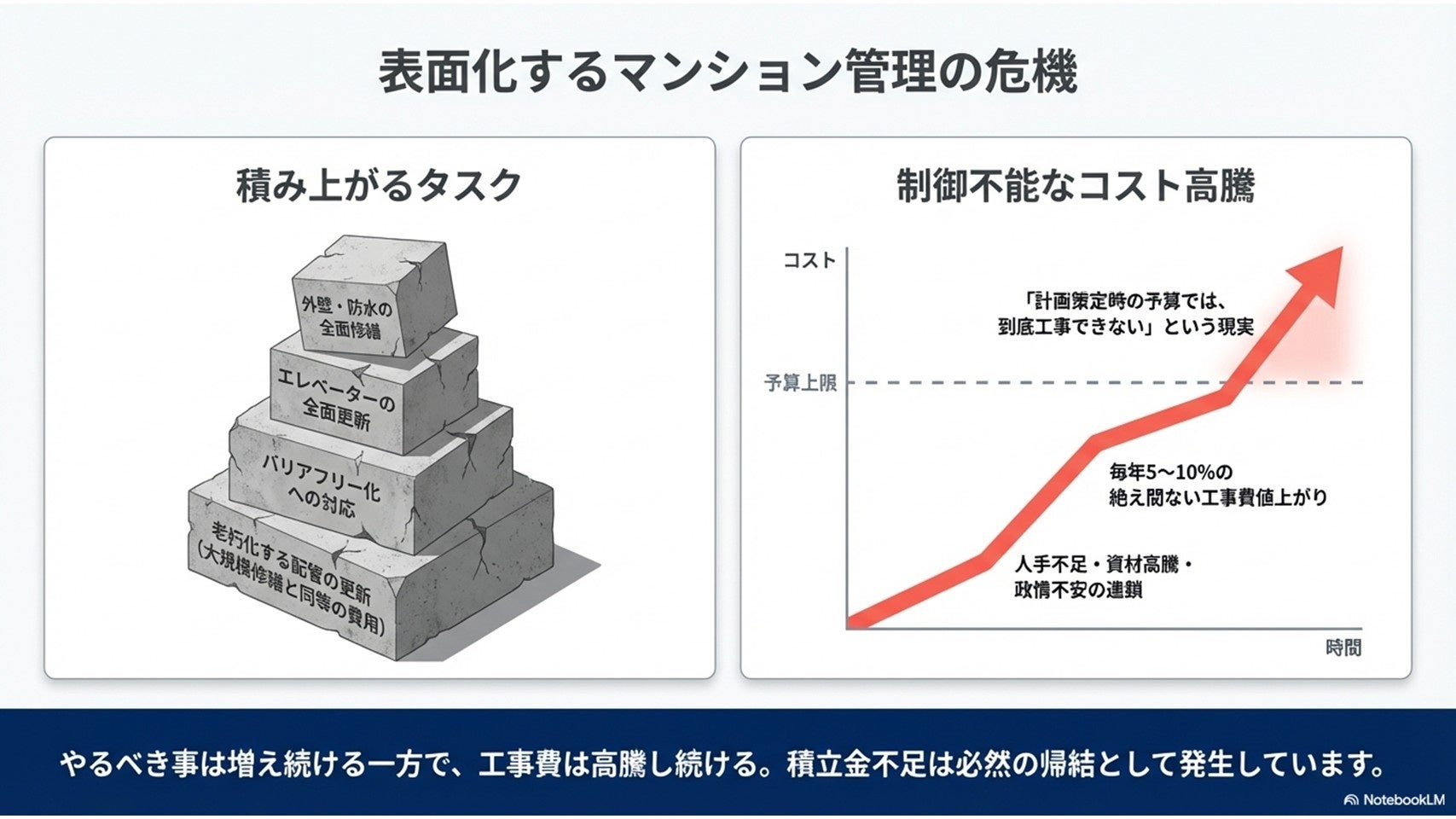
Our company receives over 100 inquiries from management associations each month, and consultations regarding "insufficient repair reserve funds" and "long-term repair plans no longer matching reality due to rising construction costs" are rapidly increasing.
This problem is not simply about "lack of funds." When we investigate the cause of the funding shortage, we find that there are structural problems in the long-term repair plan itself, which lead to a shortage of funds midway through the plan.
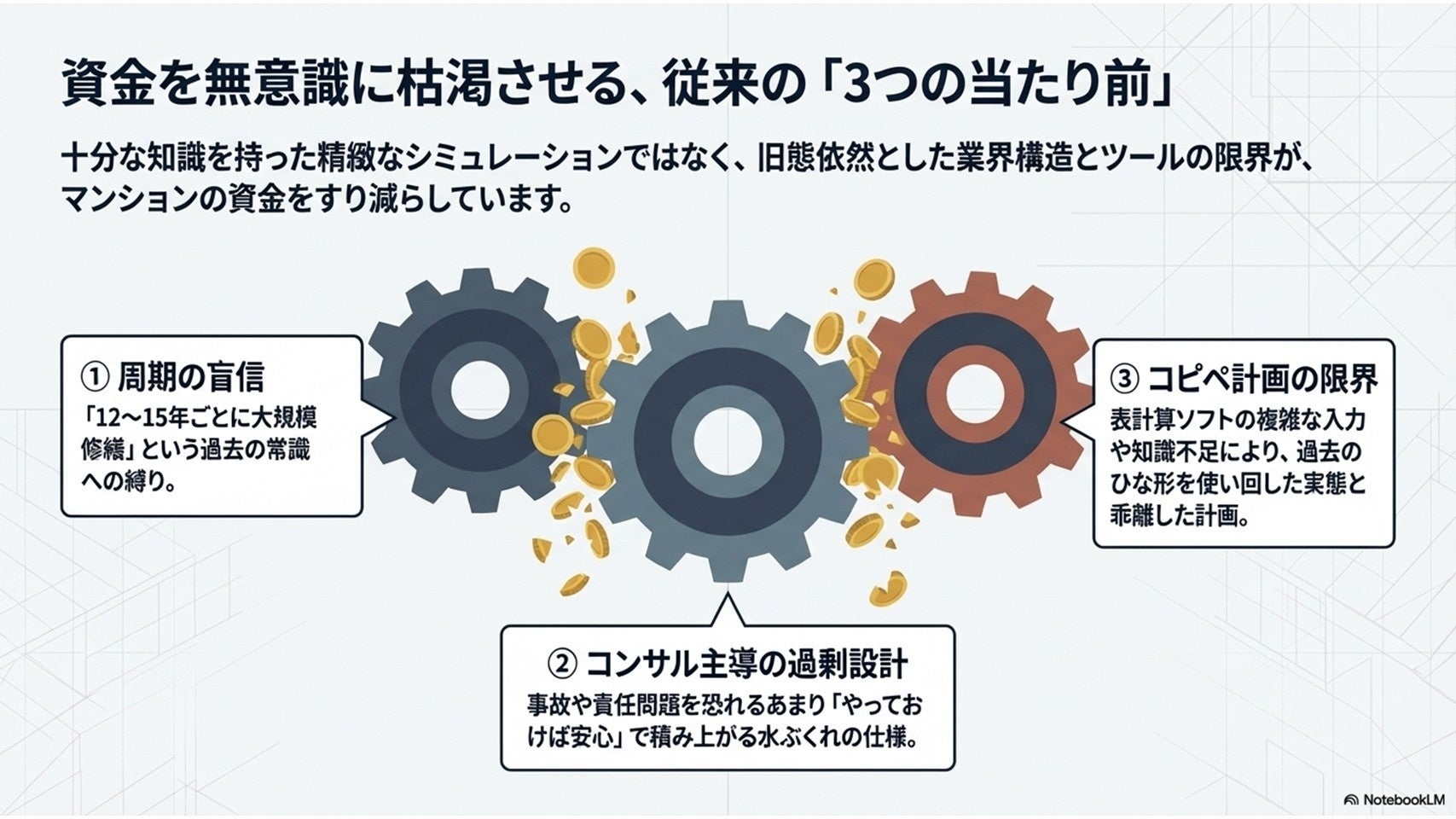
• Despite advances in building materials, large-scale repairs are still based on a 12-15 year cycle (blind faith in cycles)
• Management companies and design consultants build up plans with excessive specifications, believing "it's safer to do it" (consultant-led over-design)
• Plans deviate from the actual condition of the condominium due to copy-pasting past plans (limitations of copy-paste plans)
In other words, by changing the way long-term repair plans are formulated, there is a significant potential to generate more funds compared to the current situation. Therefore, "AI Repair Doctor" was born as a service that solves this structural problem and resolves the repair reserve fund shortage for management associations by utilizing AI to create long-term repair plans.
Why a "Pipe Maintenance Professional" Examines the Entire Repair Plan
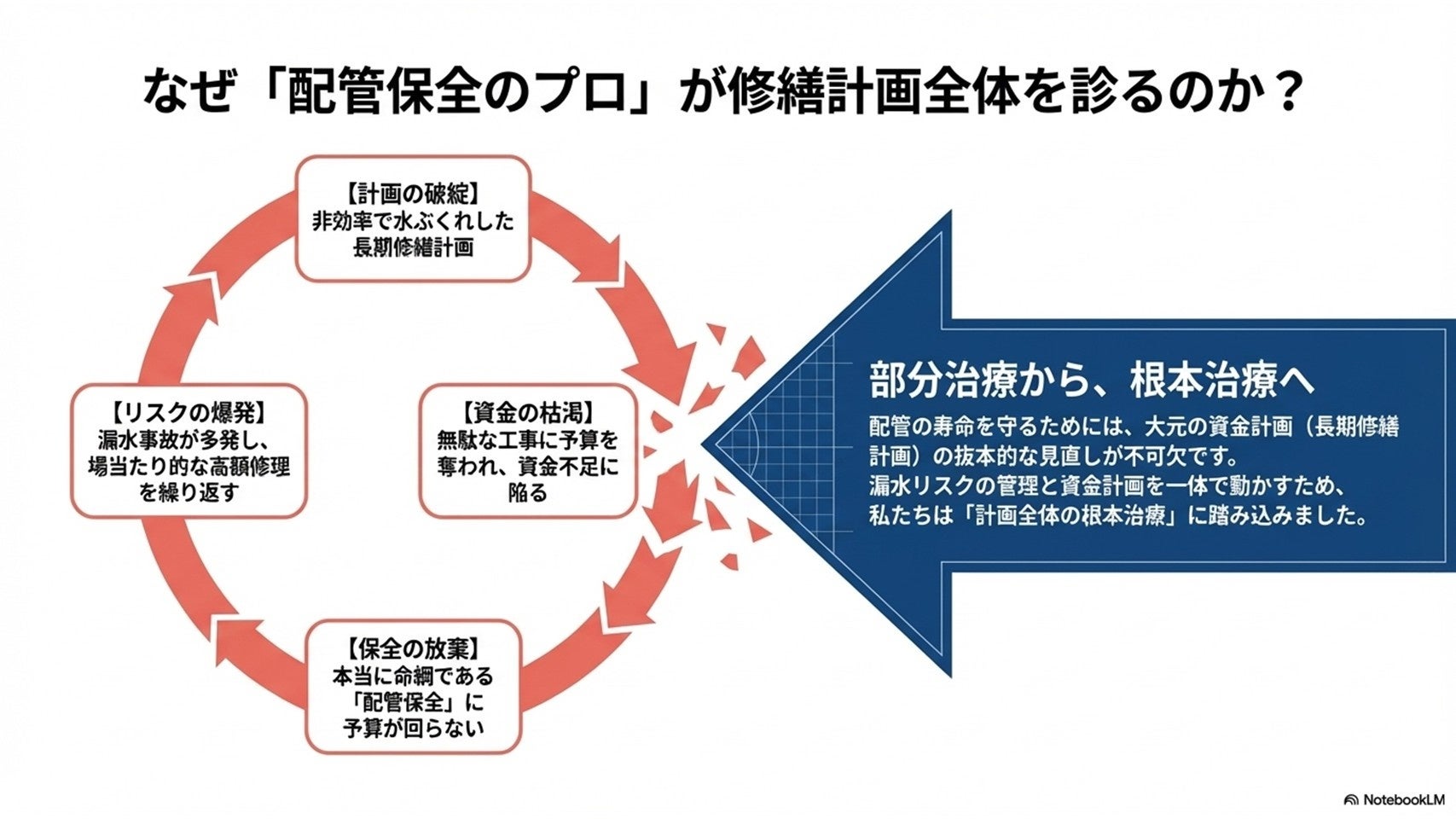
Haikan Hozen Center has primarily focused on the maintenance of water supply and drainage facilities. In doing so, we realized the reality that "even if we want to maintain pipes, we cannot do so if the entire repair plan is broken." Under an inefficient and bloated long-term repair plan, budgets are consumed by unnecessary construction, leading to a depletion of funds, and essential pipe maintenance, which is a lifeline directly connected to daily life, cannot be funded. As a result, water leakage accidents occur frequently, leading to repeated ad-hoc, high-cost repairs - creating a vicious cycle.
To protect the lifespan of pipes, a fundamental review of the original financial plan (long-term repair plan) is essential. To manage leakage risks and financial planning in an integrated manner, we have embarked on a "fundamental treatment of the entire financial plan."
Now is the Time to Solve Long-Term Repair Plan Problems - Four Conditions Are Met
While long-term repair plan problems have been difficult to solve until now, the arrival of an era where management associations can wisely control costs has come, with the following four conditions being met.
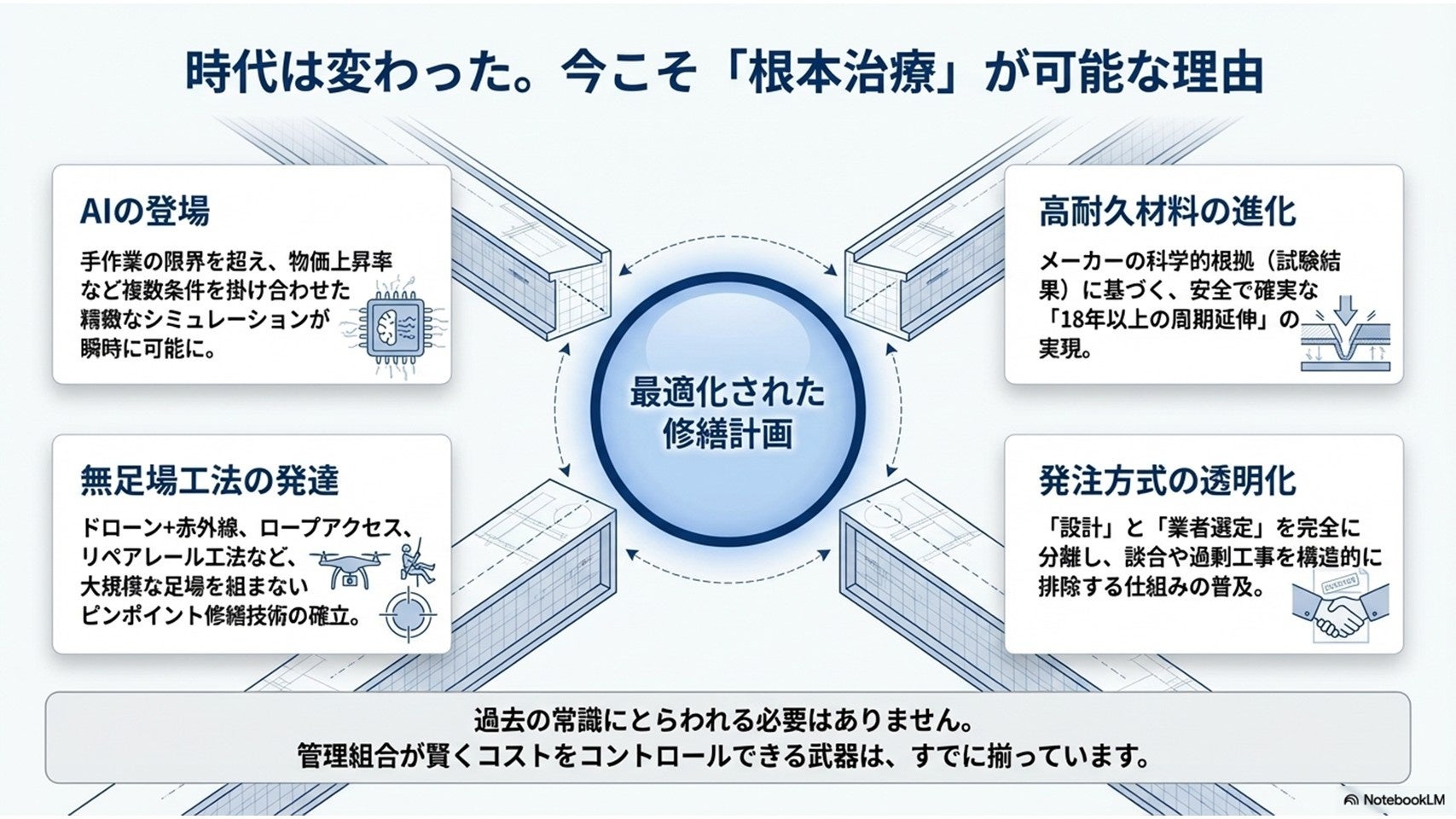
[1] Emergence of AI
Beyond the limits of manual work, precise simulations combining multiple conditions such as inflation rates are now possible instantly. Optimal plans can be derived based on current data, not past customs.
[2] Increased Durability of Building Materials
Based on manufacturers' scientific evidence (test results), it has become realistically possible to extend the cycle of large-scale repairs to 18 years or more if properly selected and managed.
[3] Development of Scaffold-Free Construction Methods
Technologies such as drones + infrared, rope access, and repair rail methods have made it possible to inspect and repair necessary areas pinpointedly without assembling large scaffolds.
[4] Transparency of Ordering Methods
Mechanisms that completely separate design and contractor selection, structurally eliminating bid-rigging and excessive construction, have become widespread. An environment where management associations can order construction at appropriate prices has been realized.
Three Approaches of "AI Repair Doctor"
AI Repair Doctor addresses the structural flaws in long-term repair plans through three approaches: "changing plans," "changing construction," and "changing contractor selection," thereby generating new funds that can be used as repair reserve funds.
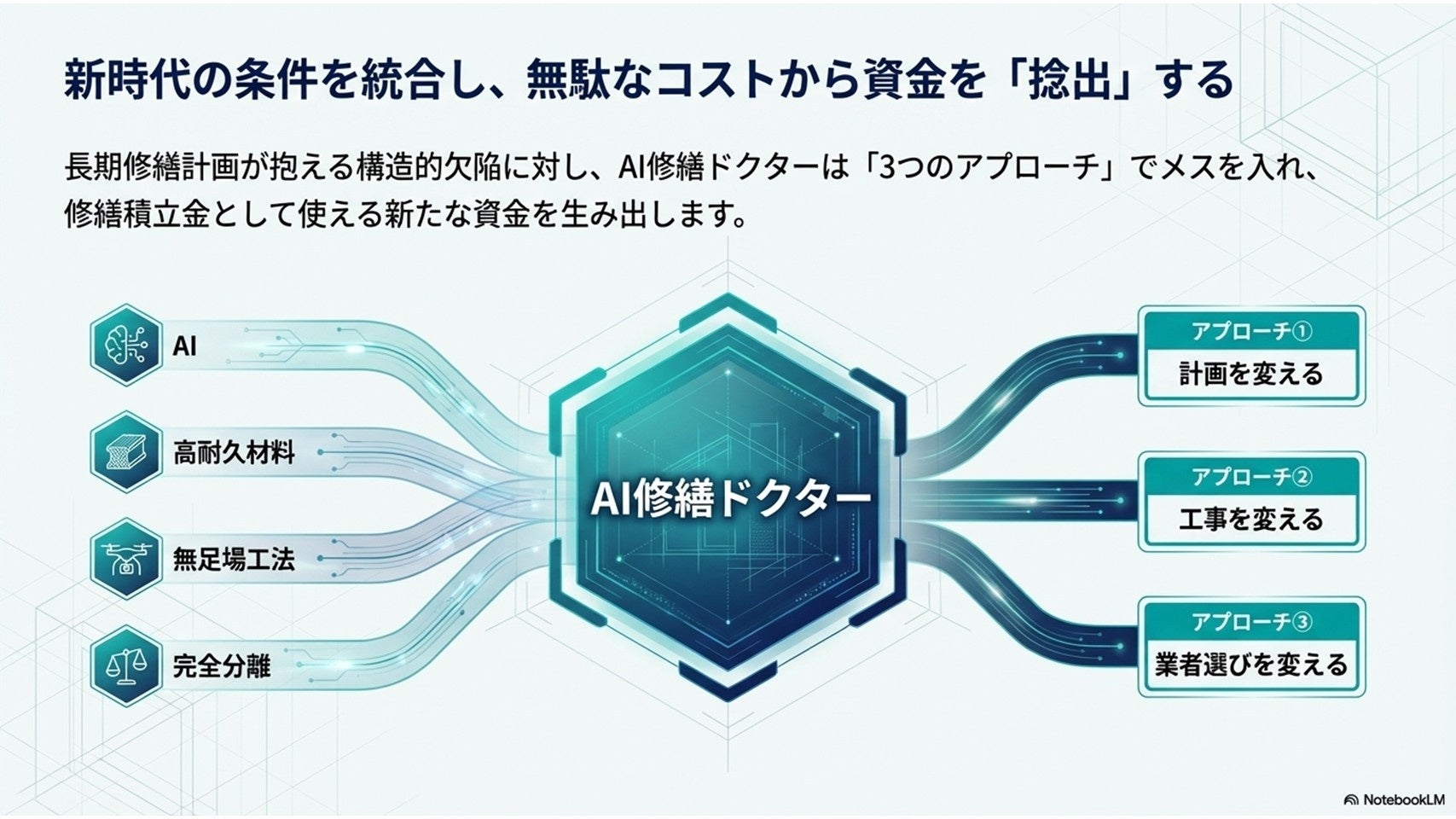
[Approach ①] Changing Plans - Creation and Continuous Update of Long-Term Repair Plans by AI
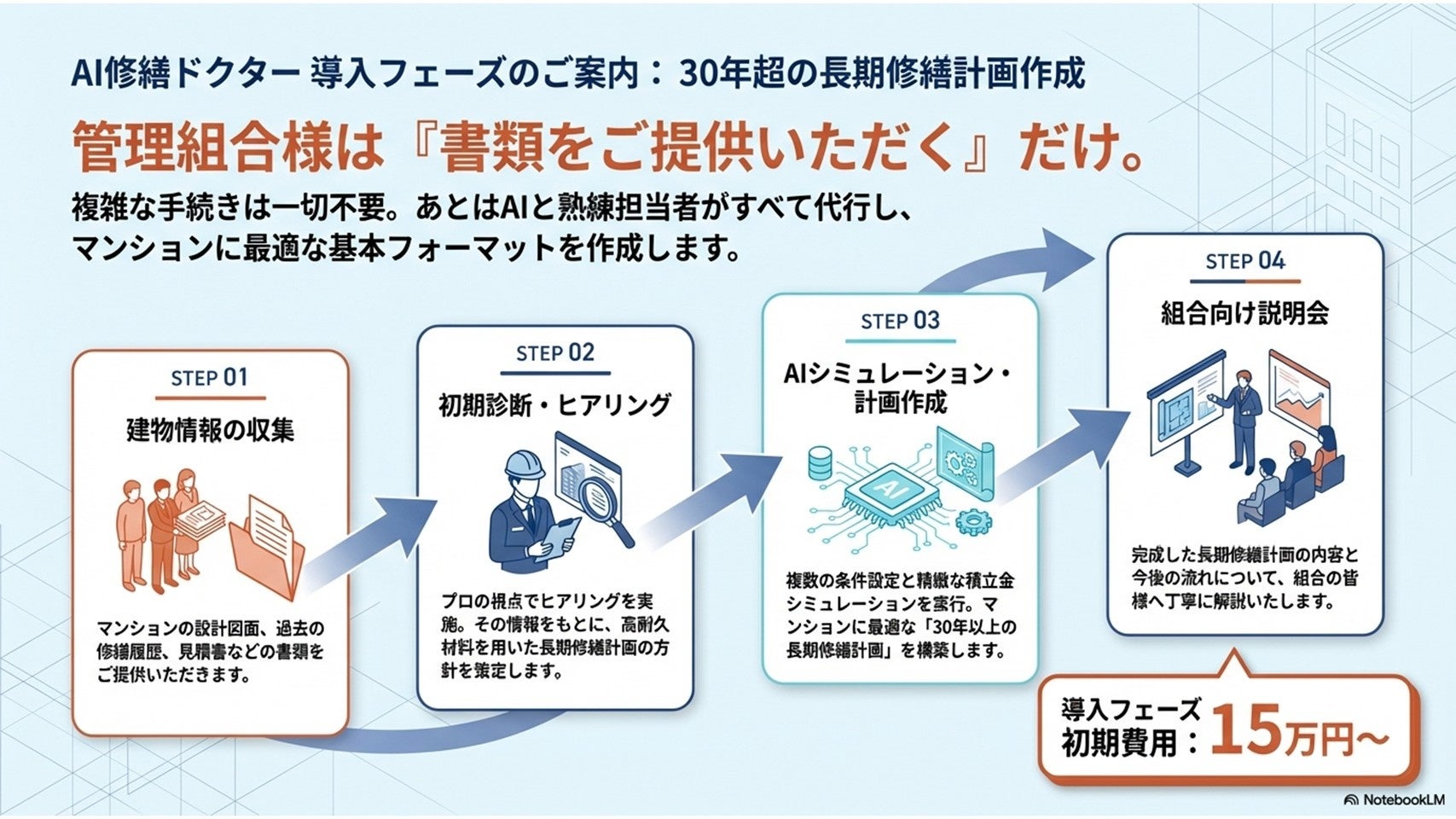
Management associations only need to provide documents such as condominium blueprints, past repair history, and estimates. No complicated procedures are required. AI and experienced staff will handle everything, creating a basic format for a long-term repair plan of 30 years or more, assuming high-durability materials. Briefing sessions for associations will also be held.
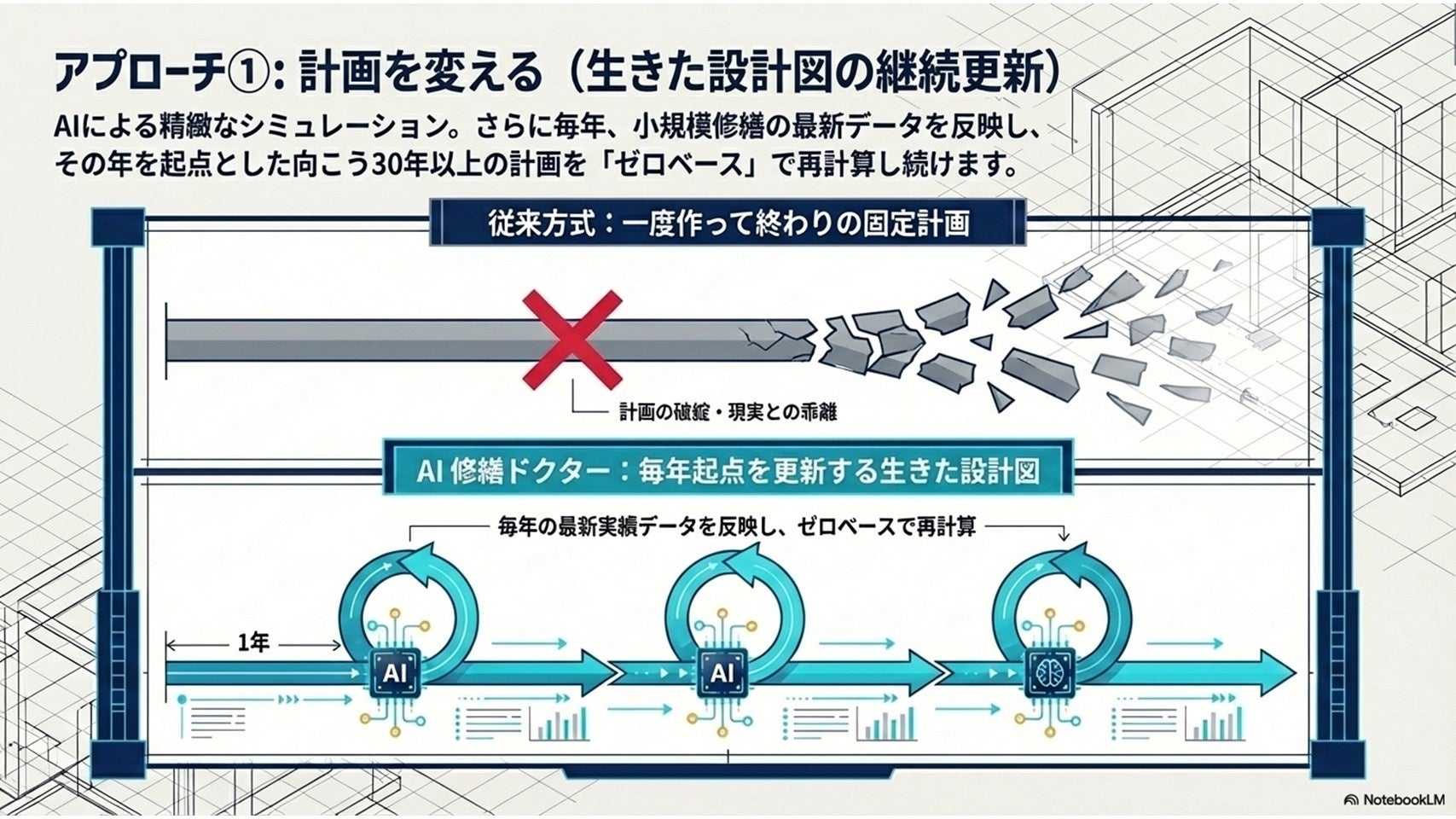
The plan is not a one-time creation. Each year, actual repair results and the latest construction cost data are reflected, and a long-term repair plan of 30 years or more is recalculated from scratch, with that year as the new starting point. This ensures that the plan does not deviate from reality, always maintaining a "latest and accurate future forecast," providing a living blueprint.
The durability period of high-durability materials strictly adheres to the test results and scientific evidence officially published by manufacturers. We do not determine durability periods independently.
[Approach ②] Changing Construction - Accumulation of Efficient Inspections and Small-Scale Repairs
We shift the concept from "fixing everything at once with large-scale repairs" to "fixing only necessary parts when needed." By combining technologies such as drones + infrared, rope access, and repair rail methods, "distributed repairs" without scaffold costs become possible, achieving a large-scale repair cycle of 18 years or more in combination with high-durability materials.
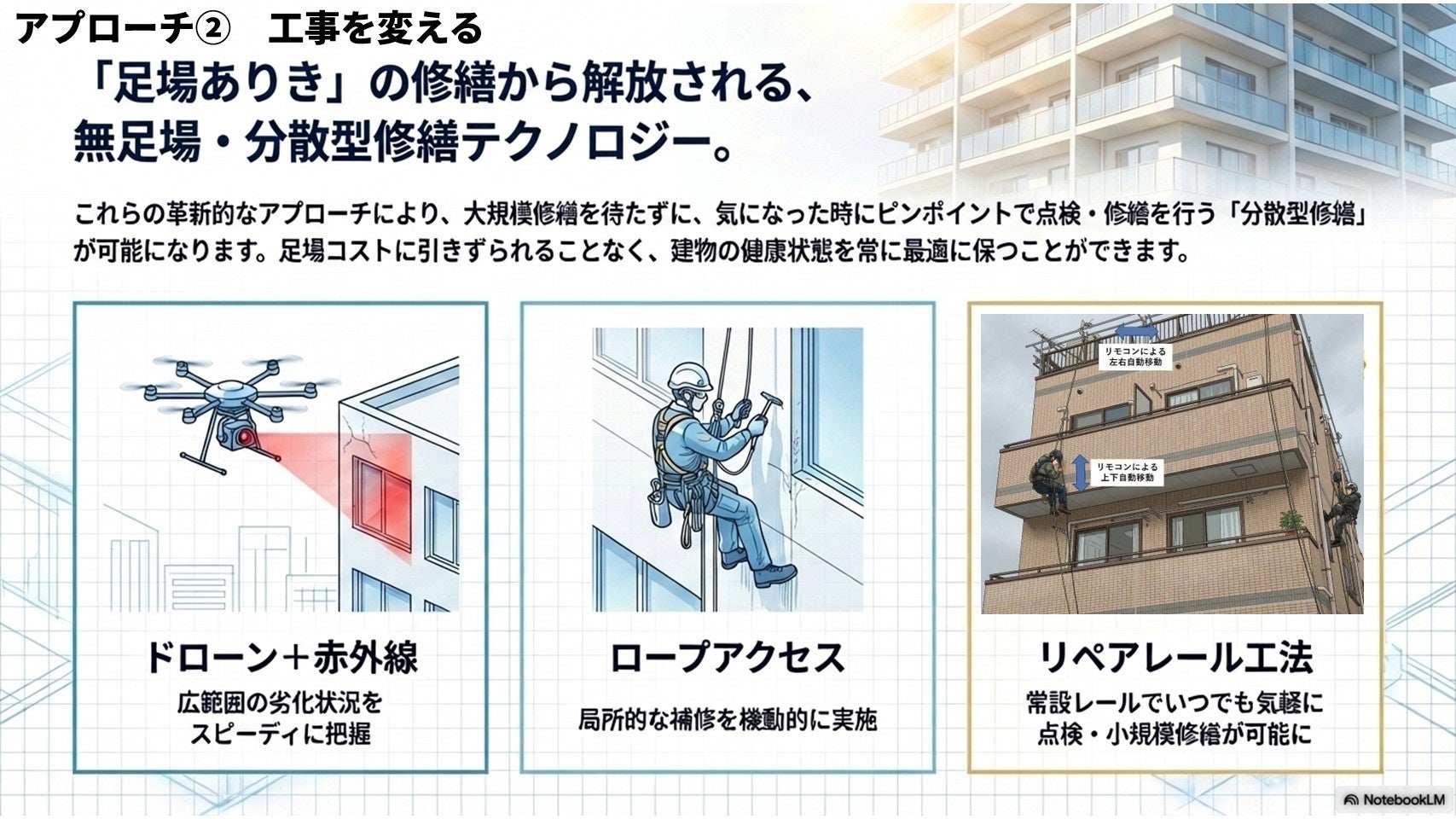
The highest risk to human safety, tile spalling, is managed with top priority. For this, there is no need to erect huge scaffolds around the entire condominium. Balconies and corridor sides often do not require scaffolds, and the areas that actually need checking are limited to gable walls and elevator walls.
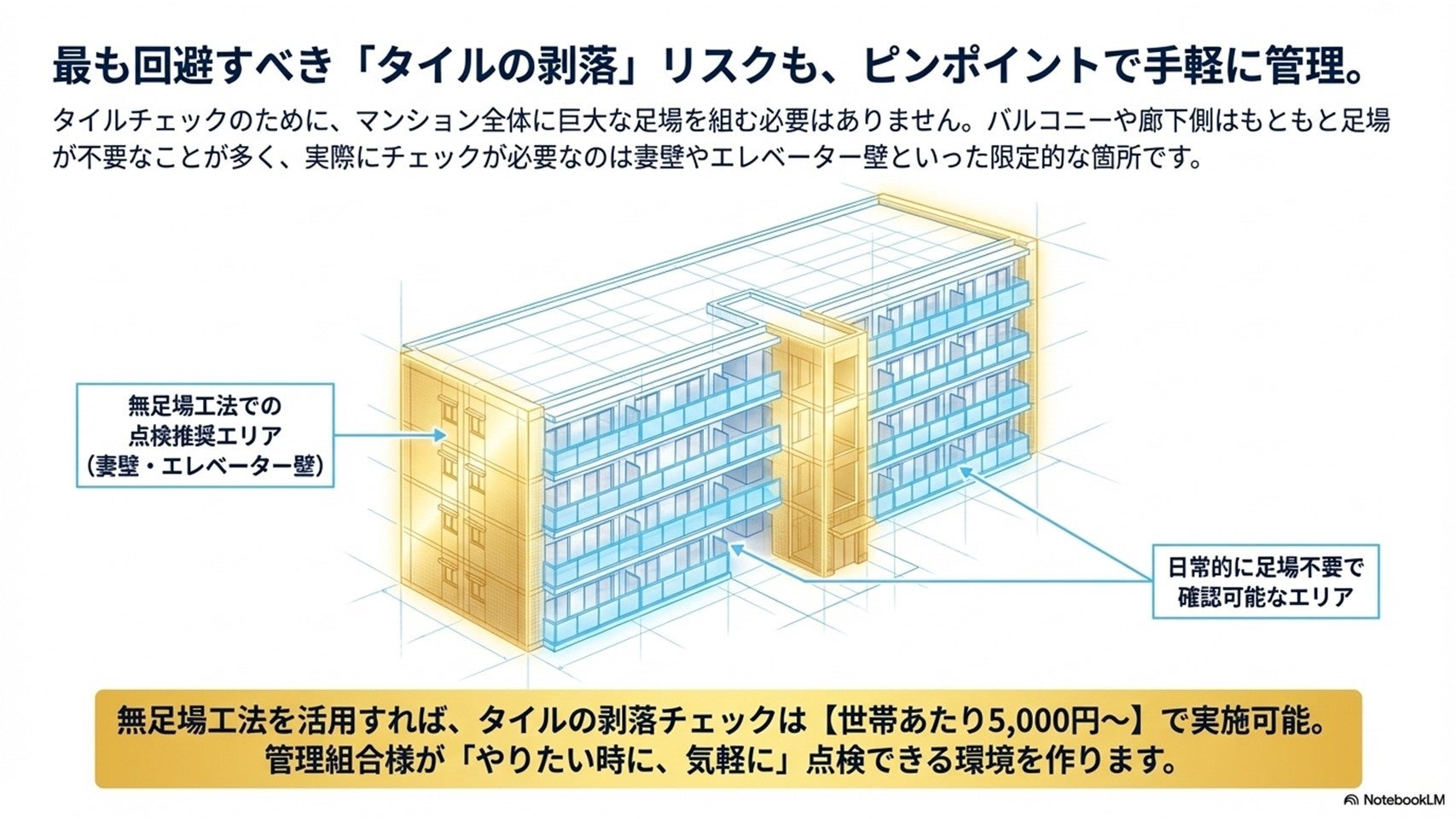
Utilizing scaffold-free construction methods, tile spalling checks can be performed for as little as 5,000 yen per household. We create an environment where management associations can inspect "easily, whenever they want."
[Approach ③] Changing Contractor Selection - Complete Separation of Design and Contractor Selection
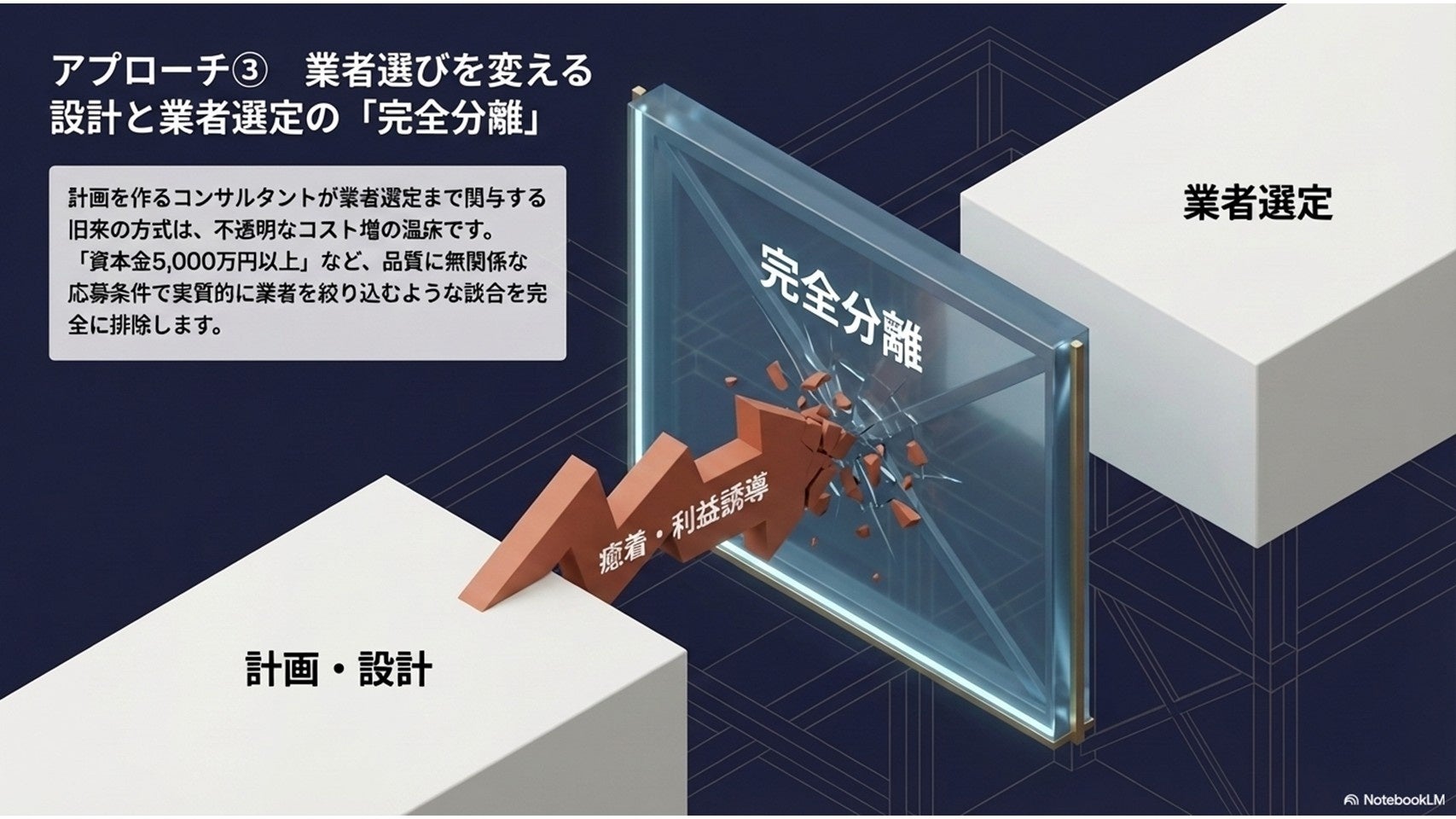
The conventional method, where consultants who create plans are also involved in contractor selection, is a hotbed for opaque cost increases. With AI Repair Doctor, companies responsible for different types of repair work are clearly separated.
FAQ
What kind of service is AI Repair Doctor?
It is a service that optimizes long-term repair plans for condominiums using AI, eliminating excessive construction and bid-rigging, thereby resolving the shortage of repair reserve funds.
Why does Haikan Hozen Center oversee the entire repair plan?
Through pipe maintenance experience, we realized that a breakdown in financial planning (long-term repair plan) makes even pipe maintenance difficult, so we aim for a fundamental solution.
What are the costs for introducing the service?
The initial fee starts from 150,000 yen, and the annual fee starts from 30,000 yen. Please contact us for details.