Approximately 60,000 Tokyo Metropolitan Government Employees Begin Utilizing Generative AI "A1"
The Tokyo Metropolitan Government has launched the full-scale operation of its generative AI platform "A1" for approximately 60,000 metropolitan government employees, aiming to improve the quality of citizen services and enhance operational productivity. This platform, which has been undergoing trial operation since September last year, is a common base that allows employees to flexibly develop and use AI applications for their work. The developed AI applications can be shared within the organization and are expected to become "digital public goods" reusable by other local governments.
📋 Article Processing Timeline
- 📰 Published: April 10, 2026 at 02:00
- 🔍 Collected: April 10, 2026 at 09:01 (7h 1m after Published)
- 🤖 AI Analyzed: April 16, 2026 at 01:32 (136h 30m after Collected)
The Tokyo Metropolitan Government is actively promoting the use of AI in all aspects of metropolitan administration, from citizen services to internal operations, based on the Tokyo AI Strategy.
Since September last year, we have been conducting trial operations of a "generative AI platform" that serves as a common base, allowing employees to flexibly develop and use AI applications for their work to improve operational productivity.
We are pleased to announce that we have now established usage rules and other environmental settings, decided on the name "A1" (pronounced "Eiichi"), and commenced full-scale operation for approximately 60,000 metropolitan government employees.
Moving forward, we will continue to thoroughly utilize AI to improve the quality of citizen services and operational productivity, increase the disposable time of citizens and businesses, and further enhance the quality of life (QOL) for Tokyo residents.
Generative AI Platform "A1" (Eiichi)*
Overview
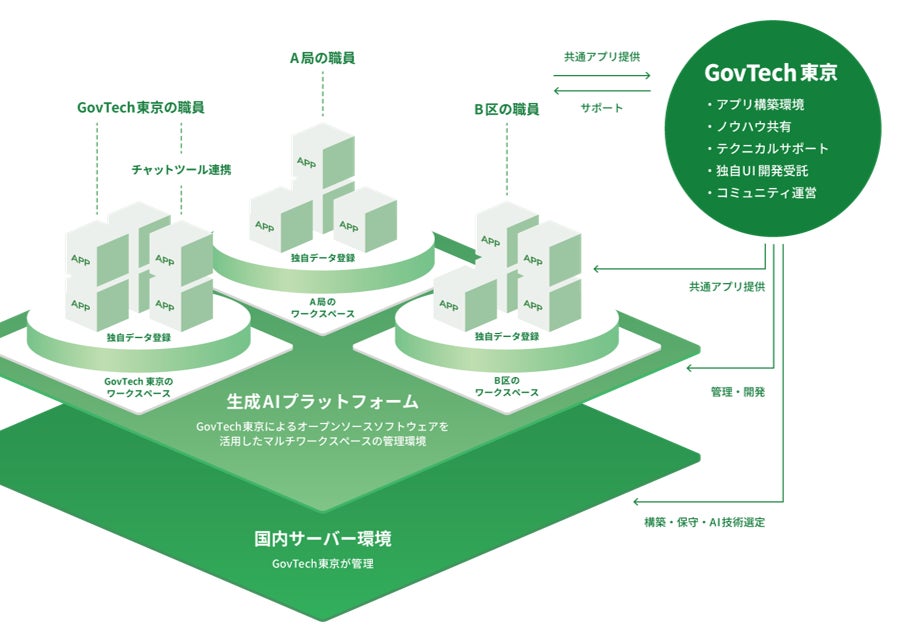
GovTech Tokyo, in collaboration with the Tokyo Metropolitan Government's Digital Services Bureau, has internally developed and built the generative AI platform "A1" (Eiichi) as a common base that allows employees to easily create applications utilizing generative AI.
This platform aims to improve administrative operational productivity and the quality of citizen services by providing an environment where employees can quickly develop and utilize AI applications tailored to their business challenges.
Furthermore, the developed AI applications can be shared within the organization and are reusable by other local governments, making them expected to become "digital public goods" that spread across municipalities.
*Name of the generative AI platform "A1" (pronounced: Eiichi)
Named with the aim of becoming the foundation for creating AI applications and transforming operational productivity and citizen services, just as Eiichi Shibusawa laid the foundation for modern industry.
Specific Examples of Utilization
Through the generative AI platform "A1," various useful applications can be developed without code. The following are examples of applications that are being commonly used within the agency:
An application that supports the creation of draft specifications for contracts
An application that supports key points to address when introducing and utilizing AI
An application that supports work related to deliberation based on Tokyo Metropolitan Assembly minutes, etc.
(Reference) Tokyo AI Strategy
The "Tokyo AI Strategy" was formulated to thoroughly utilize AI to improve the "quality of citizen services" and "operational productivity," outlining basic ideas and directions for initiatives when dealing with AI.
For details, please refer to the Digital Services Bureau website.
FAQ
What is the generative AI platform "A1"?
It is a common platform developed by the Tokyo Metropolitan Government that allows metropolitan government employees to easily create and use applications utilizing generative AI. It aims to improve operational productivity and the quality of citizen services.
When and for whom did the full-scale operation of "A1" begin?
Full-scale operation began for approximately 60,000 metropolitan government employees after the usage rules and other environmental settings were established. The specific start date is not explicitly stated in the text, but trial operations had been ongoing since September last year.