FRONTEO and Keio University School of Medicine Acquire Two Patents for Conversational AI Program Supporting Depression Diagnosis
FRONTEO Inc. and Keio University School of Medicine have jointly developed and patented two conversational AI programs designed to assist in the diagnosis of depression. These programs analyze approximately 10 minutes of free conversation between patients and healthcare professionals to provide objective diagnostic support, aiming to improve early detection and treatment access for depression patients.
📋 Article Processing Timeline
- 📰 Published: March 31, 2026 at 18:00
- 🔍 Collected: April 1, 2026 at 13:39 (19h 39m after Published)
- 🤖 AI Analyzed: April 17, 2026 at 08:30 (378h 51m after Collected)
FRONTEO Inc. (Headquarters: Minato-ku, Tokyo; President and CEO: Masahiro Morimoto; hereinafter "FRONTEO") and a group led by Professor Taishiro Kishimoto (Center for Medical Science Research Collaboration Promotion) of Keio University School of Medicine (Location: Shinjuku-ku, Tokyo) are pleased to announce that they have acquired two patents for a conversational AI program jointly developed by both parties, aimed at supporting the diagnosis of depression. This conversational AI program analyzes approximately 10 minutes of free conversation between patients and healthcare professionals using AI, with the objectives of supporting diagnosis by doctors, establishing methods for early detection of diseases and symptoms, and securing objective evidence in diagnosis.
[Patent Overview]
Name of Invention: Depression Symptom Determination Device, Determination Model Generation Device, and Learning Data Generation Method
Patent Numbers: Patent No. 7807764, Patent No. 7807765
Registration Date: January 20, 2026
Depression is said to be a challenge due to the need for psychological evaluation in diagnosis, the high subjectivity of symptoms, and the possibility of delayed medical consultation due to social stigma, among other factors, leading to a large number of potential patients who have not yet sought medical attention. Therefore, in the diagnosis of depression, it is considered important to make a determination from two perspectives: ① the patient's "State" of actually suffering from depression, and ② the patient's "Trait" or predisposition to depression. FRONTEO and Keio University School of Medicine have now acquired patents for two conversational AI programs that respectively determine the "State" requiring early diagnosis and treatment, and the "Trait" that can help resolve delays in patients seeking medical attention.
The social implementation of this conversational AI program is expected to enable more objective diagnostic support even in medical institutions that do not specialize in neuropsychiatric disorders. Furthermore, it can be utilized in a wide range of medical and healthcare fields, including remote medical settings where direct consultation with a doctor is not possible, examinations by industrial physicians, health checkup facilities, and brain docks. We believe this will contribute to lowering the barrier for potential patients who have not yet sought medical attention, and respond to the diverse social needs surrounding depression.
[Current Situation Surrounding Depression]
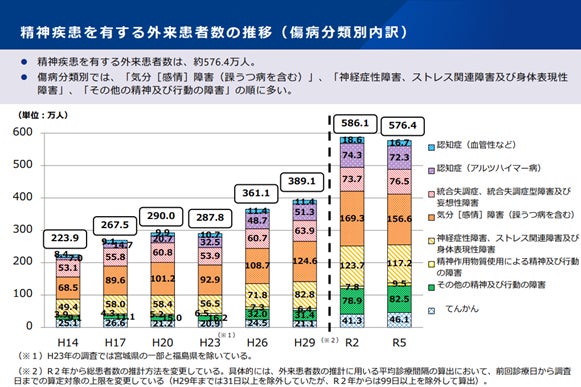
According to the Ministry of Health, Labour and Welfare, approximately one in 15 Japanese people*1 experience depression in their lifetime, and the number of outpatients visiting medical institutions for "mood [affective] disorders," including depression, was approximately 1.566 million*2 as of 2023, making it the most common mental illness.
On the other hand, according to the World Mental Health Survey*3 Japan Survey, only 42.9% of depression patients visit medical institutions (of which 28.6% visit psychiatrists and 21.4% visit general practitioners), suggesting that more than half*4 of patients with medical needs are not adequately connected to medical care, and that depression is a disease with a large "treatment gap."
Early detection and early treatment of depression are urgent issues for society as a whole.
Through the social implementation of this conversational AI program, FRONTEO aims to contribute to improving medical access for depression patients, support doctors in optimal diagnosis and judgment, and reduce the burden on both patients and healthcare professionals. By doing so, we will promote early detection and early treatment of depression and contribute to solving the important social issue of neuropsychiatric disorders.
*1 Ministry of Health, Labour and Welfare: Depression - Learning about mental illness, Let's take care of our minds, https://www.mhlw.go.jp/kokoro/youth/stress/know/know_01.html
*2 Ministry of Health, Labour and Welfare: 4th Study Group on Future Policy Promotion for Mental Health and Medical Welfare, Reference Material 4 Current Status of Mental Health and Medical Welfare, https://www.mhlw.go.jp/content/11121000/001374464.pdf
*3 An epidemiological survey conducted in approximately 30 countries worldwide, primarily by the WHO (World Health Organization) and Harvard Medical School in the United States, regarding the frequency of mental disorders, related factors, medical consultation behavior, and impact on social life.
*4 Ministry of Health, Labour and Welfare: Large-scale epidemiological research on the prevalence of mental disorders: World Mental Health Japan Survey Second, FY2013 General and Sub-research Report, https://mhlw-grants.niph.go.jp/system/files/download_pdf/2013/201317070A.pdf
Special Notes
This research and development was supported by the Japan Agency for Medical Research and Development (AMED) Advanced Medical Devices and Systems Technology Development Project "Development of a device that provides real-time objective evaluation of mental symptoms from quantification of facial expressions, voice, and daily life activities" (Research Representative: Taishiro Kishimoto).