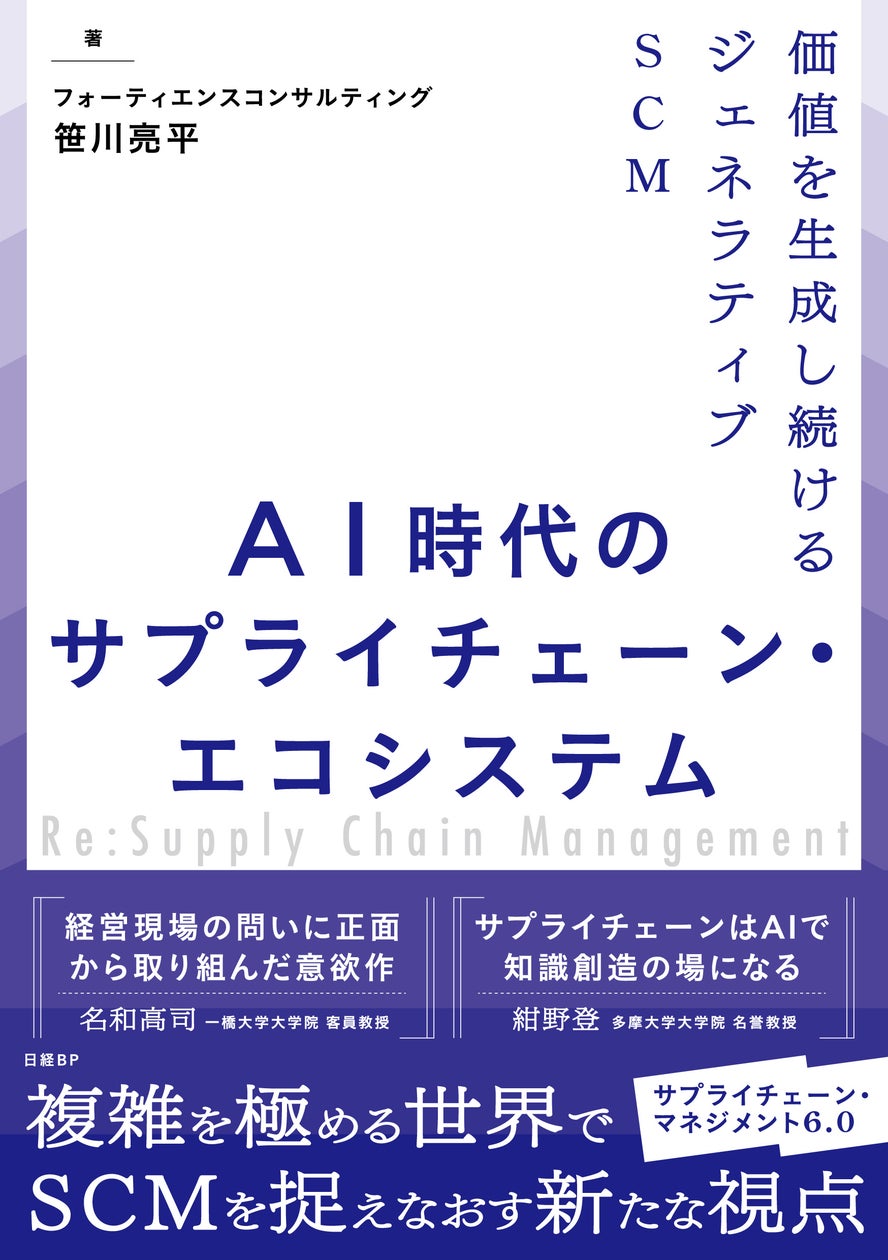
Fortience Consulting Co., Ltd. (formerly KUNIE Corporation, headquarters: Chiyoda-ku, Tokyo; President and CEO: Shigeki Yamaguchi; hereinafter referred to as Fortience) has launched a new book titled 'Supply Chain Ecosystem in the AI Era' (published by Nikkei BP), authored by Ryohei Sasagawa, Executive Officer of the company, on July 3, 2026.
This book proposes Generative SCM (SCM6.0), a transformative approach to supply chain management (SCM) that shifts the focus from 'reduction' to 'value generation,' supported by theoretical frameworks and case studies from Japan and abroad.
Drawing on the author’s over 25 years of practical experience leading SCM transformations, ERP/SCP implementations, and the development of inter-enterprise SCM platforms connecting over 100 companies, the book systematically outlines a new direction for SCM innovation in the AI era.
Additionally, Fortience will host a related seminar titled 'Generative SCM: What Should Supply Chain Management Look Like in the AI Era?' on August 3, 2026 (free, prior registration required). The seminar will feature discussions with Takashi Nawa (Kyoto University of Advanced Science / Hitotsubashi Business School), Tetsuya Tajima (i-PRO Corporation), Yuji Yamada (Rei3 Corporation), Shin Hamada (Google Cloud Japan LLC), and Atsunori Kanaya (Taylor Corporation), analyzing the future of enterprises and SCM from the perspectives of 'management,' 'business,' 'organization,' and 'technology.'
Background
In recent years, rapid advancements in generative AI and agent-based AI have raised high expectations for AI adoption in the SCM field. However, despite technological progress, AI use cases such as demand forecasting, inventory optimization, and production planning have remained largely unchanged for over 25 years.
Moreover, ongoing geopolitical risks continue to disrupt supply chains, making it increasingly difficult to predict all potential risks in advance. As a result, traditional centralized SCM models—where a single department controls the entire supply chain—are reaching their limits. Moving forward, it will be crucial to build ecosystem-type SCM models that leverage technologies like A2A (Agent to Agent), enabling multiple companies to collaborate and co-evolve, thereby enhancing 'antifragility'—the ability to turn environmental changes and disruptions into strengths.
This book offers insights for a wide range of readers, from executives to mid-level leaders driving change on the ground, as well as SCM, DX, and IT departments, guiding them toward the realization of 'Generative SCM'—a model that continuously generates new value amid change.
Key Points of the Book
Shifting SCM from 'Reduction' to 'Value Generation': The book advocates a transition from traditional SCM, which primarily aims to reduce inventory and costs, to 'Generative SCM'—a model that continuously creates new value even in times of change.
The Five Driving Principles of Transformation: '5-AIs': Utilizing Fortience Consulting’s proprietary transformation framework, the Value Structure Re-exploration Model™, the book shifts the focus from 'how to use AI' to 'which SCM assumptions should be changed alongside AI.' It systematizes action principles across five dimensions—purpose, people and organization, AI utilization, strategy, and learning—to ensure continuous SCM evolution.
Redesigning the SCM Foundation with AI as a Given: Transitioning from centralized models to 'A2A-type' systems, where multiple AI agents autonomously collaborate. The book introduces a mechanism based on the Digital SECI Model (Note) to transfer human tacit knowledge to AI, thereby expanding its application scope.
Conditions for 'Co-evolution' Revealed by Pioneering Cases: By analyzing leading domestic and international cases such as Haier and Fujifilm, the book identifies what is needed for companies to evolve together beyond individual optimization. It provides actionable insights readers can apply to their own SCM strategies.
A Platform to Bridge Learning and Practice: The SCM-focused media site 're:Question' (https://www.fortience.com/req/) will continuously publish content to deepen understanding and support practical implementation, including explanatory articles, infographics, checklists aligned with each chapter, and dialogue initiatives between the author and readers. At the end of each article, 'Questions for Inquiry' will prompt readers to reflect on their own operations, helping them connect insights from the book to their organizational challenges and drive real transformation.
Book Information
Overview
Title: Supply Chain Ecosystem in the AI Era: Generative SCM That Continuously Creates Value
Price: ¥2,700 + tax
ISBN: 978-4-296-21012-1
Release Date: July 6, 2026
Author: Ryohei Sasagawa (Fortience Consulting Co., Ltd.)
Publisher: Nikkei BP
Pages: 262
Format: A5
Supply Chain Ecosystem in the AI Era
Table of Contents
Part 1: re:Question – Re-examining the Premises Chapter 1: What Does AI Bring to SCM?
Chapter 2: What Structural Problems Hinder SCM Transformation?
Chapter 3: What Is Happening in the Current Supply Chain Environment?
Part 2: re:Quadrant – Reinterpreting with New Axes Chapter 4: Clues for Rethinking SCM
Chapter 5: A New Worldview of Supply Chains
Chapter 6: Re-editing SCM
Part 3: re:Quest – Toward a New Exploration Chapter 7: Appreciative Inquiry: How to Build Collaborative Relationships?
Chapter 8: Autonomous Innovation: What Systems Are Needed for Autonomy?
Chapter 9: Augmented Intelligence: How Should Humans and AI Collaborate?
Chapter 10: Adaptive Innovation: How to Continuously Create and Adapt to Change?
Chapter 11: Action Inquiry: What Questions Should We Ask to Keep Evolving?
Part 4: re:Quickening – Setting Sail Again Chapter 12: What Can We Learn from Pioneers’ Small Initiatives?
Chapter 13: How to Take the First Step Toward Generative SCM?
Appendix: re:Quickstart – A Guide to Starting Generative SCM
Author
Ryohei Sasagawa
Executive Officer, Fortience Consulting Co., Ltd.
With over 25 years of experience supporting SCM transformations, primarily in the manufacturing sector. Currently leads a team of approximately 80 SCM and business transformation consultants while also directly managing projects and driving innovation in consulting service delivery. Broadly involved in SCM planning—from strategy formulation to business design, implementation, and stabilization. Has led numerous projects, including global SCM reforms, ERP/SCP implementations, and SCM platform development, advancing transformation from both operational and digital perspectives. Author of 'Dynamic Supply Chain Management' and other works. Through 25 years of hands-on experience, he realized he had once been a mere executor of mechanical management, which led him to deeply reflect on what SCM should truly be to create value for enterprises.
Sales Channels
Nikkei BP: https://bookplus.nikkei.com/atcl/catalog/26/06/19/02671/
Amazon: https://www.amazon.co.jp/dp/4296210122/ref=nosim?tag=nkbookplus-22
Rakuten Books: https://books.rakuten.co.jp/rb/
FACT BOX
- Source: PR TIMES
- Category: New Product
- Products / services: SCM6.0