Why is 'Correct Eating' Difficult to Spread? — An Era Where Food Reflects Political Values
Key facts
- Why is 'Correct Eating' Difficult to Spread? — An Era Where Food Reflects Political Values
- A survey of 2,210 people by the Food Ethics Institute reveals that ethical food choices are strongly linked to liberal political views in Japan, while conservative views show resistance to norms like meat reduction. The study highlights the importance of communication strategies that minimize friction.
- Source: PR Times
- Date: April 2, 2026
Direct answer
A survey of 2,210 people by the Food Ethics Institute reveals that ethical food choices are strongly linked to liberal political views in Japan, while conservative views show resistance to norms like meat reduction. The study highlights the importance of communication strategies that minimize friction.
- Citation
- Why is 'Correct Eating' Difficult to Spread? — An Era Where Food Reflects Political Values (April 2, 2026), PR Times
- Source
- PR Times
- Date
- April 2, 2026
A survey of 2,210 people by the Food Ethics Institute reveals that ethical food choices are strongly linked to liberal political views in Japan, while conservative views show resistance to norms like meat reduction. The study highlights the importance of communication strategies that minimize friction.
📋 Article Processing Timeline
- 📰 Published: April 2, 2026 at 19:00
- 🤖 AI Analyzed: June 2, 2026 at 12:59 (1457h 59m after Published)
In Western democracies, with the rise of populism, political polarization has advanced, and the phenomenon where even food choices reflect values and political leanings has become evident.
This survey (2,210 respondents) conducted by Takuya Akiyama, a researcher deciphering food ethics and philosophy (trade name: Food Ethics Institute), confirmed a similar trend in Japan: ethical foods such as organic and plant-based options are strongly preferred by liberal segments, while conservative segments show resistance to norms like meat reduction.
Food is a device that visualizes values, and at the same time, it can be a source of friction. To spread ethical food, it is crucial to communicate and design in a way that minimizes friction, rather than simply presenting 'correctness.'
For detailed analysis, click here ⇒
Cross-tabulation of the survey, detailed analysis of free-form responses, and the social implications of the politicization of food can be found in the following article.
URL:https://foodethicsinstitute.com/qwejH12E/whatweeatspeakspolitics
In recent years, political polarization, symbolized by the rise of populism, has become severe in Western democracies. Values, lifestyles, and even daily consumption behaviors are linked to political stances, and this phenomenon is widely recognized as visualizing societal polarization.
This polarization extends not only to elections and policies but also to daily choices like "what to eat." Foods such as organic, plant-based, fair trade, and animal welfare are perceived as expressing attitudes towards the environment, ethics, and society, creating a situation where food functions as a signal of values.
Food is no longer just a matter of taste. Food is a lens that reflects societal polarization, and "what you eat is becoming a way to tell what you believe and who you are."
So, what about Japan?
Until now, Japan has been considered a society where political polarization is less evident than in Western countries. However, this survey confirmed that in Japan, too, a connection between food, values, and political leanings, i.e., signs of the "politicization of food," are beginning to emerge.
Key Survey Findings
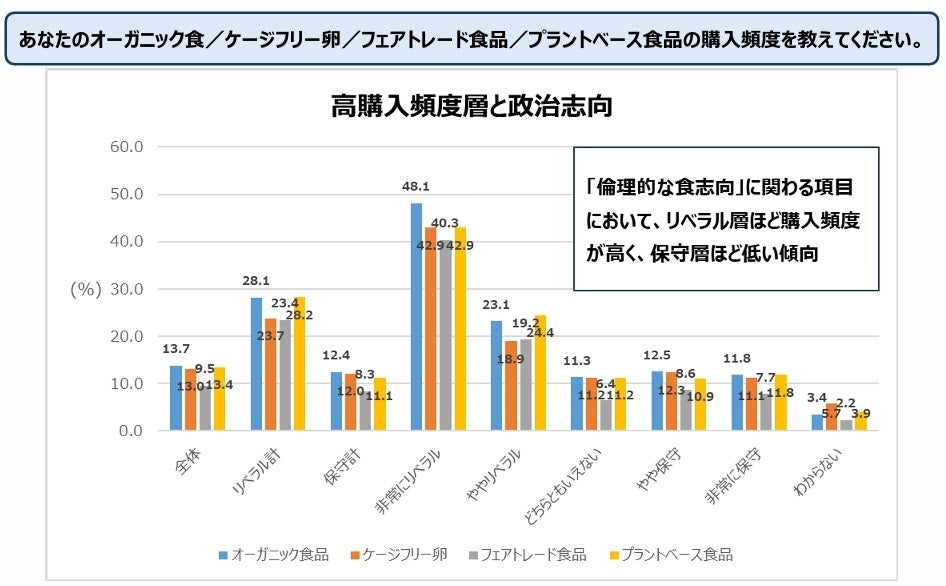
This survey confirmed that the more ethical the food, the more political leanings tend to be expressed.
In items related to "ethical food preferences" such as organic foods, cage-free eggs, fair trade foods, and plant-based foods, liberal segments showed a higher frequency of purchase, while conservative segments showed a lower frequency.
This suggests that food choices are not merely purchasing behavior but function as "value consumption."
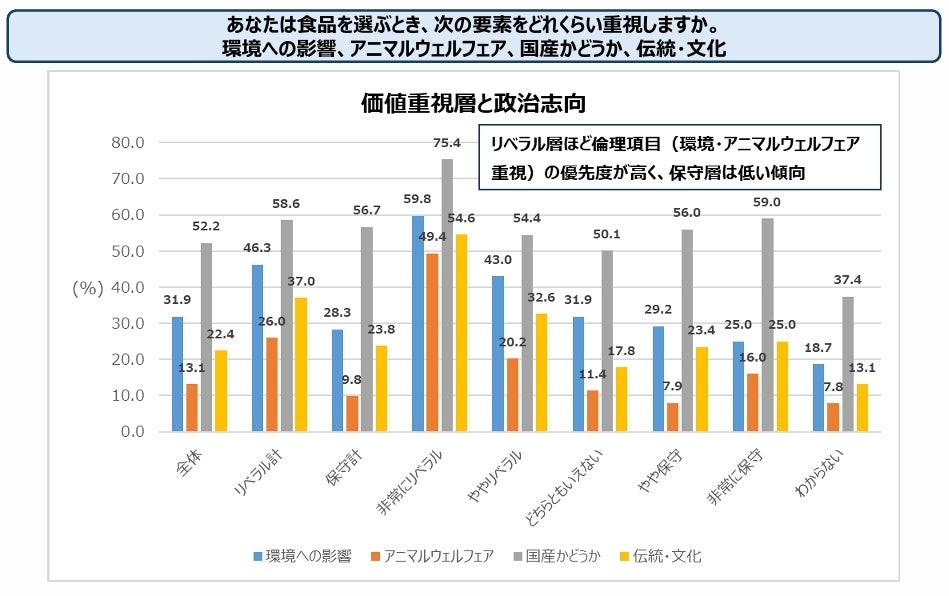
Differences were also observed in the criteria for food selection.
-
Liberal segments: High priority on ethical items (emphasizing environment and animal welfare)
-
Conservative segments: Low priority on ethical items
On the other hand, "preference for domestic products" showed little difference based on political leanings, confirming its potential as a widely shared value.
Conflict Structure Surrounding Norms
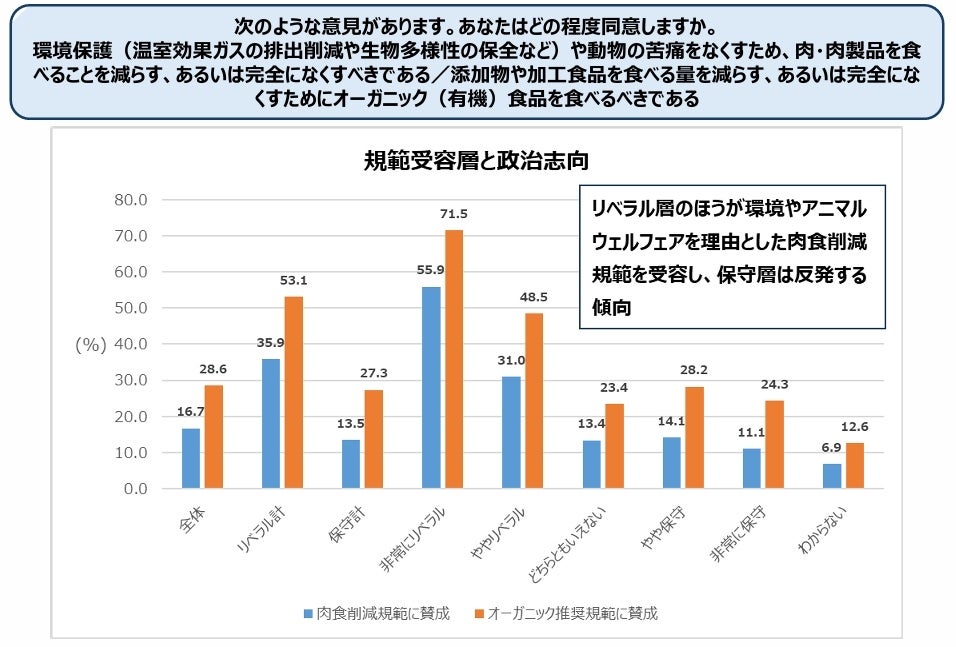
Particularly striking in this survey was the difference in attitudes towards the "normalization of food."
Regarding the norm of meat reduction for environmental and animal welfare reasons:
-
Liberal segments: Acceptance of the norm
-
Conservative segments: Resistance to the norm
This structure was observed.
However, overall, "judgment reserved (neither agree nor disagree)" was the majority, suggesting that Japan is still in an unpolarized state.
Essence Revealed from Free-Form Responses
Analysis of free-form responses yielded important insights.
What is causing backlash may not be food itself, but rather how ethical food is discussed.
Among responses opposing meat reduction, tendencies such as:
-
Rejection of imposition (should be left to individuals)
-
Resistance to normalization (discomfort with "should")
-
Distrust of communicators (distrust of ethical claims and those who make them)
were observed. This is a phenomenon that can be called "ethical friction." That is, the more "correctness" is advocated, the more it invites backlash.
On the other hand, for arguments promoting organic foods, the focus was on:
-
Barriers to practice (price, accessibility)
-
Partial agreement (acknowledging benefits but denying obligation)
and it was confirmed that the nature of the conflict is different.
Implications of This Survey
This survey indicates the following points:
To spread ethical food, communication that reduces friction is important.
The reason ethical food does not spread is not simply a lack of awareness.
The problem lies largely in the way it is discussed and designed, rather than the ideals themselves.
Therefore, what will be important going forward are approaches such as:
-
De-enlightenment approach (avoiding top-down narratives of correctness)
-
Partial transition (gradual change)
-
Friction minimization design (design that does not create conflict)
What is being questioned is not correct eating, but a transition with minimal friction.
Summary
Look at food, and you see society.
Food is increasingly becoming an entity that visualizes values, including political identity, beyond its function of supplying nutrients and calories.
And that change is also a "leading indicator" reflecting societal polarization.
Compared to Western societies, Japan is still in an unpolarized state.
That is why it is a stage where food changes can be designed without deepening conflict, and we are given the chance to consider how to achieve a transition with even less friction.
Survey Overview
-
Survey Name: Questionnaire on Japanese Eating Habits and Values
-
Survey Date: March 5, 2026
-
Number of Responses Analyzed: 2210
-
Survey Tool: Macromill, Inc. "Questant"
-
Implementing Body: Food Ethics Institute (Takuya Akiyama)
*Request for citation
When reprinting or citing this survey, please include a source like the following: (e.g., "Survey by Food Ethics Institute," "According to Food Ethics Institute")
*We welcome inquiries from media professionals for interviews, etc. Please feel free to contact us at the inquiry address listed in the sender information below.
Sender Information
Takuya Akiyama (Trade name: Food Ethics Institute)
Researcher deciphering food ethics and philosophy
[URL]https://foodethicsinstitute.com/
[Email Address] akiyamat@foodethicsinstitute.com
[Profile]https://yellowpage.tokyo/creators/category/takuyaakiyama
[Services Offered]
Research & Analysis:
-
Analysis of food ethics and values
-
Food trend research
-
Analysis of overseas policies and research
-
Market research for ethical food
Article & Column Writing:
-
Columns and essays on social issues related to food
-
Explanatory articles on food systems and food trends
-
Explanations and organization of specialized topics for a general audience
Survey Design:
-
Consumer awareness surveys
-
Food preference and value surveys
-
Analysis of food, politics, and values
Lectures & Seminars:
-
Food and ethics
-
Food, politics, and society
-
Philosophical background of food trends
FAQ
What exactly is the phenomenon of "politicization of food"?
It is a phenomenon where ethical food choices, such as organic or plant-based diets, are strongly linked to an individual's political leanings (liberal or conservative), making food a means of expressing values.
Why is a similar trend observed in Japan as in Western countries?
It is believed that the populism and political polarization advancing in Western countries, through global information flow, have influenced Japan, and value divisions have begun to appear in food choices.
What approaches are effective in promoting ethical food?
Instead of imposing "correctness," it is important to use communication methods and designs that minimize friction. De-enlightenment approaches and partial transitions that encourage gradual change are considered effective.