Ideal Star Rating for Reviews is "4.0 or Higher," but About Half Consider Visiting with "3.5 or Higher" [Survey on Review Utilization]
A survey by FINEXT reveals that while an ideal star rating for reviews is 4.0 or higher, about half of consumers consider visiting a store with a rating of 3.5 or higher. The trust threshold for reviews is "10 or more," and freshness is "within 3 months."
📋 Article Processing Timeline
- 📰 Published: April 2, 2026 at 19:00
FINEXT Co., Ltd. (Headquarters: Fujimino City, Saitama Prefecture, https://finext.co.jp/), which supports Web marketing for small and medium-sized enterprises based in Fujimino City, Saitama Prefecture, conducted a "Survey on Review Utilization" targeting 329 men and women aged 20-60 nationwide who have referred to reviews when choosing stores or services.
This survey was conducted to clarify, as primary information, how star ratings, number of reviews, and freshness of reviews influence consumers' decisions to visit.
The results revealed that while the most common minimum star rating considered for use was "4.0 or higher" (28.3%), nearly half (47.4%) of respondents would consider visiting even with a rating of 3.5 to 3.9.
Furthermore, the trust threshold for the number of reviews was "10 or more," and for freshness, it was "within 3 months," suggesting that the presence or absence of a mechanism to continuously collect reviews leads to differences in customer attraction.
■ Survey Overview
Survey Period: March 11 (Wed) - March 16 (Tue), 2026
Target Audience: Men and women aged 20-60 nationwide who have referred to reviews when choosing stores or services
Valid Responses: 329 (121 males / 208 females)
Age Breakdown: 20s: 68 / 30s: 124 / 40s: 81 / 50s: 44 / 60s: 12
Survey Method: Internet survey
*Percentages for multiple-choice questions are calculated based on the number of valid respondents.
*Data is rounded to the first decimal place, so the total may not always be 100%.
■ Summary of Survey Results
・The most used platform for collecting reviews is Google Maps (76.6%), followed by Tabelog (64.1%), with e-commerce sites like Amazon and Rakuten also ranking high.
・When viewing reviews, the most important factor is "overall star rating" (76.9%), followed by "review content" (74.2%) and "number of reviews" (61.7%).
・The most common minimum star rating considered for use is "4.0 or higher" (28.3%), but nearly half (47.4%) would consider visiting even with a rating of "3.5 to 3.9."
・The threshold for the number of reviews is most commonly "10-19 reviews" (21.3%), with a total of about 70% trusting 10 or more reviews.
・The freshness of reviews is most commonly "within 3 months" (30.1%), with over half (56.2%) emphasizing reviews within 1 month or 3 months.
・Over 60% have "posted reviews," indicating a growing awareness among consumers about posting reviews.
・The biggest motivation for posting reviews is "when experiencing something exceptionally good" (62.2%), suggesting that experience design influences reviews.
・The top 3 reasons for not posting reviews are "no habit of writing" (56.3%), "takes effort/time" (41.4%), and "privacy concerns" (33.6%), all of which are barriers that can be resolved through mechanisms.
■ Request for Citation
When citing the survey results, please state "Citation: FINEXT Co., Ltd.『Survey on Review Utilization』" and link as follows:
・Link https://finext.co.jp/ to FINEXT Co., Ltd.
・Link https://media.finext.co.jp/meo_investigation02-review-measures/ to Survey on Review Utilization.
Google Maps is the undisputed top platform for review collection at 76.6%.
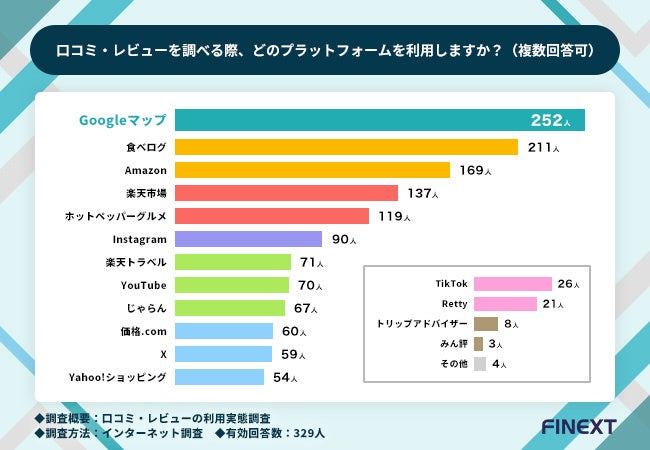
When asked, "Which platforms do you use when looking for reviews? (multiple answers allowed)," the most common response was 'Google Maps' with 252 people (76.6%). This was followed by 'Tabelog' with 211 people (64.1%), 'Amazon' with 169 people (51.4%), and 'Rakuten Ichiba' with 137 people (41.6%).
Indeed, more than three out of four people search for reviews on Google Maps. This indicates that for all physical stores, including restaurants, retail, and service industries, Google Maps review management is an unavoidable customer acquisition strategy.
It is also noteworthy that 'Tabelog' (64.1%), 'Amazon' (51.4%), and 'Rakuten Ichiba' (41.6%) ranked high after Google Maps.
In particular, cases of referring to reviews on e-commerce sites like Amazon and Rakuten Ichiba are prominent. It is presumed that consumers widely check reviews on e-commerce sites before purchasing products, not only when buying online but also to decide on purchases.
"Overall Star Rating" is the most important factor in reviews; number and freshness also directly impact customer acquisition.
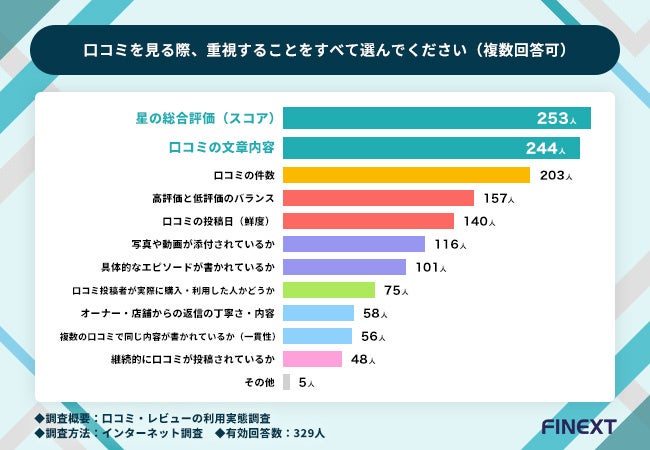
When asked, "Please select all factors you consider important when viewing reviews (multiple answers allowed)," the most common response was 'Overall star rating (score)' with 253 people (76.9%). This was followed by 'Review content' with 244 people (74.2%) and 'Number of reviews' with 203 people (61.7%).
The overall star rating seems to be the most important quantitative information, as it can be judged at a glance. However, the content of reviews (74.2%) and the number of reviews (61.7%) are also highly valued, indicating that it's not simply a matter of having high stars.
Businesses with physical stores should focus not only on increasing star ratings but also on collecting a certain number of reviews and high-quality review content.
Furthermore, it is noteworthy that "Review date (freshness)" was emphasized by 42.6%, or about 40%. This also revealed the reality that it becomes difficult to maintain trust if only old reviews are accumulated.
The most common star rating considered for use is "4.0 or higher," while nearly half consider visiting with "3.5 to 3.9."
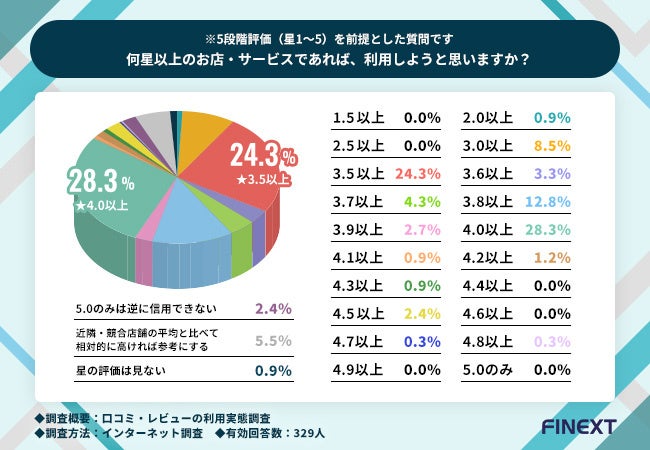
In the previous question, it was found that 'Overall star rating (score)' (76.9%) is the most important factor in review evaluation. So, what star rating would actually make people want to use a store or service?
When asked, "What star rating would make you consider using a store or service?" the most common response was '4.0 or higher' at 28.3%. This highlights the reality that high ratings are demanded.
However, it is important not to overlook the total percentage of respondents who would consider visiting with a rating in the "3.5 to 3.9" range.
When combining "3.5 or higher" to "3.9 or higher," the total reaches 47.4%, indicating that nearly half of users would consider visiting even with a rating of 3.5 to 3.9.
Of course, "4.0 or higher" remains the most frequent answer. However, even stores currently rated 3.5 to 3.9 have the potential to reach a considerable number of users.
From these results, it can be said that a realistic MEO strategy is to aim for over 4.0 while first maintaining a level of 3.5 or higher and improving the quantity and quality of reviews.
The trust threshold for the number of reviews is "10-19 reviews"; at least 10 reviews are essential.
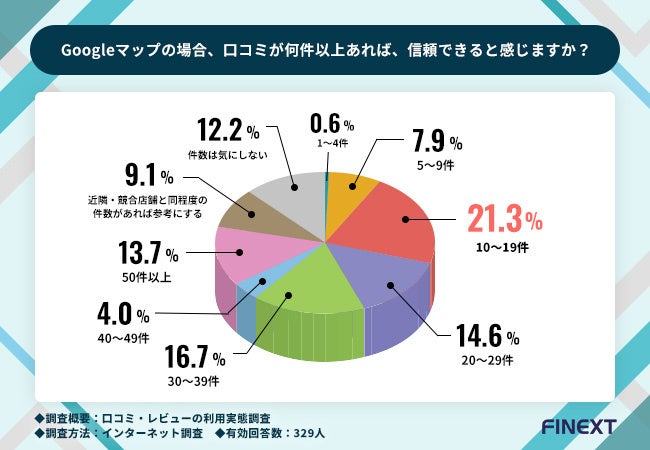
In the previous question, 'Number of reviews' (61.7%) was the third most important factor in review evaluation. So, how many reviews are needed for a business to be trusted?
When asked, "In the case of Google Maps, how many reviews would make you feel a business is trustworthy?" '10-19 reviews' was the most common answer at 21.3%. This was followed by '30-39 reviews' (16.7%) and '20-29 reviews' (14.6%).
The total for answers of 10 or more reviews (10-19 reviews, 20-29 reviews, 30-39 reviews, 40-49 reviews, 50 or more reviews) reached 70.3%, indicating that about 70% of users consider "10 or more reviews" as the minimum threshold for trust.
Conversely, if there are only 1-9 reviews, the business is unlikely to be perceived as "trustworthy" by the majority of users. For MEO measures, it is essential to set a goal of acquiring at least 10 reviews on Google Maps.
"Within 3 months" is the most common freshness for reviews; a system for continuous review collection may be necessary.
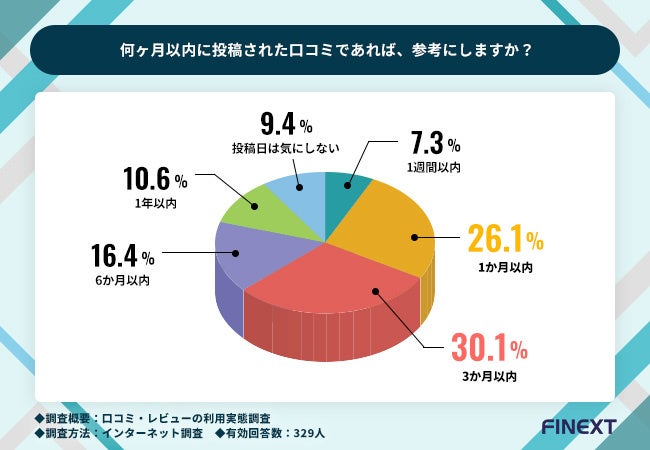
In the previous question, it was found that the freshness of reviews tends to be somewhat important. So, within what period should reviews be posted to be most useful?
When asked, "Within how many months of posting would you refer to a review?" the most common answer was 'Within 3 months' at 30.1%. This was followed by 'Within 1 month' (26.1%) and 'Within 6 months' (16.4%).
Combining 'Within 1 month' (26.1%) and 'Within 3 months' (30.1%) totals 56.2%, revealing that over half of users refer to "reviews within 3 months."
From this result, it is clear that creating a mechanism for continuously posting reviews within 3 months is important.
Even if a store has received many reviews in the past, if new reviews stop coming in, it may become difficult to maintain user trust. It can be said that creating a system to continuously collect reviews, rather than one-off campaigns, is essential for long-term customer acquisition.
Over 60% have "posted reviews," indicating a growing awareness of reviews.
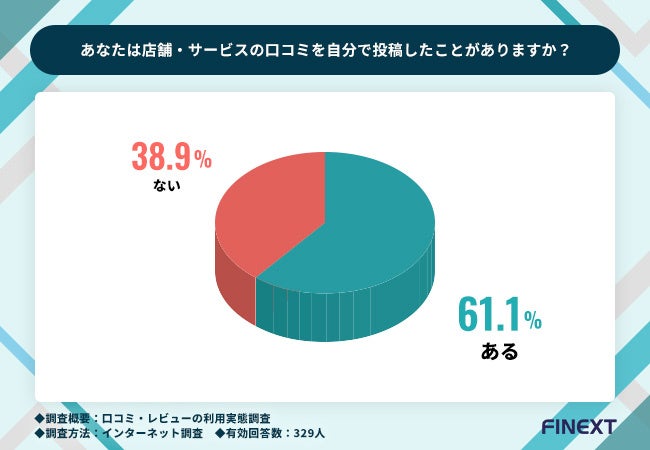
When asked, "Have you ever posted a review for a store or service yourself?" the result was 'Yes' at 61.1% and 'No' at 38.9%.
Over 60% have experience posting reviews, indicating that review posting has become somewhat established among consumers.
The biggest motivation for posting reviews is "when experiencing something exceptionally good"; good experiences generate reviews.
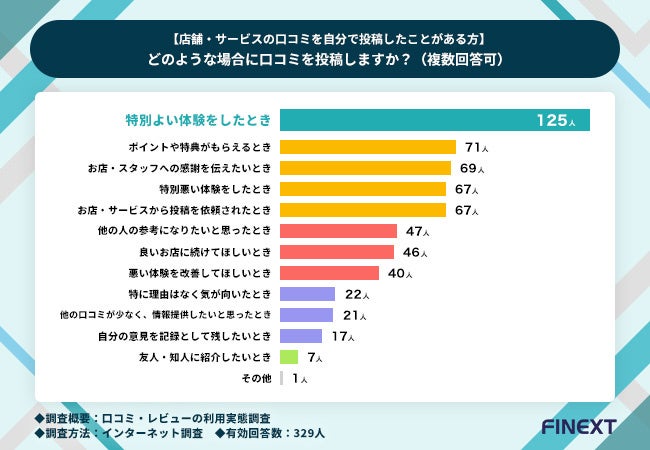
The biggest motivation for posting reviews is "when experiencing something exceptionally good" (62.2%), suggesting that experience design influences reviews.
FAQ
What is the ideal star rating for reviews?
Ideally 4.0 or higher, but about half of consumers consider visiting with 3.5 or higher.
How many reviews are considered trustworthy?
About 70% of consumers consider 10 or more reviews as the minimum threshold for trust.
How fresh should reviews be to be considered important?
Over half of consumers refer to reviews posted within 3 months.