The Key to Restoring Japanese Corporate Competitiveness: Practical Job-Based AI Utilization - Released on business video media PIVOT on April 6th
Job-Us Inc., provider of the job-based AI 'Job-Us,' has released an explanatory video on the business video media 'PIVOT.' The video addresses the challenges of superficial job-based employment systems and presents AI-driven solutions, aiming to restore the competitiveness of Japanese companies.
📋 Article Processing Timeline
- 📰 Published: April 7, 2026 at 01:00
- 🔍 Collected: April 6, 2026 at 16:30
- 🤖 AI Analyzed: April 21, 2026 at 00:41 (344h 10m after Collected)
Job-Us Inc. (Headquarters: Minato-ku, Tokyo; CEO: Taichi Mabuchi), provider of the job-based AI 'Job-Us,' has released an explanatory video on the business video media 'PIVOT' program '& TALK,' which was streamed on Monday, April 6, 2026. The video discusses the personnel challenges facing Japanese companies and the potential of 'job-based AI'.
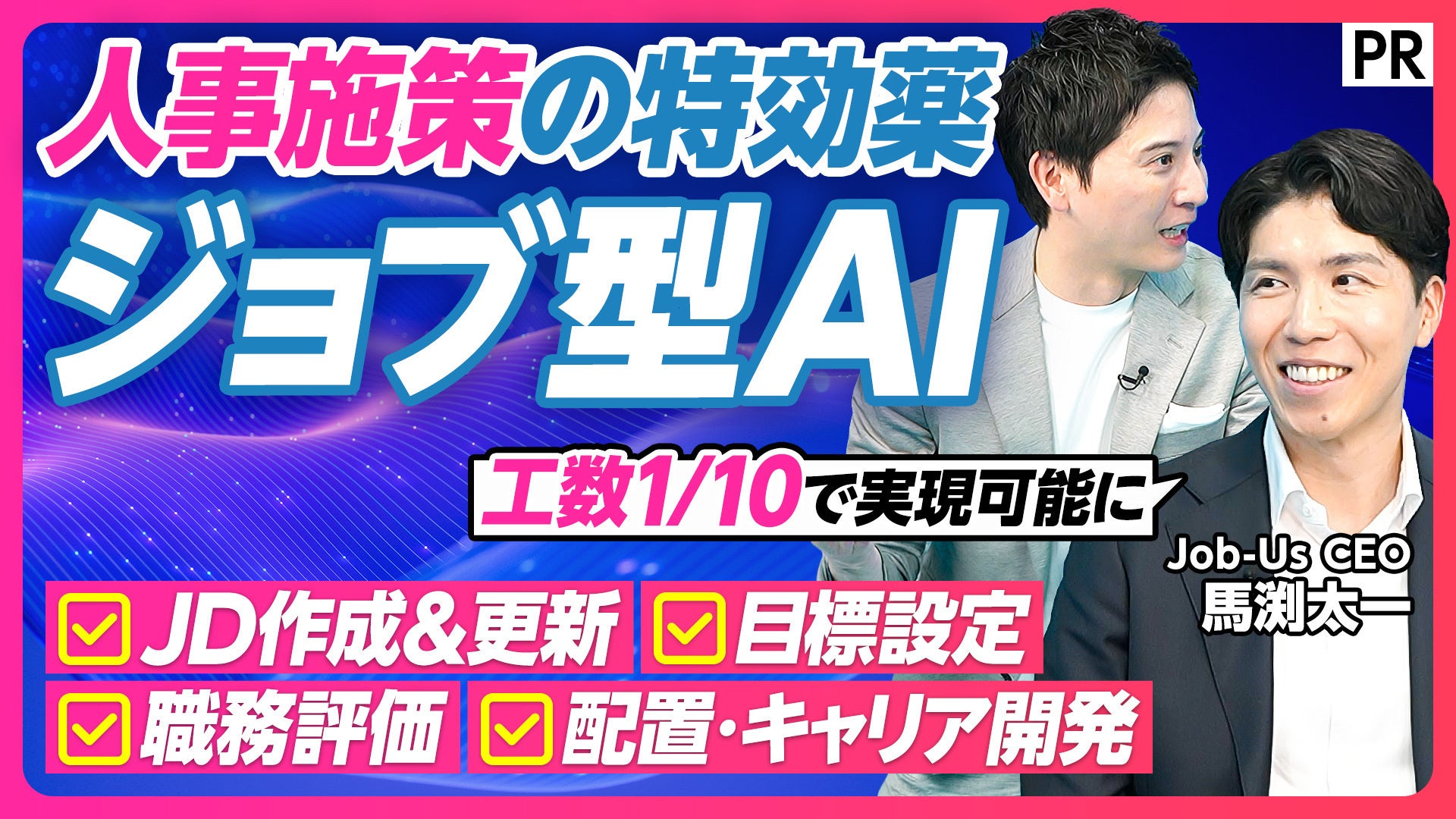
Our CEO, Taichi Mabuchi, appears in this video, explaining the current situation in many Japanese companies where 'job-based systems have been introduced but their operation has become a mere formality (job-based in name only).' He also discusses the importance of 'living job descriptions (JDs)' as a solution, complete with a demonstration.
In conjunction with the video's release, we will be holding a special campaign and an explanatory webinar where participants can actually experience the 'job-based AI' functions introduced in the video.
◾️Program Overview
-
Program Name: PIVOT & TALK
-
Release Date: April 6, 2026 (Monday) 16:00
-
Theme: Part 1|Why companies fall into 'job-based in name only' / Part 2|The mechanism of 'job-based AI' that prevents formalization / Part 3|The future of Japan opened up by job-based HR
-
Video URL: https://youtu.be/nZ-TMWH5IkM
Key Points of This Video
-
Part 1: Why do many Japanese companies fall into a 'job-based in name only' situation?
-
This part explains the current situation where many companies are promoting the introduction of job-based HR but are hitting a wall in the operational phase. It delves into how the root causes—the 'quality issue' (JDs becoming mere task lists or person-dependent) and the 'freshness issue' (JDs being left un-updated)—lead to the system becoming a formality.
-
-
Part 2: The mechanism of job-based AI to prevent formalization and realize 'living JDs'
-
This part introduces how the job-based AI 'Job-Us' breaks through these walls, including an actual demo screen. It explains the function where AI checks and suggests improvements for JD content and the mechanism for detecting JDs that need updating. Furthermore, it covers methods for linking JDs to specific HR measures such as goal setting, job evaluation, and optimal talent placement (visualizing skill gaps), and shares a success story of a large company that prepared and operated over 500 JDs with just two HR staff members.
-
-
Part 3: The 'Fair and Proactive Society' unlocked by job-based HR
-
Job-based HR, which was difficult to operate with manpower alone, becomes feasible with the use of AI technology. This part discusses the future vision of how the social implementation of job-based systems—such as moving away from seniority, promoting career autonomy for each employee, and realizing appropriate wage increases—will lead to the recovery of Japanese corporate competitiveness and the construction of a 'fair and proactive society'.
-
FAQ
What is the job-based AI 'Job-Us'?
It is a system that uses AI to manage the quality and freshness of job descriptions (JDs) and prevent the formalization of job-based HR practices. It supports the entire process from assisting in the creation of JDs to linking with HR initiatives.
Why is job-based AI needed now?
Many Japanese companies have introduced job-based systems, but the updating of JDs has not kept up, leading to formalization. AI can reduce this operational burden and ensure the system functions as intended.
What are the benefits of implementing 'Job-Us'?
It can significantly reduce the workload of HR personnel while maintaining high-quality JDs. This leads to better talent placement, fair evaluations, and promotion of employee career autonomy.