Survey on English Proficiency Among Working Professionals: 60% Have Experienced Difficulties; Shift Toward 'Conversation' x 'Situation' Based Learning
ECC conducted a survey on English proficiency among working professionals, revealing that over 60% face difficulties due to language barriers and are seeking practical, situational learning methods.
📋 Article Processing Timeline
- 📰 Published: March 28, 2026 at 16:41
- 🔍 Collected: March 28, 2026 at 21:59 (5h 17m after Published)
- 🤖 AI Analyzed: April 15, 2026 at 07:41 (417h 41m after Collected)
ECC Co., Ltd. (Headquarters: Kita-ku, Osaka; President: Masahiro Hanafusa; hereinafter 'ECC'), a comprehensive education and lifelong learning institution, conducted a 'Survey on English Proficiency Among Working Professionals' targeting 600 individuals: 300 general employees in their 20s and 30s (including chiefs and section leaders) and 300 managers in their 40s to 60s (section manager level and above).
The results show that across all generations, there is a common trend of feeling that a lack of English proficiency hinders work performance and a desire to study if supported by the company. However, differences in the specific situations where they struggle were observed between generations. Furthermore, both generations ranked practical learning methods, such as 'talking with instructors' and 'role-playing based on actual work scenarios,' as the most effective ways to learn.
<Survey Overview>
Target Audience:
・300 general employees (including chiefs and section leaders) aged 20–39 who wish to improve their English for work.
・300 managers (section manager level and above) aged 40–65 who wish to improve their English for work.
Survey Organizer: ECC Co., Ltd.
Survey Method: Internet survey
Survey Period: February 20, 2026 – March 2, 2026
Valid Responses: 600 (300 general employees, 300 managers)
<Summary of Results>
▼ Over 60% have experienced work-related difficulties due to a lack of English proficiency. General employees struggle most with 'inability to speak,' while managers struggle with 'inability to understand or convey information.'
▼ Among the four English skills (listening, speaking, reading, writing), 'speaking' is the weakest for both groups (41.0% for general employees, 38.7% for managers).
▼ The top condition for being able to study is 'securing study time during working hours' (40.7% for both groups). The top three conditions are all related to institutional support from the company.
▼ Time available for English study is 'almost zero' for 31.3% of general employees and 32.7% of managers, highlighting a gap between motivation and action.
▼ Effective learning methods: 'Talking with instructors' was the top choice for managers (50.3%), while 'role-playing' was the top choice for general employees (49.7%). Practical learning methods dominate the top rankings.
<Survey Results>
【Q1】 Over 60% have 'experienced difficulties' due to lack of English proficiency; high levels across all generations.
When asked if they have experienced work-related difficulties due to a lack of English proficiency, 61.0% of general employees (20.3% 'frequently,' 40.7% 'sometimes') and 63.3% of managers (18.0% 'frequently,' 45.3% 'sometimes') responded in the affirmative. This indicates that a majority in both groups feel their English skills are a challenge.
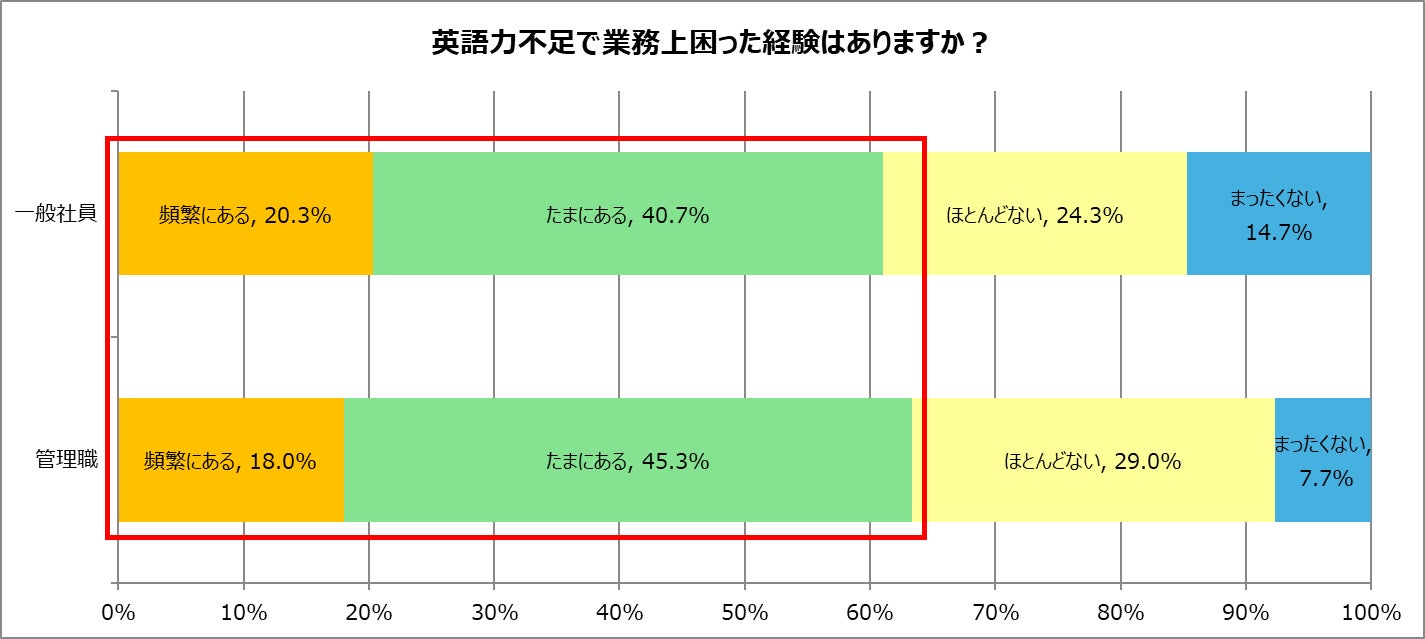
Furthermore, when the 183 general employees and 190 managers who answered 'frequently' or 'sometimes' were asked about specific situations where they struggled, differences between generations emerged.
General employees focused on 'inability to speak.' Many expressed frustration at being able to understand English but being unable to produce it, citing issues like 'words didn't come out immediately,' 'could listen but couldn't respond in English,' and 'feeling anxious because it took too long to start speaking.'