Direava Inc. has been engaged in the "Development of a Vision-Language Integrated AI Foundation Model for Surgical Support" (hereinafter referred to as "this project") as part of the "GENIAC (Generative AI Accelerator Challenge)" project, conducted by NEDO and the Ministry of Economy, Trade and Industry to strengthen generative AI development capabilities. We have now developed Japan's first surgeon-specific generative AI (Surgical VLM) that understands and interacts with surgical situations in real-time.
Conventional generative AI used in the surgical field has been limited to image recognition (eyes) to assist in identifying patient organs and affected areas. The surgeon-specific generative AI developed this time is a groundbreaking system that understands "what to do next" from the surgical situation like a "surgeon's brain" and engages in advanced dialogue with surgeons.
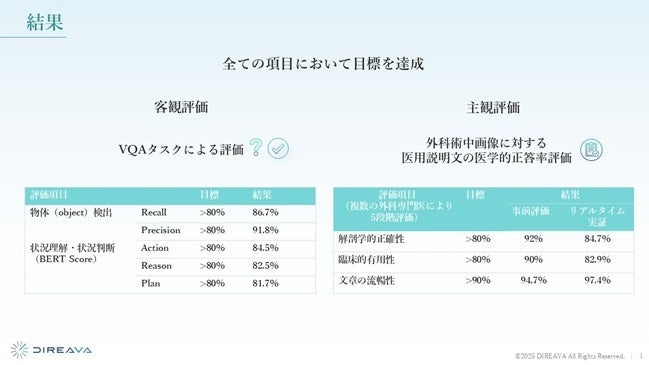
A demonstration test was conducted on February 20, 2026, during a gastric cancer surgery at Keio University Hospital. Its usefulness was confirmed by meeting the demanding standards of medical education (anatomical accuracy, clinical utility, and fluency of text).
Currently, fostering young talent who can inherit advanced medical techniques is a challenge in the medical field. Direava will now begin full-scale preparations for commercialization (service launch) within 2026 and will proceed with demonstrations beyond gastric cancer surgery. This will strongly support the training of surgeons and advanced surgical education, contributing to future improvements in medical quality and safety. 1. Background Since FY2024, NEDO, in collaboration with the Ministry of Economy, Trade and Industry, has been promoting the GENIAC project to accelerate R&D and support for generative AI. GENIAC supports the development of various domain-specific foundation models from general-purpose foundation models, and as of the end of March 2026, a total of 53 companies are developing generative AI foundation models.
Direava, which has achieved the results presented here, is one of these companies and is a medical startup originating from Keio University School of Medicine. The company has been developing medical AI and systems using it, including obtaining manufacturing and sales approval for the AI-equipped programmed medical device "Surgical Image Recognition Program KINOSURA"※1 from the Minister of Health, Labour and Welfare on December 9, 2025.
The company was selected for GENIAC in July 2025 and, based on its proprietary foundation model, developed the "Surgical VLM," Japan's first※2 surgeon-specific generative AI with unprecedented functions, by training it on a large dataset of intraoperative images and natural language captions. The results were then demonstrated in an actual surgical setting. In evaluating the developed AI, in cooperation with Keio University Hospital, items considered important for the training of surgeons, as well as accurate grasp of surgical situations, were established.
Evaluation Items and Performance of the Developed Surgeon-Specific Generative AI
2. Achievements in This Project (1) Development of Generative AI with a "Brain" that Understands Surgical Context To date, the application of generative AI in the surgical field has focused on "anatomical recognition (= eye function)" which identifies patient organs, blood vessels, etc., through image recognition. However, the ability to understand complex surgical procedures and the condition of the affected area in response to recognized information, and to infer and converse about "what to do next" and "what to be cautious about" (i.e., "advanced situation understanding" = "brain function") has not been implemented, posing a significant challenge for such AI. Against this backdrop, Direava has been working to address this challenge in the medical education field.
FACT BOX
- Source: PR TIMES
- Category: News