Heart Failure Narratives Released in Video, Audio, and Text
Certified NPO Health and Illness Narratives DIPEx Japan has launched its 12th project, "Narratives of Heart Failure," featuring over 150 accounts from 33 heart failure patients and 3 family members. These experiences, covering the condition, treatment, and life impacts, are available in video, audio, and text formats to serve as a resource for patients, families, and healthcare professionals.
📋 Article Processing Timeline
- 📰 Published: March 31, 2026 at 22:50
- 🔍 Collected: April 1, 2026 at 13:39 (14h 49m after Published)
- 🤖 AI Analyzed: April 16, 2026 at 23:25 (369h 46m after Collected)
Certified NPO Health and Illness Narratives DIPEx Japan (Chairman: Takeo Nakayama, Secretariat: Chuo City, Tokyo) has recently released its 12th project, "Narratives of Heart Failure." https://www.dipex-j.org/heart-failure/
Heart failure is a condition where heart function gradually declines due to various causes. As it progresses, symptoms such as shortness of breath and swelling occur, impeding daily life.
"Narratives of Heart Failure" features personal experiences shared through interviews by 33 individuals suffering from heart failure (13 women, 20 men) aged 20s to 90s, and 3 family members aged 50s to 60s. (Several topics are currently under preparation).
The content includes over 150 narratives in the form of interview videos, audio, and text from the individuals. These are categorized into three narrative themes: "What is Heart Failure," "Treatment," and "Life," and are divided into 12 topics. "What is Heart Failure" begins with an explanation of the condition by Dr. Mitsuru Koshijima, a cardiologist, followed by narratives on "Symptom Onset," "Heart Failure and Stress," and "Causes of Heart Failure (under preparation)." "Treatment" includes narratives on "Pharmacotherapy," "Pacemakers," "Catheter Treatment (under preparation)," "Experiences in the ICU (Intensive Care Unit)," and "Interaction with Healthcare Professionals." "Life," which has a particularly large number of items, covers a wide range of topics such as "Diet and Fluid Intake/Activity," "Relationship with Work (Onset of heart disease during work, Return to work, Changes in approach to work, Disclosure and consultation about illness, Workplace relationships, Resignation/Job change)," "Economic Impact (Cost of treatment, Reduced income due to job change, Little impact from work, Financial burden)," "Utilization of Public Systems and Social Resources (Systems supporting medical expenses, Systems supporting living expenses, Disability certificate)," and "Marriage/Childbirth."
■ From the Narratives of Interviewees
◇ While on a business trip, I had severe chest pain from a bad cold, and after seeing a doctor upon returning home, I was immediately hospitalized. I hadn't experienced any symptoms that seemed unusual before that. (Heart failure, myocardial infarction, diabetes - 50s, male)
◇ Heart disease is not visible. After treatment for myocardial infarction, I returned to work, but I can say "I'm tired," so I try not to do today what can be done tomorrow. (Myocardial infarction - 50s, male)
◇ I feel a dilemma that taking medication allows me to live a healthy life, but taking medication means I am sick. (Mitral valve insufficiency, congestive heart failure - 60s, male)
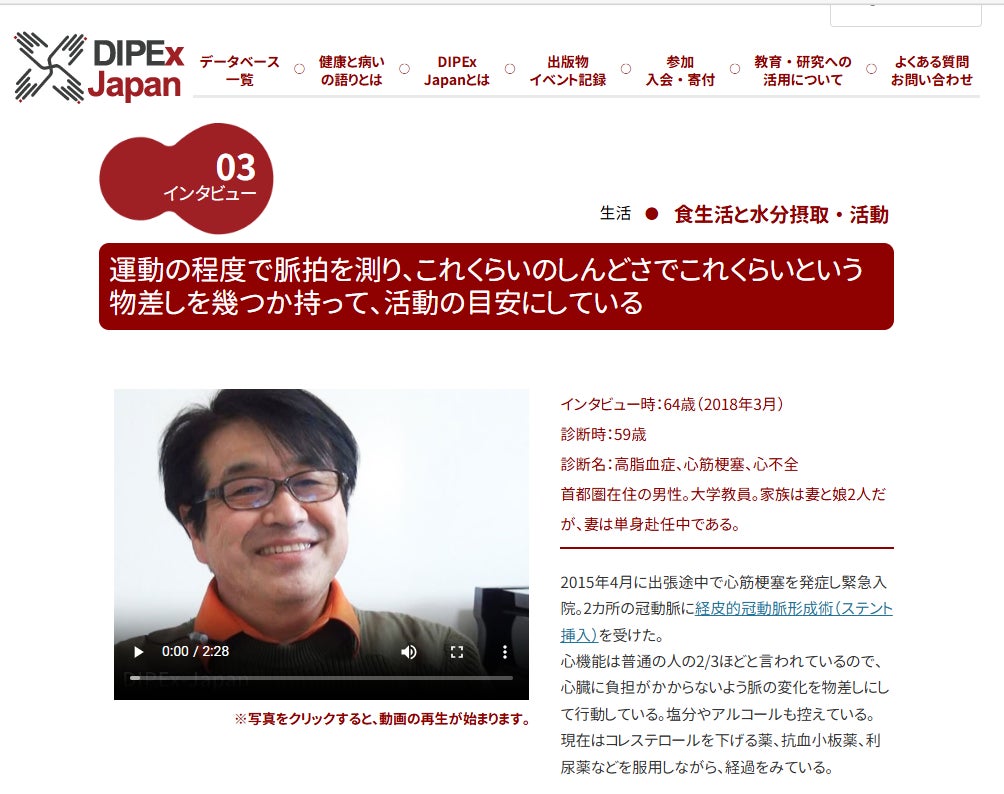
◇ I measure my pulse based on the level of exercise and use several benchmarks, like "this much exertion for this much intensity," as a guide for my activities. One benchmark isn't enough; I have about three for myself. (Myocardial infarction - 50s, male)
◇ In the ICU, I could hear the loud cries of a baby trying to live through the curtain. I thought I had to try hard too. (Infective endocarditis, mitral valve insufficiency, post-valve repair, cardiac tamponade - 40s, female)
◇ I had an ICD (implantable cardioverter-defibrillator) implanted to provide an immediate electrical shock when ventricular fibrillation occurs. It activated once in 8 years, and at that time, it hit me with a "bang" strong enough to blow off my glasses. (Acute myocardial infarction, ventricular fibrillation - 70s, male)
◇ After the surgery, my heart condition didn't change significantly, so I underwent fertility treatment and was able to have a child. However, during pregnancy, bacteria attached to my mitral valve, causing regurgitation. I was told to decide within a few days whether to give up the baby, and considering the impact on those around me and my own body, I made a difficult decision. (Ventricular septal defect, aortic regurgitation, mitral regurgitation - 40s, female)
■ Thoughts from the Project Leader of "Narratives of Heart Failure" (Noriko Iba)
I encountered various narratives, from the elusive nature of heart failure and the bewilderment of treatments involving implanted "devices" like pacemakers, to the impact on daily life such as diet and work, and even crucial life decisions like marriage and childbirth. This project initially began as a partial subcontract for a research project evaluating the quality of end-of-life palliative care for cardiovascular diseases, involving interviews with four patients. However, driven by the desire to cherish the narratives of those four individuals, I obtained research funding with the cooperation of my long-time acquaintance, Tamami Taniguchi (then a professor at the University of Yamanashi), and the project started in 2018. After interruptions due to the COVID-19 pandemic and my own health issues, the cooperative structure within DIPEx was established, and the project is now almost publicly released, four years after the interviews concluded. I hope that "Narratives of Heart Failure" reaches patients, their families, and healthcare professionals, allowing the experience of having a heart condition to be shared and to be of some help. *Kakenhi is an abbreviation for Grants-in-Aid for Scientific Research. It is a "competitive research fund" aimed at promoting all "academic research" across all fields, providing grants for original and pioneering research. (Japan Society for the Promotion of Science)
■ Project Members (◎ Leader and Co-Representative)
◎Noriko Iba, Tayese Asano, Natsumi Morita, Rika Sato (Sakuma) (DIPEx Japan)
Yoshinori Takada (Japanese Red Cross College of Nursing, Saitama Department of Nursing)
■ "Narratives of Heart Failure" Research Grants
1. FY2017-2018 AMED (Japan Agency for Medical Research and Development) "Construction of End-of-Life Palliative Care Quality Evaluation and Educational Program Based on High-Quality Objective Indicator Analysis (Prognostic Prediction Model) for Cardiovascular Disease Patients" (Research Representative: Dr. Atsushi Mizuno, Department of Cardiology, St. Luke's International Hospital, Project Number 18ek0210072h0003) commissioned project
2. FY2018-2022 Grants-in-Aid for Scientific Research (Grant-in-Aid for Scientific Research (C)) "Creation of Narrative Educational Materials Aimed at Improving the QOL of Heart Failure Patients and Their Families Through Patient Participation" (Research Representative: Noriko Iba, University of Yamanashi, JP18K10308)
【Certified Non-Profit Organization "Health and Illness Narratives DIPEx Japan"】
"There are things I want to convey because I experienced them, and things that only those who experienced them can tell."
Certified Non-Profit Organization "Health and Illness Narratives DIPEx Japan" was established in 2007 with the aim of building a Japanese version of the "Narratives of Health and Illness" database, modeled after DIPEx (Database of Individual Patient Experiences) developed at the University of Oxford, and utilizing it as a social resource. In 2009, it became an NPO and in the same year, independently released "Narratives of Breast Cancer." The organization provides free access to video, audio, and text information from over 12 conditions, including "Prostate Cancer," "Dementia," "Crohn's Disease," "Coronavirus," as well as common symptoms and concerns shared by patients and families facing illnesses or disabilities, and experiences with "Colorectal Cancer Screening" and "Clinical Trial Participation." (As of March 2026). The website receives an average of 75,000 monthly visitors (2024), with over 500 patient and family interviews recorded, and 10-20% of the total 1,000+ interview hours made public.