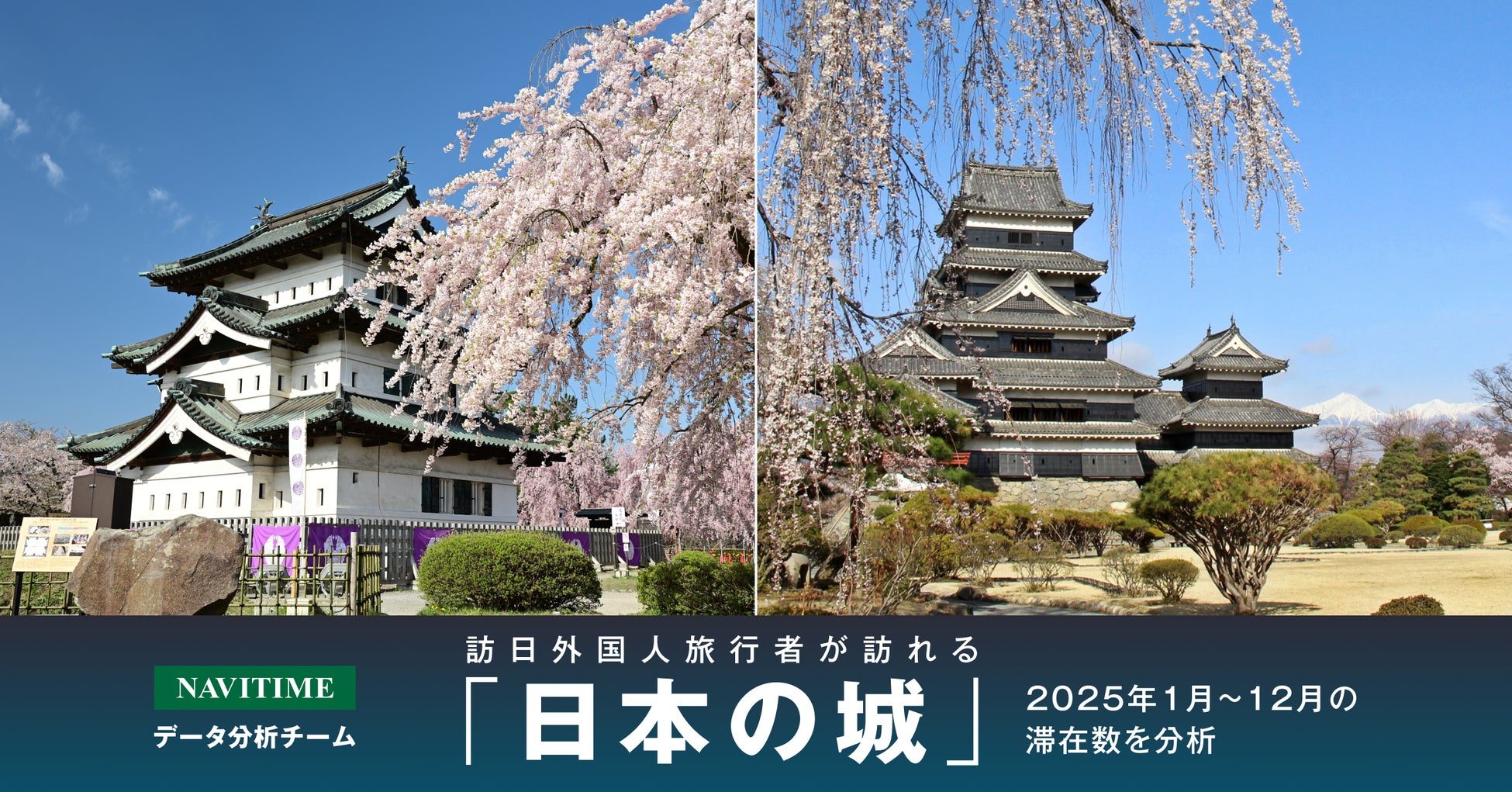
NAVITIME Japan (President and CEO: Keisuke Onishi, Headquarters: Minato-ku, Tokyo)'s NAVITIME Data Analysis Team announced the results of an analysis of popular "Japanese Castles" visited by foreign tourists throughout 2025, based on usage data from 'Japan Travel by NAVITIME', a navigation app for foreign tourists visiting Japan.
Japanese castles are of high interest to foreign tourists, consistently ranking high in the 'Destination Search Ranking for Foreign Tourists Visiting Japan' TOP30, which NAVITIME Japan announces annually. This time, we analyzed the stay status of travelers at "Japanese Castles" based on usage data from navigation apps for foreign tourists provided by NAVITIME Japan.
・Analysis of the number of stays at "Japanese Castles" visited by foreign tourists from January 2025 to December 2025 ・Popular rankings, stay duration analysis, and analysis of castles with market-specific trends in the Asian and European/American/Oceanian markets
Analysis Target: Data is aggregated using inbound GPS data and attribute questionnaires obtained with consent from navigation apps for foreign tourists provided by NAVITIME Japan ('Japan Travel by NAVITIME').
*The definition of "stay" is a state where positioning is continuously confirmed for 30 minutes or more within an area (polygon) demarcated on a map by NAVITIME Japan, based on its own research referencing the Japan Castle Foundation's "Japan's Top 100 Castles". *In this analysis, the Asian market primarily includes Taiwan, Thailand, Hong Kong, South Korea, and China, while the European/American/Oceanian market primarily includes the United States, Australia, and France.
Analysis Results Top 10 Popular Japanese Castles by Market for Foreign Tourists (Asia, Europe/America/Oceania)
Osaka Castle was the most popular castle in both the Asian and European/American/Oceanian markets. Nagoya Castle, Kumamoto Castle, Nijo Castle, Himeji Castle, and Edo Castle also commonly ranked in the top 10 for both markets.
Specific to the Asian market, Hirosaki Castle, Inuyama Castle, Okayama Castle, and Matsuyama Castle, which are relatively easy to access from regional airports with direct flights, ranked in the top 10. Specific to the European/American/Oceanian market, Kanazawa Castle, Hiroshima Castle, Matsumoto Castle, and Odawara Castle ranked in the top 10, likely due to their good accessibility along the "Golden Route" and "Three-Star Road" (a wide-area tourist route visiting Michelin three-star attractions such as Kanazawa, Shirakawa-go, Takayama, and Matsumoto). Comparing stay durations, a correlation was observed between stay duration and castle area in both the Asian and European/American/Oceanian markets. Generally, larger castles tend to have longer stay durations. Osaka Castle, which ranked first in both markets, is one of the castles with a long average stay duration. Exceptions include Edo Castle and Kanazawa Castle, which ranked only in the European/American/Oceanian market. For these castles, similar to Hiroshima Castle, which has a small area, over 70% of visitors had short stays of less than 60 minutes.
*The definition of "castle area" is an area (polygon) demarcated on a map by NAVITIME Japan, based on its own research referencing the Japan Castle Foundation's "Japan's Top 100 Castles".
Next, we will introduce the analysis results for Hirosaki Castle and Matsumoto Castle, which showed particularly distinctive trends among the castles that ranked in only one of the Asian or European/American/Oceanian markets.
6th Place in Asia: Hirosaki Castle (Hirosaki City, Aomori Prefecture)
Hirosaki Castle showed a remarkably high number of visitors in April. This is presumed to be due to many visitors coming to the castle, known as one of Japan's premier cherry blossom viewing spots, to coincide with the peak blooming season.
According to Hirosaki City, "In 2025, the proportion of foreign overnight guests in Hirosaki City is approximately 70% from Asia, 20% from Europe/America/Oceania, and 10% from other regions. Taiwanese guests account for 30% of the total. The number of overnight guests increases significantly in April, October, and November, likely due to the cherry blossom festival in April and the autumn leaves and apple harvesting experiences in October and November. Seasonal festivals and the nearby World Natural Heritage site 'Shirakami-Sanchi' also contribute to attracting visitors."
An analysis of the accommodation locations of Asian market travelers who visited Hirosaki Castle revealed that many stayed in cities with Shinkansen stations, such as Aomori City, Sendai City, Morioka City, Tokyo's 23 wards, and Hakodate City, with Aomori City being the center. Comparing the proportion of accommodation locations before and after the visit, Aomori City was the most common on the day before the visit, followed by Sendai City, Morioka City, and Tokyo's 23 wards, indicating a dispersed pattern, with over 50% staying within Aomori Prefecture. On the day of the visit, the proportion of stays in Aomori City and Hirosaki City (where the castle is located) increased compared to the previous day, with approximately 70% of stays within Aomori Prefecture. On the day after the visit, the proportion of stays within Aomori Prefecture decreased, while the proportion of stays in cities outside Aomori Prefecture, such as Sendai City, Tokyo's 23 wards, and Hakodate City, increased, suggesting a tendency for many people to move outside the prefecture after visiting Hirosaki Castle.
Hirosaki Castle (Hirosaki City, Aomori Prefecture)
9th Place in Europe/America/Oceania: Matsumoto Castle (Matsumoto City, Nagano Prefecture)
Matsumoto Castle showed a high number of visitors in April and November. This is presumed to be due to an increase in visitors during the sightseeing season, coinciding with the cherry blossom viewing in April and the peak autumn leaves in November.
According to the Matsumoto Castle Management Division, "Comparing the number of people from Asia and Europe/America/Oceania, the latter was about twice as many as the former. Comparing monthly throughout the year, April, May, October, and November showed a particular increase. Also, some people visit Kamikochi and Daio Wasabi Farm in Azumino City along with Matsumoto Castle."
An analysis of the accommodation locations of European/American/Oceanian market travelers who visited Matsumoto Castle revealed that Matsumoto City (where the castle is located) was central, followed by Tokyo's 23 wards, Nagano City, and on the next day, cities along the Three-Star Road such as Takayama City and Kanazawa City. Comparing the proportion of accommodation locations before and after the visit, Matsumoto City was the most common on both the day before and the day of the visit, followed by Tokyo's 23 wards and Nagano City. On the day of the visit, the proportion of stays in Matsumoto City significantly increased compared to the previous day, suggesting that many visitors use Matsumoto City as their main base on the day of their Matsumoto Castle visit. On the day after the visit, the proportion of stays in Matsumoto City decreased, while Tokyo's 23 wards became the most common, and the proportion of stays in new cities such as Takayama City and Kanazawa City increased. This suggests a tendency for travel to split into two directions: towards Tokyo and towards the Three-Star Road.
Matsumoto Castle (Matsumoto City, Nagano Prefecture)
NAVITIME Japan's NAVITIME Data Analysis Team hopes to contribute to the discovery of various attractions across Japan and the revitalization of local communities through behavioral data analysis that clarifies the dynamics of foreign tourists visiting Japan.
Top 10 Popular Japanese Castles by Market for Foreign Tourists (Asia)
<div
FACT BOX
- Source: PR TIMES
- Category: News