"Research Before Discarding" is the New Norm. | "Survey on Danshari"
60% of people who have experienced Danshari (decluttering) gather information beforehand, with younger generations tending to heavily utilize social media and AI.
📋 Article Processing Timeline
- 📰 Published: March 28, 2026 at 17:14
- 🔍 Collected: March 28, 2026 at 21:59 (4h 45m after Published)
- 🤖 AI Analyzed: April 15, 2026 at 08:57 (418h 58m after Collected)
Neo Marketing Inc. (Location: Shibuya-ku, Tokyo), which provides marketing support services, conducted an internet research survey on the theme of "Danshari" (decluttering) for two days, from March 3 (Tuesday) to March 4 (Wednesday), 2026, targeting men and women aged 20 and over nationwide who have experienced Danshari.
<Survey Background>
In recent years, in addition to rising prices and a reevaluation of living environments, the spread of flea market apps and buying services has diversified how consumers "acquire" and "let go" of possessions more than ever before. Danshari is becoming an action that reflects lifestyles and consumption awareness, not just by reducing items, but also by including how to decide whether to "discard," "sell," or "keep" them.
To capture these changes, this survey broadly questioned men and women aged 20 and over nationwide who have experienced Danshari, covering the frequency of Danshari, triggers, disposal categories, disposal methods, information gathering, reasons for giving up, presence of regret, and even "purchases made with the intention of selling." Please use this as a reference for your future marketing activities.
【Survey Overview】Survey Method: Conducted via a web-based questionnaire system operated by Neo Marketing Inc.
Target Audience: Men and women aged 20 and over nationwide who have experienced Danshari.
Valid Responses: 1,000 people
Survey Dates: March 3 (Tuesday) – March 4 (Wednesday), 2026
◆"Survey on Danshari" Key Questions and Answers◆Do you "gather information" before Danshari?: Approximately 60% of the total conducted some form of information gathering before Danshari.
While "checking disposal methods on the local government's website" was the top answer, looking at it by gender and age group, "checking the selling price of similar items on flea market apps" was strong among those in their 20s and 30s, with high levels: 41.8% for women in their 20s, 39.0% for men in their 30s, 34.6% for women in their 30s, and 35.5% for men in their 20s.
Furthermore, younger generations tend to research across multiple platforms such as social media, AI, and YouTube, indicating an attitude of not just discarding items, but rather determining "whether they can be sold (in the first place)" or "if it's better to sell them than to throw them away" before choosing a disposal method.
◆When shopping, what items are "purchased with the intention of selling"?: "Clothing, bags, and shoes" topped at 23.2%.
While "clothing, bags, and shoes" accounted for the largest share at 23.2%, "home appliances" remained at 11.7%. This suggests that categories that are more familiar and have a faster turnover are more likely to be chosen with the "intention of selling" than durable goods that might have high resale value.
By gender and age group, "CDs, DVDs, and games" stood out among men in their 30s at 40.3%, men in their 40s at 32.6%, and men in their 20s at 32.3%. It appears that younger to middle-aged men have a relatively strong tendency to view entertainment-related items as "something to sell eventually."
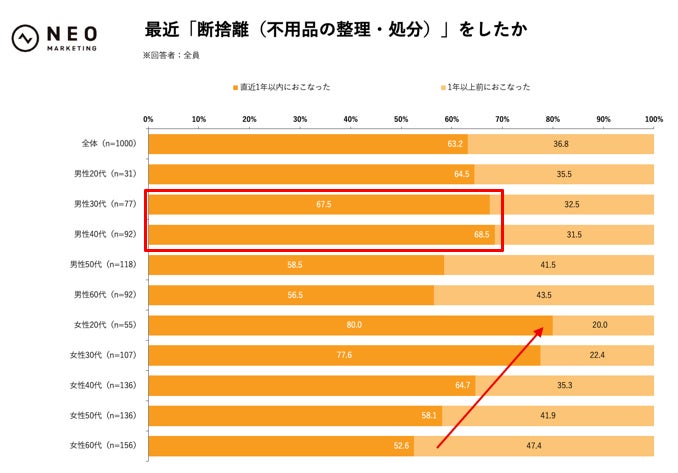
First, we asked if respondents had recently performed "Danshari (organizing and disposing of unnecessary items)." The following is a graph of responses from those who passed the screening (those with Danshari experience).
※Here, Danshari refers not merely to disposing of unnecessary items, but to the "philosophy and act" of letting go of attachment to possessions and aiming for a comfortable state of mind and body.