Conrad Tokyo to Offer 4 Sustainable Seafood Menu Items at All-Day Dining "Cerise" and Room Service from April 1st (Wednesday)
Conrad Tokyo will launch four sustainable seafood dishes, certified by MSC and ASC, at its all-day dining restaurant "Cerise" and through room service starting April 1st, promoting responsible sourcing and environmental protection.
📋 Article Processing Timeline
- 📰 Published: April 1, 2026 at 19:00
- 🤖 AI Analyzed: June 2, 2026 at 12:57 (1481h 57m after Published)
Conrad Tokyo (Minato-ku, Tokyo; General Manager Neil MacInnes) will begin offering menu items using certified seafood (hereinafter, sustainable seafood) managed and promoted by MSC (Marine Stewardship Council) and ASC (Aquaculture Stewardship Council), international non-profit organizations dedicated to promoting sustainable fisheries and aquaculture and conserving marine environments, at its all-day dining restaurant "Cerise" and through room service starting Wednesday, April 1st.
Hilton has set a corporate responsibility strategy, "Travel with Purpose," to promote responsible travel globally, aiming to halve its environmental footprint and double its social investment by 2030. This initiative aims to preserve the environment and protect human rights in the supply chain through sustainable food sourcing. On this occasion, in addition to MSC-certified bonito, Conrad Tokyo has obtained CoC (Chain of Custody) certification to handle ASC-certified seafood, including six types of seafood such as Atlantic salmon and black tiger shrimp, which indicates they are produced through responsible aquaculture. With this, four menu items at the all-day dining "Cerise" and room service will display eco-labels indicating that over 95% of the seafood used is sustainable seafood, with service commencing on Wednesday, April 1st.
By acquiring international certifications and displaying eco-labels, Conrad Tokyo aims to accelerate its environmental and social initiatives, enhance transparency, and provide customers with a more reassuring experience. For more information on Conrad Tokyo's activities, please visit the official website.
MSC "Seafood Eco-label", ASC-labeled Menu Items
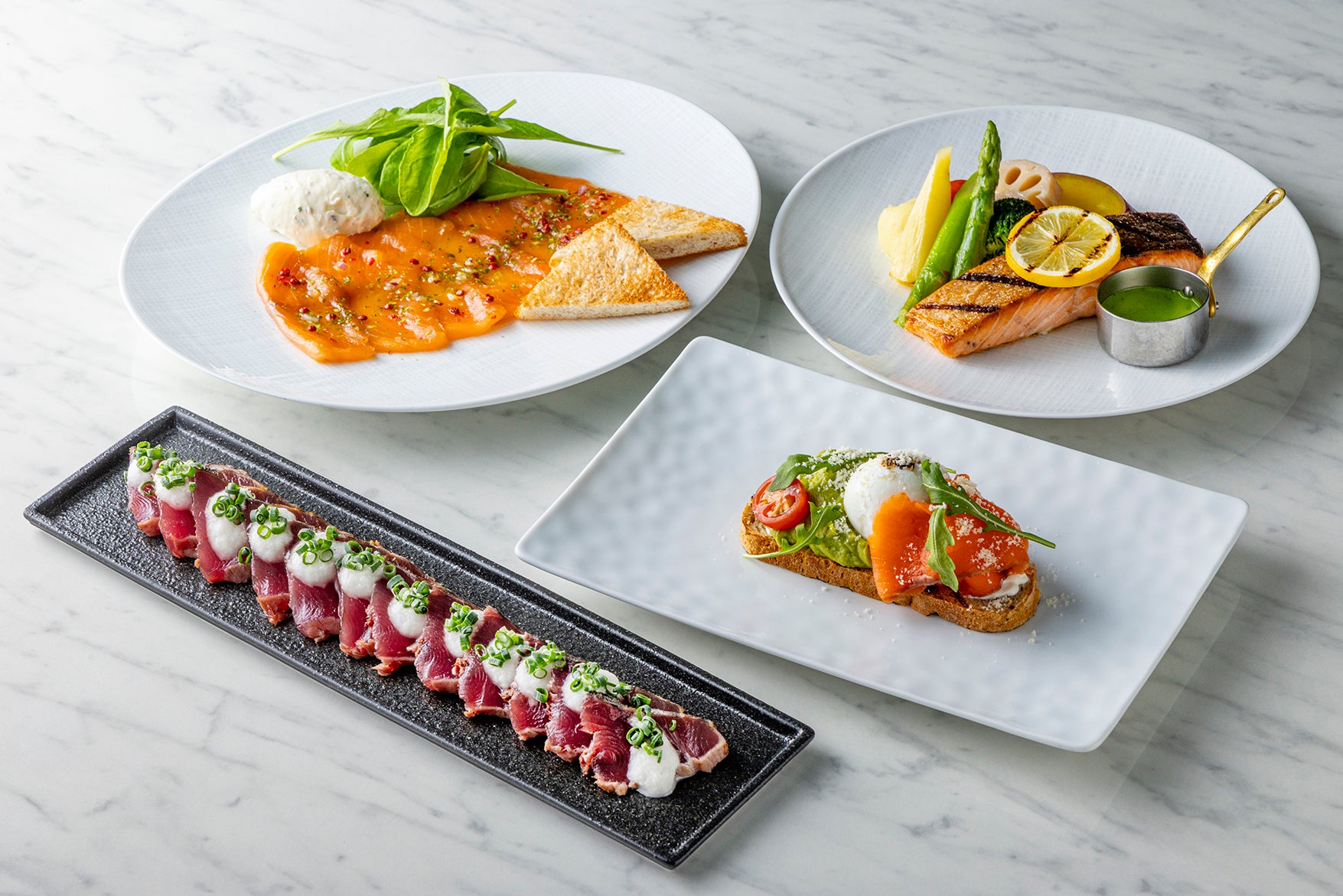
Seared Bonito (Katsuo no Tataki)
Available at the breakfast buffet

Smoked Salmon
Available on the all-day dining "Cerise" grand menu and through room service
Grilled Salmon
Available on the all-day dining "Cerise" grand menu and through room service
Avocado Toast (using ASC-certified smoked salmon)
Available as a selectable main dish for breakfast and through room service
Overview
Start Date: From Wednesday, April 1st, 2026
Location: 28F All-Day Dining "Cerise" and Room Service
Hours:
-
All-Day Dining Cerise
Breakfast: 6:30 AM - 10:30 AM
Lunch/Dinner: 11:30 AM - 10:00 PM (Last Order 9:00 PM)
-
Room Service: 24 hours
Menu & Prices:
Smoked Salmon 5,200 yen
Grilled Salmon 5,000 yen
Avocado Toast 2,500 yen
Seared Bonito (Katsuo no Tataki) (part of breakfast buffet)
*Inquiries: Official Website or 03-6388-8745 (Restaurant Reservations Direct)
*Prices include tax and service charge.
*Contents and prices are subject to change without notice depending on ingredient availability.
*Images are for illustration purposes only.
###
About MSC (Marine Stewardship Council)
MSC is an international non-profit organization dedicated to promoting sustainable and well-managed fisheries through its certification program and seafood eco-label, to ensure seafood resources for future generations. Established in London in 1997, it now operates globally with offices in approximately 25 countries. MSC Japan was established in 2007. In fiscal year 2024, approximately 22,000 MSC "blue eco-label" products were sold in over 70 countries worldwide, with 660 items sold in Japan. Domestically, they are sold at Aeon Group, Co-op, Seiyu, Ito-Yokado/York, McDonald's, and other retailers.
For more details, please visit the MSC website: https://www.msc.org/jp
About ASC (Aquaculture Stewardship Council) Japan
ASC (Aquaculture Stewardship Council) is an international certification scheme for seafood produced through responsible aquaculture that considers the environment, local communities, and people. ASC-certified aquaculture products, rigorously audited, ensure traceability through CoC certification (shared with MSC) throughout the processing and distribution chain. The ASC logo serves as a powerful message to consumers, informing them that the products they purchase are sustainable seafood.
About MSC/ASC CoC Certification
MSC/ASC CoC (Chain of Custody) certification is a management certification for the processing and distribution supply chain of seafood after it is landed. Its purpose is to ensure that MSC/ASC certified seafood reaches consumers without being mixed with uncertified seafood.
To offer seafood as MSC/ASC certified, CoC certification is required.
About Conrad Tokyo
Conrad Tokyo, located in Shiodome, close to Ginza, offers panoramic views of Hamarikyu Gardens, Rainbow Bridge, and Tokyo Bay, with a concept of modern Japanese design. It boasts spacious 291 guest rooms, with even standard rooms being among the largest in Tokyo at 48㎡, four vibrant restaurants and bars & lounges, large, medium, and small banquet facilities equipped with state-of-the-art equipment, and extensive facilities such as "Mizuki Spa & Fitness" spanning 1,400㎡ with a spa, pool, and fitness center. It consistently receives top ratings domestically and internationally from publications such as 'Forbes Travel Guide', 'Condé Nast Traveler', and 'Travel + Leisure'. For more details on Conrad Tokyo, please visit conradtokyo.jp. Information is also available on Facebook, X, Instagram, and LINE.
FAQ
What are MSC/ASC certifications?
They are international certification schemes promoting sustainable fishing and aquaculture, aiming to protect marine environments and conserve fishery resources.
What kind of menus will be offered?
Four dishes will be offered: Smoked Salmon, Grilled Salmon, Avocado Toast, and Seared Bonito (Katsuo no Tataki).
Why is sustainable seafood being introduced?
Based on Hilton's corporate responsibility strategy, it aims to reduce environmental impact and protect human rights in the supply chain.