[Research Report] SIGQ Releases "Survey on the Reality of Individual Dependency in Incident Response 2026"
"Incident response relies on a specific individual" 72.0%, of which 88.9% recognize the risk of key personnel leaving ~ Approximately 30% of organizations that tried to resolve individual dependency responded "did not improve." The breakthrough is the design of "usable knowledge" ~
📋 Article Processing Timeline
- 📰 Published: April 2, 2026 at 20:10
- 🔍 Collected: April 2, 2026 at 13:36
- 🤖 AI Analyzed: April 17, 2026 at 20:13 (366h 36m after Collected)
SIGQ Co., Ltd. (Headquarters: Tsukuba City, Ibaraki Prefecture; Representative Director: Takaaki Kanetsuki), which develops "Incident Lake," an Agentic AI specialized in incident management, has released the results of the "Survey on the Reality of Individual Dependency in Incident Response 2026" conducted among 250 VPoEs, Engineering Managers, SRE Leaders, and Tech Leads at SaaS and web product development companies.
Survey Summary
The following points regarding incident response emerged from this survey:
・Regarding incident response, 72.0% of organizations responded that they "depend on 1-2 specific individuals." Furthermore, 88.9% of them answered that there is a "risk of resignation within 1-2 years," highlighting a threat to business continuity.
・Among efforts to resolve individual dependency, "attempted but did not improve" (32.4%) was the most common response. This reveals that static measures such as document preparation alone do not lead to a fundamental solution.
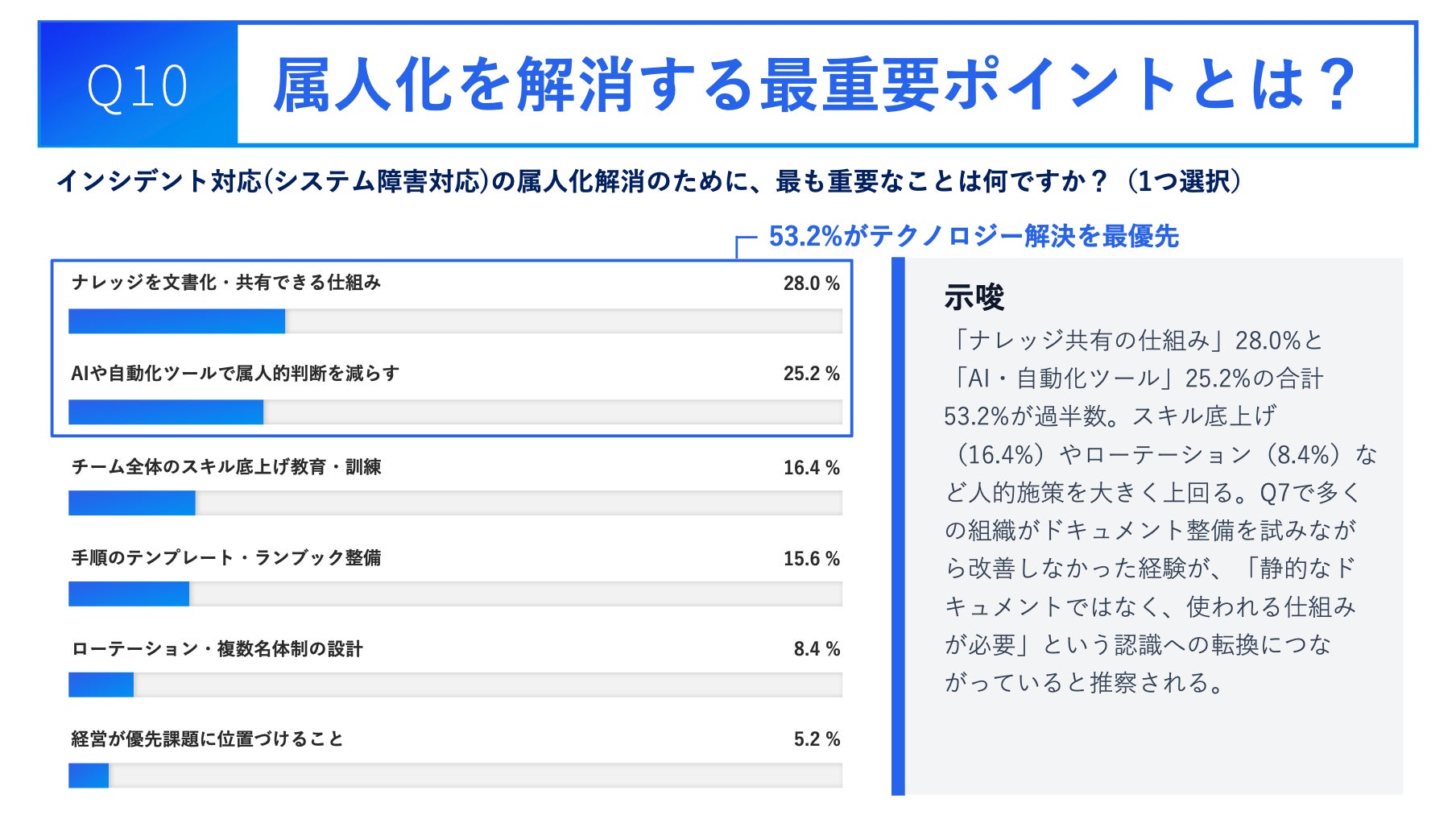
・The most important approach to resolution was "utilization of technology," answered by a majority of 53.2%. Expectations for "knowledge sharing" and "AI/automation" significantly surpassed human-centric measures.
・69.6% responded "positive" to the introduction of dedicated tools and platforms. This confirms a strong need for mechanisms to systematize tacit knowledge and reduce individual judgment.
Background of the Survey
With the widespread adoption of SaaS and cloud services, the complexity of systems operated by companies is increasing year by year. Prompt response to failures and incidents affects service reliability and is a management issue directly linked to business continuity itself.
On the other hand, in the field, "individual dependency" where "response cannot be handled without that person" has become commonplace. Knowledge concentrated in specific engineers and managers, coupled with an uneven burden of late-night and holiday responses, leads to excessive fatigue and, in many cases, the departure of talented personnel.
SIGQ conducted this survey to quantitatively grasp the extent of "individual dependency in incident response" and its impact on companies.
Survey Results Highlights
1. 70% of organizations feel individual dependency, 90% recognize the risk of key personnel leaving
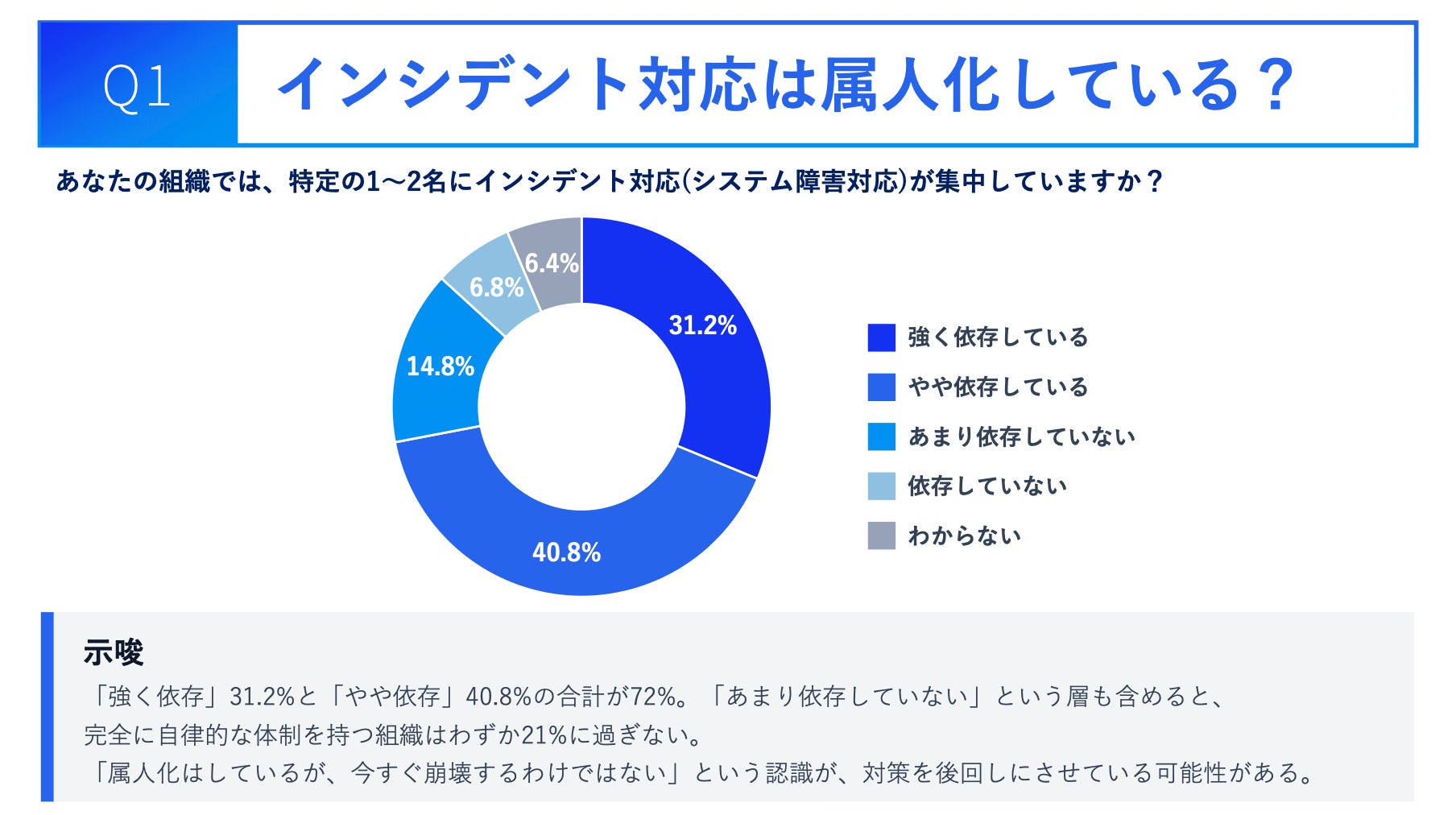
In response to the question, "Do you feel that incident response is concentrated in or dependent on 1-2 specific individuals?", 72.0% answered "dependent" ("strongly dependent" 31.2%, "somewhat dependent" 40.8%).
Furthermore, when respondents who answered "dependent" were asked about the "possibility of that personnel resigning, changing jobs, or transferring within the next 1-2 years," 88.9% answered "possible." Of these, 35.56% had concrete reasons such as signs of job hunting. This reveals a ticking time bomb situation where incident response capabilities could suddenly collapse.
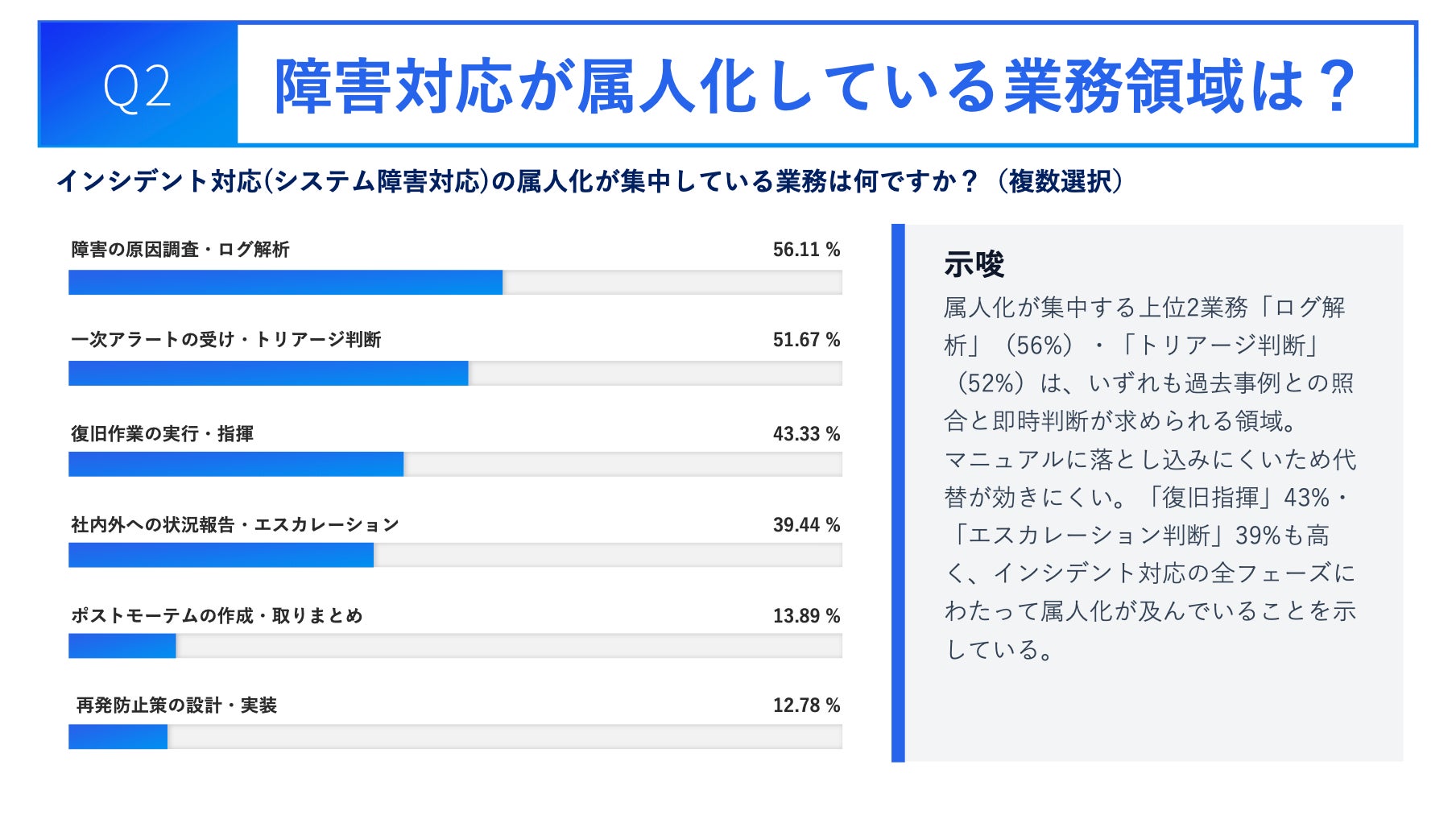
2. The most serious tasks for individual dependency are "log analysis" at 56.1% and "triage judgment" at 51.7%
The most common specific tasks handled by dependent personnel were "investigation of cause of failure/log analysis (56.11%)", followed by "receiving initial alerts/triage judgment (51.67%)". This reveals that individual dependency is progressing in areas that require instantaneous judgment based on past experience and intuition, making them difficult to manualize.
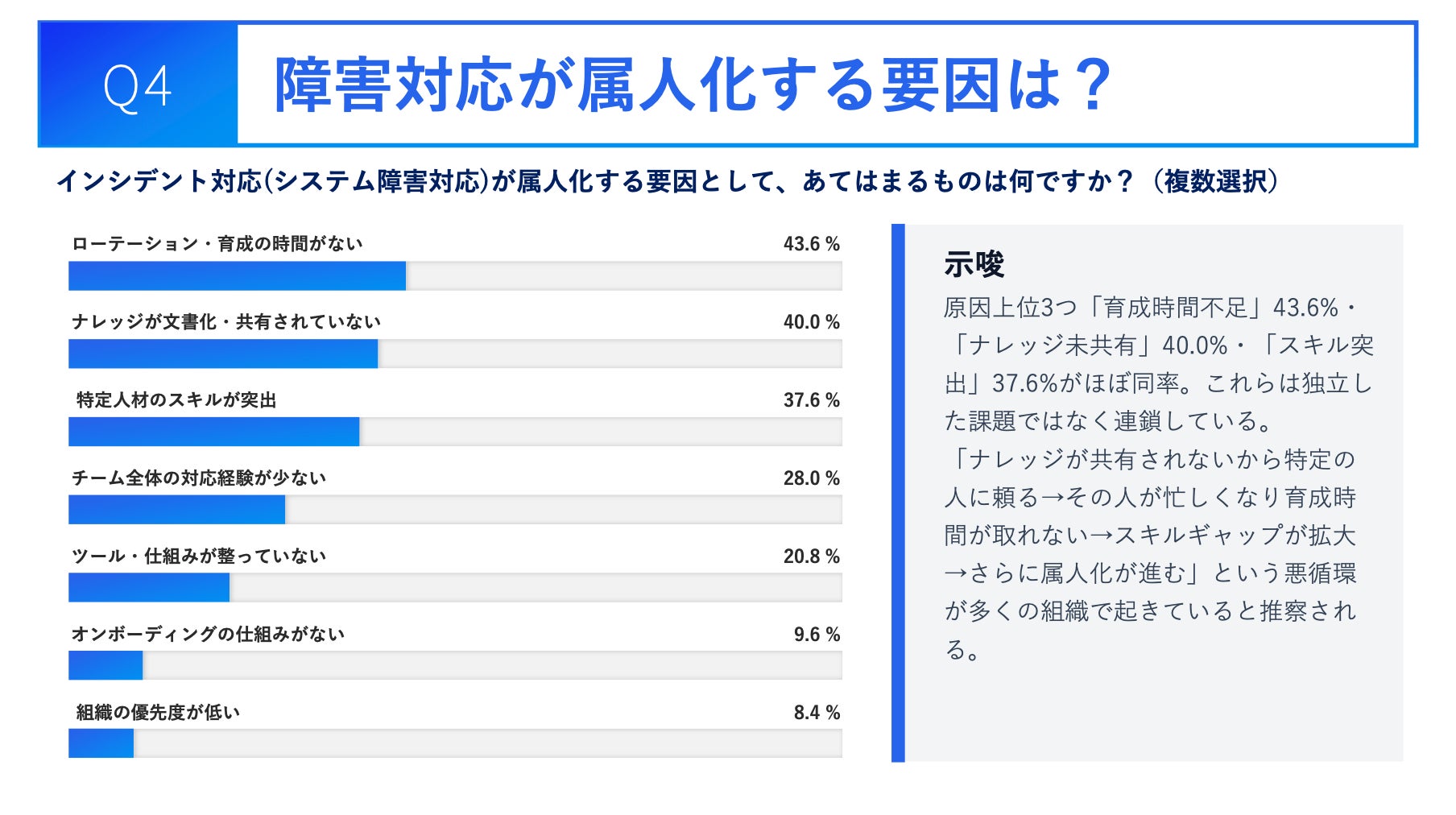
3. Causes are a three-way tie: "lack of time," "lack of knowledge sharing," and "skill gap"
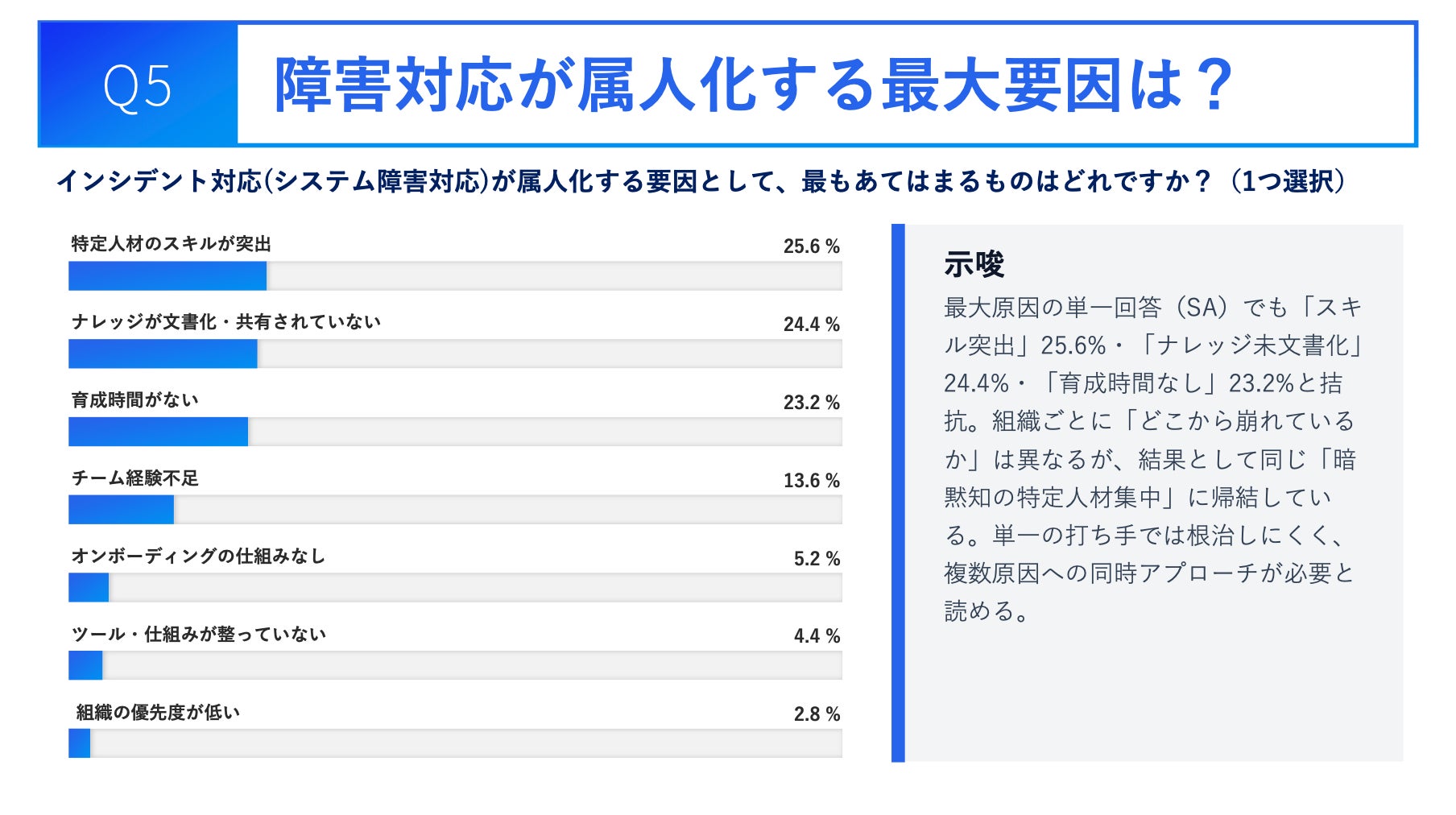
The top three causes of individual dependency were "no time for rotation or training (43.6%)", "knowledge not documented or shared (40.0%)", and "skills of specific personnel are outstanding and others cannot catch up (37.6%)". This creates a vicious cycle where reliance on specific individuals due to unshared knowledge leads to those individuals being overwhelmed, preventing training, and further exacerbating individual dependency.
4. "Documents were created, but no one looks at them" - Static maintenance alone is not enough to resolve the issue
Regarding the status of efforts to resolve individual dependency, the most common response was "tried before, but did not improve much (32.4%)" ("almost resolved" was only 16.8%).
While efforts are concentrated on "documenting knowledge" such as preparing wikis and procedure manuals, these alone are not utilized and do not lead to resolution. On the other hand, only 12.63% of organizations are working on "automation and efficiency improvement using AI/tools," indicating that technological solutions are still in their early stages.
5. The biggest barrier for organizations that cannot take action is "low management interest" at 32%
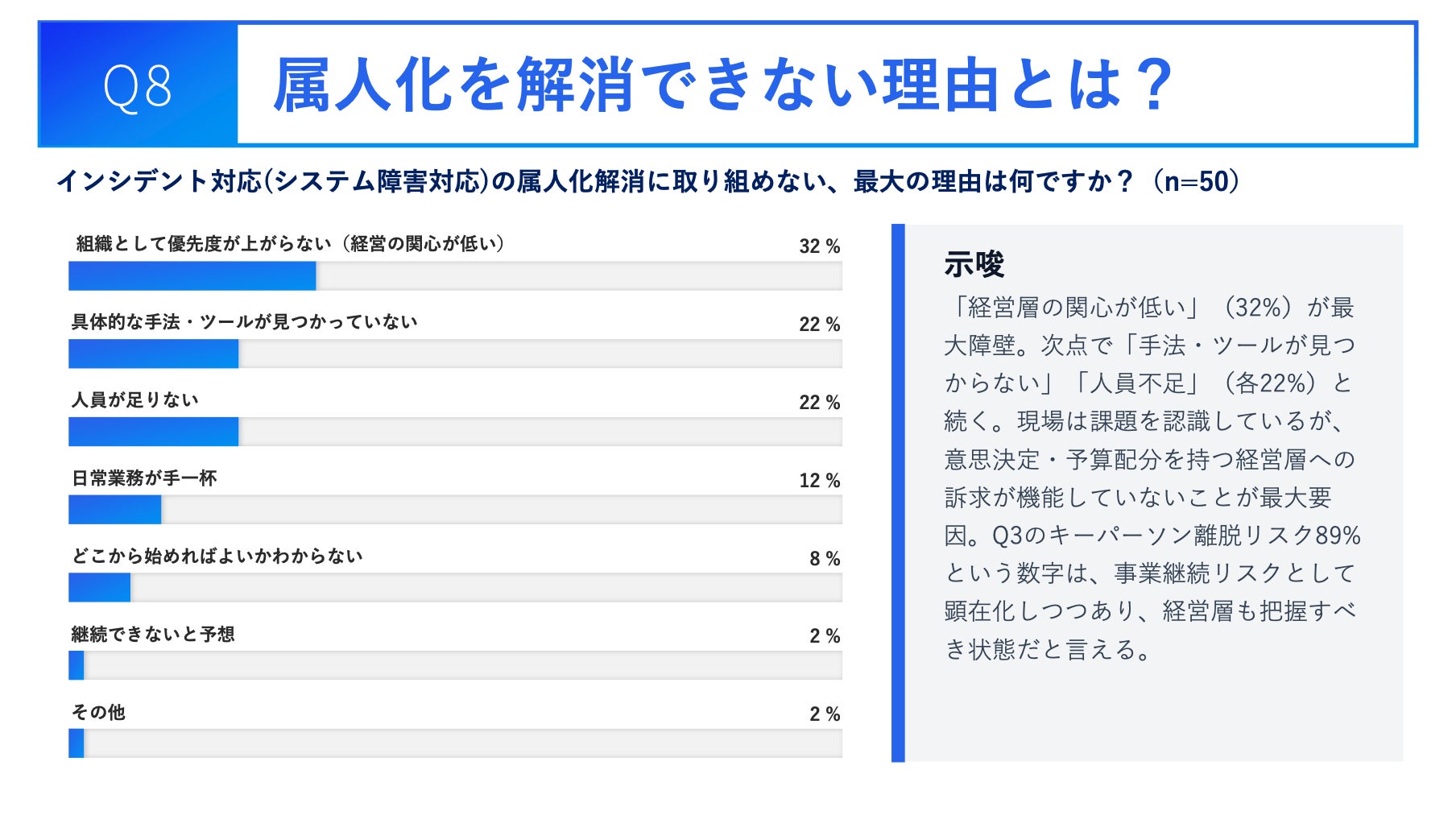
The biggest reason for organizations that have not yet addressed individual dependency (n=50) was "organizational priority is not raised (low interest from superiors/management) (32%)".
Risks of inaction include "overload/fatigue/resignation of specific engineers (39.6%)" and "variations in response quality/speed (38.4%)", highlighting a gap between the urgency felt by frontline teams and management's perception.
6. 53.2% prioritize technological solutions, 69.6% are positive about tool adoption
Regarding the most important things to resolve individual dependency, "creating a mechanism to document and share incident response knowledge (28.0%)" and "reducing individual judgment by utilizing AI and automation tools (25.2%)" accounted for the majority.
69.6% also responded "positive about introduction" regarding dedicated tools and platforms, confirming a strong need for systemic solutions.
Download the Survey Report (All 11 Questions)
The full report summarizing the detailed results of this survey (aggregated data, graphs, and analysis for all 11 questions) can be downloaded for free from the link below.
Download URL: https://incidentlake.com/incident-management-report-202604
Survey Overview
Survey Name: Survey on the Reality of Individual Dependency in Incident Response 2026
Survey Method: Freeasy Online Questionnaire
Target Audience: SRE Leaders, EM, VPoE, Tech Leads involved in system failure (incident) response
Valid Responses: n=250 people
Number of Survey Questions: All 11 questions (reality of individual dependency, causes, risks, countermeasures, intention to introduce tools)
Survey Period: Conducted in March 2026
Comment from Takaaki Kanetsuki, Representative Director of SIGQ Co., Ltd.
Through this survey, it has become clear once again that individual dependency in incident response is not a 'problem to be dealt with someday,' but a 'serious management issue currently in progress' directly linked to the risk of ace personnel leaving.
In the field, many organizations are taking the first step of preparing documents. However, they are facing the wall that 'created documents are not utilized' in an emergency when an incident occurs. What is needed now is not just static document management. It is a mechanism for 'usable knowledge' where AI structures the tacit knowledge of experienced professionals and actively supports decision-making in times of crisis.
The fact that 'the risk of key personnel leaving is 88.9%' indicates that this is no longer a problem that can be solved by frontline efforts alone. I am convinced that management should address this as a 'knowledge insurance' for business continuity with a sense of urgency. Through Incident Lake, we will support the fundamental resolution of this issue.

About "Incident Lake"
"Incident Lake" is an "incident intelligence layer" that dramatically accelerates decision-making by integrating scattered operational data, powered by the evolution of cutting-edge LLMs.
A "Knowledge Hub" where accumulation sharpens LLM
It goes beyond mere data processing. It incorporates "live data" such as conversations on Slack, information accumulated in existing ticket management tools (ServiceNow, Atlassian Jira, etc.), and on-site judgments, and stores it in Incident Lake in a format that LLM can immediately utilize. The more data accumulates, the deeper LLM understands "rules and past lessons specific to that organization," building a mechanism where the accuracy of responses and support continuously self-evolves.
Collaborating with existing tools to assetize the "last mile" of operations
It demonstrates its true value not by replacing existing ticket management tools, but by being used in conjunction with them.
-
Data Assetization: Incident Lake extracts and structures not only the "results" recorded in existing tools (ServiceNow, etc.) but also the "reasons for judgment" and "trial and error" in the process, which are last-mile data.
-
Decision-making Hub:
FAQ
How serious is the individual dependency in incident response?
According to the survey, 72.0% of organizations rely on 1-2 specific individuals, and 88.9% of them recognize the risk of key personnel leaving.
What is the most important approach to resolve individual dependency?
Over half, 53.2%, responded "utilization of technology," with high expectations for AI and automation in particular.
What kind of product is SIGQ Co., Ltd.'s "Incident Lake"?
It is an Agentic AI specialized in incident management, an "incident intelligence layer" that integrates scattered operational data and leverages LLM to support decision-making.