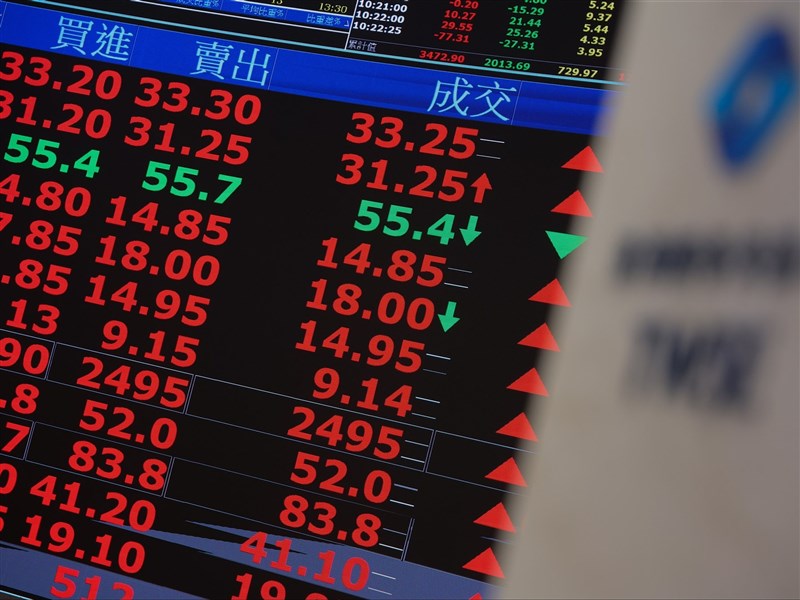
Driven by NVIDIA's outstanding financial report, which boosted the performance of tech stocks, the Taiwanese stock market staged a revenge rebound today. Ignited by large-cap stocks and the passive components sector, the index once surged by 1586.09 points, marking the third-largest intraday point gain. The market closed at 41368.21 points, an increase of 1347.39 points, which is the fifth-largest closing point gain in the history of Taiwan's stock market. The gain was 3.37%, with a turnover of NT$1.12931 trillion.
The Electronics Index rose by 3.87% today, and the Semiconductor Index climbed 3.22%. The TPEx Index, which represents small and medium-sized enterprises, increased by 3.38%. Among traditional industry sectors, the Cable and Plastics indices showed stronger performance, closing up 5.02% and 4.58%, respectively.
Among large-cap electronics stocks, TSMC closed at NT$2230, up NT$45 or 2.06%; Delta Electronics closed at NT$2030, up 6.01%; MediaTek hit its limit-up price of NT$3550; and Hon Hai rose 3.12% to close at NT$247.5.
The passive components sector saw a renewed price hike trend, with Yageo, Walsin Technology, Holy Stone, and Prosperity Dielectrics all hitting their limit-up prices, closing at NT$572, NT$266, NT$433.5, and NT$175, respectively.
Several active ETFs (Exchange Traded Funds) attracted significant capital. The UBOTC Upgraded 50 (00403A), which was listed on May 12, closed up 3.62% at NT$10.01 today, with a high trading volume of over 425,000 lots. The UBOTC Taiwan Growth (00981A) traded 242,000 lots and closed up 5.99% at NT$28.86.
The number of high-priced stocks above NT$1,000 increased to 49. Eternal Materials, Browave, G-shot, Global Unichip, and Hong Jin all surged to their limit-up prices, closing at NT$1090, NT$1045, NT$3330, NT$5065, and NT$7675. Auras Technology rallied 6.5% to close at NT$1000.
Li Fang-kuo, Chairman of Uni-President Investment Trust, told CNA that the Taiex closed at just over 28,000 points at the end of last year and has surged to over 42,000 points this year, a rally of about 14,000 points in less than half a year. He noted that the recent continuous decline to test the monthly moving average was a healthy pullback after a significant rally and a correction of an excessively high deviation, with today marking a revenge rebound.
He pointed out that the impact of rising U.S. bond yields on the stock market is similar in nature to sudden geopolitical events like the U.S.-Iran war—both are temporary and rapid external disturbances that do not affect the medium- to long-term bull trend of the Taiwanese market.
From a fundamental perspective, Li Fang-kuo stated frankly that the Taiex's rally is "the real deal." Taiwan's Q1 GDP growth reached 13.69%, a 39-year high, and April's export orders hit the second-highest monthly figure in history, both proving that the stock market's rise is well-supported.
Li Fang-kuo said that looking ahead, market watchers should pay attention to the inaugural speech of the new U.S. Federal Reserve (Fed) Chair, Kevin Warsh, on May 22. Coupled with upcoming themes like COMPUTEX in June and Apple's Worldwide Developers Conference (WWDC), the bull market in Taiwan is expected to continue.
FACT BOX
- Source: CNA (Central News Agency)
- Category: 產業