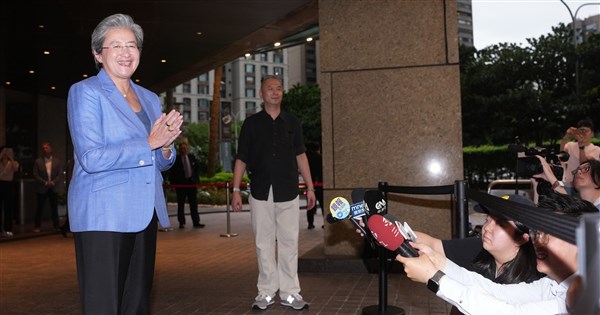
U.S. chipmaker Advanced Micro Devices (AMD) today announced an investment of over US$10 billion in Taiwan's industrial ecosystem. In an interview, AMD Chair and CEO Dr. Lisa Su stated, "TSMC is our fantastic partner." She said AMD has already been using TSMC's fab in Arizona, USA, to ramp up capacity for server processors and will continue to increase capacity in both Taiwan and Arizona.
When asked by a CNA reporter about plans to expand the Taiwan office, Su responded, "We’re always expanding in Taiwan." She noted that Taiwan is home to a great number of AMD engineers who are responsible for the research and development of all AMD product lines.
Su arrived in Taiwan for a whirlwind visit on May 20th, first meeting with TSMC Chairman C.C. Wei after landing. Today, she held a full day of closed-door meetings with supply chain partners, including Wiwynn Chairman Emily Hong, Quanta Vice Chairman C.C. Leung, and Acer Chairman Jason Chen.
Stepping out of her hotel in the evening to speak with the media, Su said it's always wonderful to be in Taiwan and a great time to meet with AMD's customers, partners, and suppliers. She expressed that tonight was an opportunity for her to express heartfelt thanks on behalf of all of AMD, saying, "Our products couldn't grow and succeed without the entire Taiwan ecosystem working with us."
She said that the current artificial intelligence (AI) infrastructure requires enormous investment, and it's essential to work together as an ecosystem to achieve it. AMD has fantastic partners in Taiwan, and "we are crazily ramping up our capacity," covering areas from wafers, advanced packaging, and substrates to rack-level systems. She expressed her excitement in announcing the investment plan of over US$10 billion.
Su emphasized that this is a perfect time to announce the investment. The demand for AI is currently far beyond anyone's expectations, with an increase in inference demand and the proliferation of agent-based AI. This requires more central processing units (CPUs) and more graphics processing units (GPUs).
When asked about AMD's next-generation AI chip, the MI455, Su revealed that progress is going very well. "Everyone is very excited to have the next generation of AI technology," she said, noting that it requires close collaboration with the entire Taiwanese ecosystem. "I'm very pleased with the progress," she added, confirming the new product is on track to launch in the second half of this year with very strong customer demand.
Questioned about considering Intel or Samsung as alternatives to diversify supply chain risk, Su stated that AMD is always looking at how to have the broadest possible supply chain, but emphasized that TSMC is an incredible partner with whom AMD has a very tight relationship.
Regarding AMD's strategy in China, a CNA reporter's question prompted Su to say, "If you take the view that AI should be everywhere, you should have a global reach, and a global product and customer footprint." AMD held a developer day in Shanghai this week focusing on the open ecosystem. Similar events have been held in Silicon Valley and other parts of the world, which she sees as a great opportunity for more developers to become familiar with AMD.
Addressing the issue of memory shortages, she admitted that the memory market is currently very tight. She mentioned that all memory suppliers are great partners to AMD, and as they expand their capacity, AMD will continue to work with them. At the same time, AMD is working closely with all its customers to ensure a perfect match between the capacity of CPUs, GPUs, and overall memory.
Su said that due to scheduling conflicts, she will not attend COMPUTEX Taipei this year. However, she genuinely enjoys coming to Taiwan and thinks COMPUTEX is fantastic, expressing her hope to attend next year.
FACT BOX
- Source: CNA (Central News Agency)
- Category: 產業