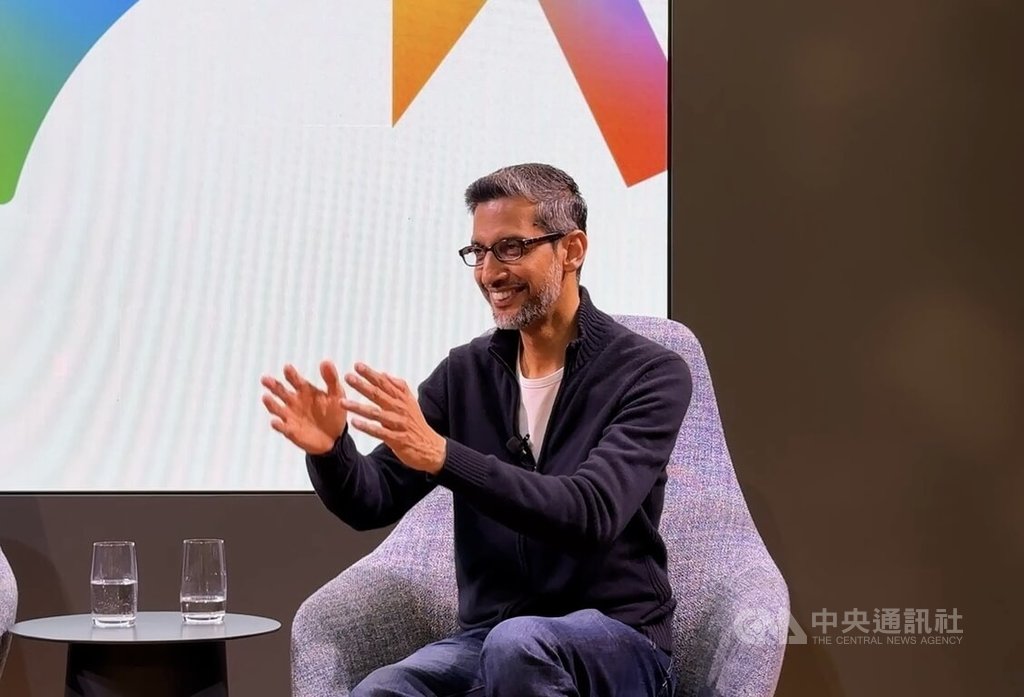
The two-day annual Google developer conference concluded today. In a press conference, Google CEO Sundar Pichai, responding to a question from Central News Agency (CNA) about computing power strategy, stated that the computing power the company has built in the past two years is equivalent to the total of the first 20 years after its founding. Regarding the heavy investment in AI infrastructure, he emphasized that Google sees market demand and is confident in its investments.
Google CEO Sundar Pichai, along with Google DeepMind CTO Koray Kavukcuoglu and Google Search VP Elizabeth Reid, held a joint interview with international media at the Google I/O annual developer conference today, addressing questions about vision, technological innovation, and product applications.
Pichai pointed out that this year's conference laid the foundation for an 'Agentic Transformation' for Google's products, introducing AI agents into Search, models, Chrome, and Android, marking it as a critical and exciting moment.
When asked how to balance competition and safety, Pichai emphasized that Google places great importance on 'responsibly' launching new technologies. This is why the company started with the Flash version when releasing the Gemini Omni multimodal generative model.
Google also announced the new generation Gemini 3.5 model at the I/O conference, similarly opening access to the 3.5 Flash version first.
CNA was one of two Taiwanese media outlets invited to I/O this year. Regarding how Google is addressing the bottleneck of computing power demand in the AI arms race, Pichai stated, 'The demands on our computing infrastructure are higher now than ever before.' He said that in the last two years, the computing power Google has built is equivalent to the cumulative total of the company's first 20 years.
He mentioned that every layer of today's full-stack technology stack faces challenges, which is why Google is expanding its investment in new energy sources, including nuclear fusion, geothermal, and small modular reactors. Simultaneously, it is accelerating the advancement of its proprietary TPU chips, with high reliance on Asian supply chains.
In April, at its Google Cloud Next conference, Google unveiled two TPU chip models for the first time, focused on training and inference respectively, and conducted a comprehensive upgrade of its entire AI infrastructure.
Regarding Google's parent company, Alphabet, increasing its capital expenditure for 2026 to up to $190 billion (approximately NT$6.2 trillion), primarily for building AI infrastructure, Pichai said, 'We see broad demand from different types of enterprises, and we also see demand from consumers, developers, and businesses globally,' which is reflected in the actual business growth of Google Cloud.
Pichai stressed that Google always takes a long-term approach, 'We see the existence of future demand, and this is what is necessary to keep up with the pace of this (AI) technology.'
CNA also asked about the challenges Google faces in enhancing the semantic nuance and accuracy of its AI models in Traditional Chinese to approach the level of English. Google DeepMind CTO Koray Kavukcuoglu responded by pointing out the importance of 'understanding cultural context.' As Google delves deeper into language research, the research direction will increasingly move towards cultural understanding.
FACT BOX
- Source: CNA (Central News Agency)
- Category: 產業
- Organizations: Google / Google DeepMind / Alphabet
- Products / services: Gemini Omni / Gemini 3.5