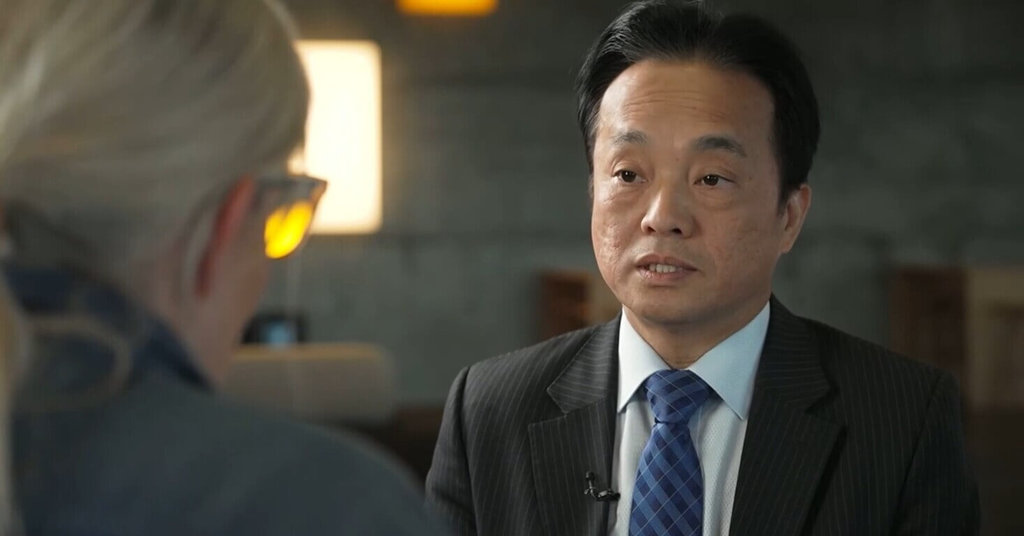
On the 18th, Cheng Jung-chun, Taiwan's representative to Denmark, was interviewed on the Danish Broadcasting Corporation's (DR) news program 'Deadline' for a discussion on the topic of the Trump-Xi summit. Cheng stated that Taiwan is closely monitoring the US-China summit, that China's aggressive militarism is the source of instability in the Indo-Pacific region, and he reiterated Taiwan's determination to maintain stability in the Taiwan Strait and the region.
On the 18th, the DR news program 'Deadline,' in its episode 'The Power Play in Beijing,' interviewed Taiwan's Representative to Denmark, Cheng Jung-chun, regarding the impact of the Trump-Xi summit on Taiwan.
The host, Trine Maria Ilsøe, first asked for his observations and overall thoughts on the summit. Cheng explained that Taiwan is closely watching the interactions at the US-China summit and expressed approval of statements from the US side, such as those by Secretary of State Marco Rubio (editor's note: per original text, Rubio is a senator), who made it clear during his trip that US policy toward Taiwan has not changed and that the US opposes any unilateral change to the status quo by force or coercion.
When Ilsøe asked about potential uncertainty in US arms sales to Taiwan, Cheng first emphasized Taiwan's determination to maintain peace and stability in the Taiwan Strait and the region. He pointed out that since Trump's first presidency, the US government has conducted several arms sales to Taiwan, with the value reaching new highs. An example he cited was the arms sale approved by Trump last December, amounting to DKK 70 billion (approximately NT$350 billion).
Cheng said that, at the same time, Taiwan is also urging the US to accelerate the delivery of already purchased weapons. Additionally, Taiwan is collaborating with other like-minded partners on developments such as drones to enhance its asymmetric combat capabilities.
When asked if he was worried about the arms sales or Taiwan becoming a bargaining chip in US-China negotiations, Cheng stressed that communication channels between Taiwan and the US are open and effective, and solutions should be achievable through close contact between the two sides. He pointed out that the source of instability in the Indo-Pacific region is China's aggressive militarism.
Cheng also mentioned that Marco Rubio had publicly stated that China's rapid military expansion is not only aimed at Taiwan but is intended to project its military power globally, taking the opportunity to call on all parties to pay attention to this phenomenon.
The program also invited two guests to discuss the issue: Mikkel Vedby Rasmussen, a professor of international politics at the University of Copenhagen, and Christian Boutrup, a TV2 Asia correspondent in Denmark who has authored several books on China.
Rasmussen opined that the issue of arms sales to Taiwan has been a key point of contention and negotiation between the US and China for 20 years. He suggested the US's suspension of arms sales to Taiwan was due to practical considerations, such as a lack of missiles after depleting stockpiles in the Iran war, and on the other hand, a continuation of a two-decade-long diplomatic performance. He believes that a Chinese invasion of Taiwan would be an extremely difficult military operation that would cause chaos and conflict with the US, which is why Beijing prefers negotiation and political manipulation.
Boutrup, looking from a geopolitical perspective, stated her belief that the US is using the suspension of arms sales to Taiwan as a bargaining chip in negotiations with China, while China controls rare earth exports to counter US tariff measures.
Although the Trump-Xi summit did not have a direct impact on Nordic countries, it was closely watched by all sectors. Trump's attitude toward Taiwan after the US-China talks also received high attention from Danish and Swedish media.
FACT BOX
- Source: CNA (Central News Agency)
- Category: 國際