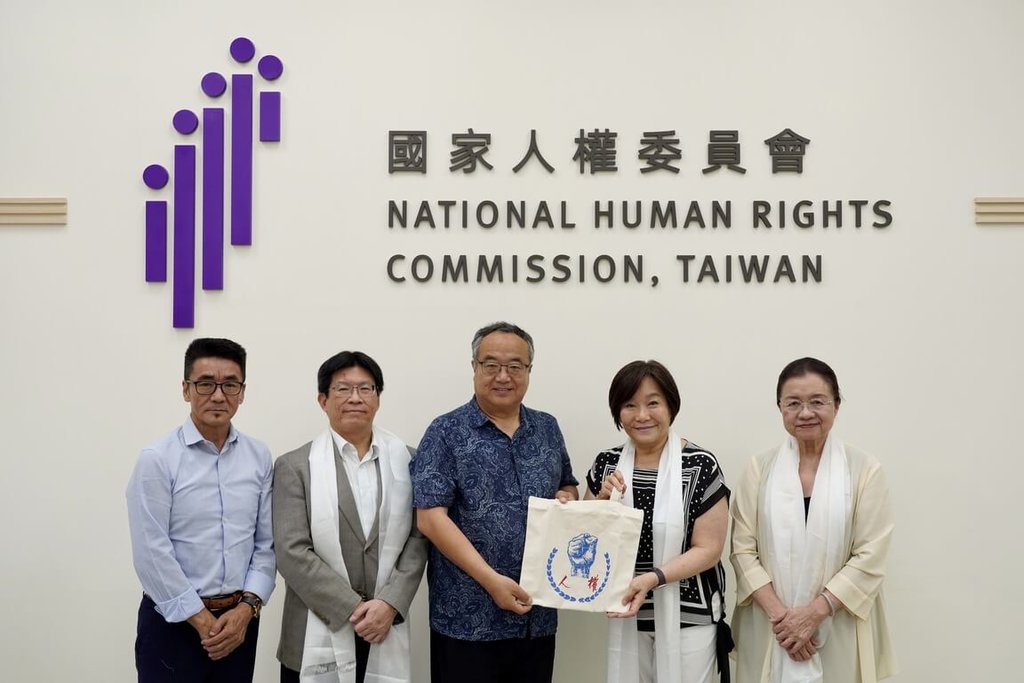
(CNA, Taipei, 20th, by reporter Kao Hua-chien) National Human Rights Commission (NHRC) Vice Chairperson Chi Hui-jung stated today that the Chinese government's use of an authoritarian system to suppress the cultural identity of Tubo (Tibet) is a profound warning that Taiwan must take to heart, and that the NHRC will continue to speak out for Tubo in the international community. The National Human Rights Commission stated in a press release that Dr. Gyal Lo of the Tibet Action Institute and Tashi Tsering, secretary-general of the Human Rights Network for Tibet and Taiwan, among others, visited the commission on the 18th. Dr. Lo stated that after obtaining his doctorate from the University of Toronto in Canada and returning to Tubo to teach, he discovered that the teaching materials provided by the Chinese government to Tubo schools were all aimed at instilling Han culture, party-state ideology, and colonial education policies. To research how the Chinese government is transforming the cultural foundations of Tubo through boarding schools, he interviewed 52 boarding schools and found that children are forced to stay from the age of 4 or 5, only able to return home on weekends. If families refuse to send their children to boarding schools, they cannot enjoy social welfare, and the children face difficulties in advancing their education. Dr. Lo observed that children who enter boarding schools become disconnected from their families, creating a rift between parents and children. Furthermore, because children are subjected to the forced indoctrination of Han culture and values by the Chinese government for long periods in these schools, many mothers suffer immense pain, some even walking to Lhasa to protest. However, the Chinese government prohibits people from providing accommodation to these mothers, and violators are fined. Dr. Lo also pointed out that in recent years, the Chinese government has installed a large number of surveillance cameras in the Tubo region, and even private activities are under strict surveillance. Additionally, the passage of the "Ethnic Unity and Progress Promotion Law" by China's National People's Congress on March 12 has drawn widespread attention. The core of this law is to regulate the entire country through legislation to "forge a strong sense of community for the Chinese nation" and strengthen identification with Chinese culture. NHRC member Kao Yung-cheng expressed concern about how the Ethnic Unity and Progress Promotion Law, passed by the Chinese government this year, will affect China's assimilation policies. Dr. Lo responded that the Chinese government has nearly 40 years of experience in ruling and suppressing protests, and the passage of this law legitimizes suppressive actions, assimilates different ethnic groups, threatens the cultural roots and educational systems of minorities, and will render autonomous regions within China existing in name only. NHRC member Tien Chiu-chin noted her concern that the Dalai Lama has announced the continuation of the reincarnation system, but it will face a younger generation already influenced by the Chinese government's colonial policies. Dr. Lo stated that Tubo people over 60 would very much hope for the Dalai Lama's reincarnation, but the younger generation under 40 has been
FACT BOX
- Source: CNA (Central News Agency)
- Category: 國際