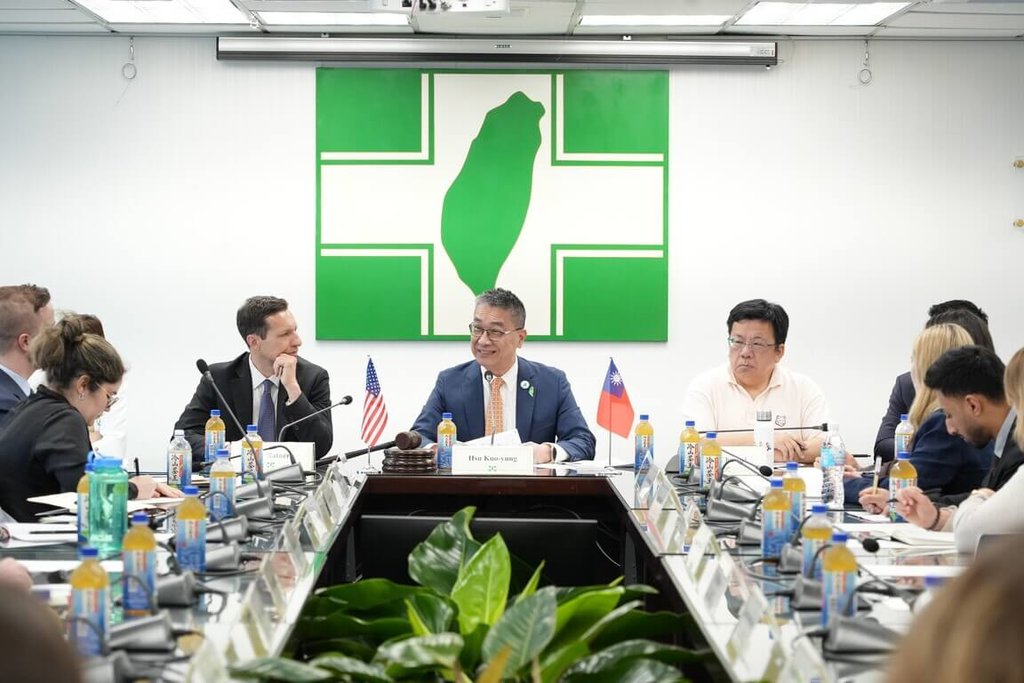
(CNA, Taipei, May 20, reporter Yeh Su-ping) Former U.S. Assistant Secretary of Defense for Indo-Pacific Security Affairs, Ely Ratner, led a delegation from the Washington-based think tank, the Center for a New American Security (CNAS), on its "Next Generation National Security Leaders Program" to visit the Democratic Progressive Party (DPP) on the 19th. DPP Secretary-General Hsu Kuo-yung stated that Taiwan never provokes, but China's ambition to annex Taiwan has never changed; the primary task of the DPP government is to ensure the safety and well-being of the people. The DPP issued a press release this evening stating that during the meeting, Hsu remarked that in the face of China's rising military and gray-zone threats, Taiwan will continue to strengthen its self-defense capabilities, deepen cooperation with like-minded countries, and steadfastly protect its democratic and free way of life. Hsu specifically expressed his gratitude for Ratner's contributions to Taiwan-U.S. relations, saying that during his tenure at the Department of Defense, Ratner worked closely with Taiwanese officials to help promote the establishment of Taiwan's "Total Defense Resilience," making him a key proponent in strengthening Taiwan's national defense. This year marks the 30th anniversary of Taiwan's first direct presidential election. Hsu noted that in 1996, China attempted to interfere in Taiwan's general election with military exercises, and the United States responded by deploying two aircraft carrier battle groups as a warning. To this day, Taiwan continues to deepen its democratic system, practice human rights values, and work with the United States and other like-minded partners to maintain regional peace and the international order. Hsu stated that regional peace and stability are the foundation for Taiwan-U.S. economic and trade cooperation and supply chain resilience, and that Taiwan firmly believes "heaven helps those who help themselves," which is a key reason for President Lai Ching-te's commitment to increase defense spending to 5% of GDP by 2030. Discussing the defense budget, Hsu pointed out that after months of delay, the opposition-led legislature only approved a budget of NT$780 billion, a scale that may be insufficient to meet current security challenges. He noted that cuts to items including drone R&D, AI-integrated command systems, and the indigenous defense industry will affect Taiwan's overall defense capacity. In response, the government is actively considering all feasible options, including a supplementary budget, to strengthen defense resilience. Regarding how to balance national security and universal values, Hsu reiterated that the DPP has always adhered to the values of democracy, human rights, and freedom, and is committed to safeguarding the free and democratic way of life of the Taiwanese people. He stated that Taiwan never provokes, but China's ambition to annex Taiwan has never changed; the primary task of the DPP government is to ensure the safety and well-being of the people. (Editor: Lin Hsing-meng)
FACT BOX
- Source: CNA (Central News Agency)
- Category: 國際