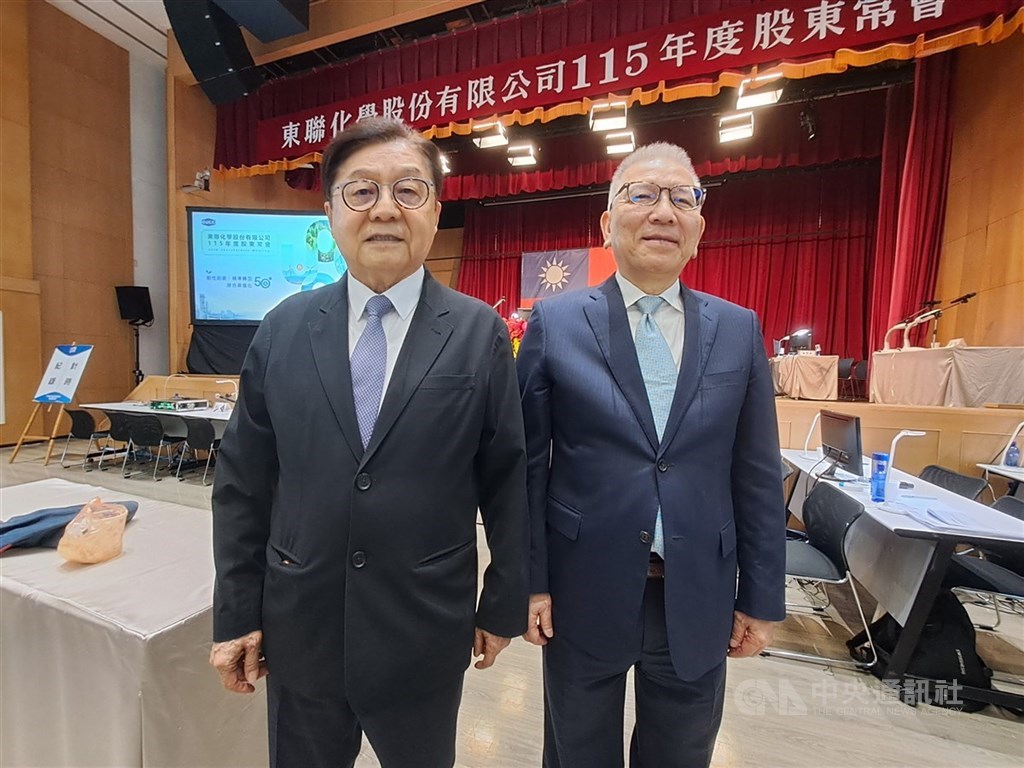
(CNA Reporter Pan Chih-yi, Taipei, 19th) Oriental Union Chemical Corp. (OUCC) held its shareholder meeting today, but Chairman Hsu Hsu-Tung was absent due to illness, with Vice Chairman Hsi Chia-I presiding. Hsi stated that the reciprocal tariffs imposed by U.S. President Trump caused global market volatility, and this year's U.S.-Iran conflict has driven up raw material prices, destabilizing the petrochemical supply chain. OUCC's performance is holding up, with a small loss in the first quarter, and it hopes to turn a profit in the second quarter. According to OUCC's statistics, despite maintaining growth last year driven by AI development, the petrochemical industry was still affected by overcapacity in China, international trade barriers, fluctuations in raw materials and exchange rates, and the implementation of a carbon fee system. Net loss attributable to the parent company last year was NT$887 million, with a net loss per share of NT$1.01. Hsi Chia-I pointed out that exchange rate fluctuations and overcapacity are the biggest pressures at present. Although there was a loss last year, and the first quarter of this year still saw losses due to more holidays and the sudden conflict, the situation has narrowed, and there is a chance for a turnaround in Q2. He noted that U.S. President Trump is facing domestic inflation and pressure from the midterm elections for the House and Senate. If the Republican Party fails to win a majority, his remaining presidential term could be a lame duck, so he is currently working to improve U.S.-China relations. Once the U.S.-Iran conflict ends, interest rates and oil prices are expected to come down. He explained that oil inventories are already low, and there is pressure to open the Strait of Hormuz. Major international chemical companies predict that even if the strait opens, it will still take 275 days for oil supplies to return to normal. Hsi Chia-I stated that the second half of the year will be a mix of positive and negative factors, with varying supply and demand for petrochemical raw materials. The wisdom of the leaders of major world countries will determine the industry's prospects. Furthermore, cost-cutting, energy saving, and carbon reduction are very important for the petrochemical industry, especially the renewal of gas equipment. Looking ahead, OUCC aims to reduce electricity consumption by 25% by 2030 and achieve a 50% carbon reduction by the same year. He pointed out that specialty chemical products are used in all industries and already account for more than half of OUCC's revenue. Generally, if they can account for more than 60%, a profitable state can be maintained. The expansion of revenue sources involves adjusting the product structure, mainly focusing on AI specialty chemical materials and new energy materials, and a new business division has been established with hopes of delivering good results. OUCC's President Tsai Hsi-chin stated that cleaning agents, photoresist strippers, surfactants, and other related chemical materials for the semiconductor process are already being supplied to semiconductor factories. However, the electronics and semiconductor materials industries require high-purity materials, and OUCC will increase its efforts to enter the electronic chemicals field this year. OUCC hopes to be not just a raw material provider but a key player in the electronic chemicals industrial chain. Regarding imported ammonia, Tsai said that in the past, they purchased ammonia from Taiwan Fertilizer, but the price of this import is lower and offers better control. As for OUCC's stock price, Hsi Chia-I frankly stated that funds in the stock market are polarized, all flowing into AI industry stocks, while traditional industry stocks have relatively low prices. Regarding the key to OUCC's turnaround, he believes it is mainly affected by the two major factors of tariffs and energy, and expects the impact of tariffs to become clear by the end of June, hoping for a turnaround in Q2. (Editor: Yang Kai-hsiang) 1150519
FACT BOX
- Source: CNA (Central News Agency)
- Category: 企業財報