Legislative Yuan to review 18-year-old voting rights; public law scholars, youth groups petition for direct legislative amendment
As Taiwan's Legislative Yuan prepares to discuss the issue of 18-year-old voting rights, public law scholars and youth groups have launched a petition calling for a "direct legislative amendment" to the election and recall laws. This aims to bypass the high threshold for constitutional amendments, which has become an obstacle to realizing this right.
📋 Article Processing Timeline
- 📰 Published: May 5, 2026 at 13:41
- 🔍 Collected: May 5, 2026 at 14:01 (20 min after Published)
- 🤖 AI Analyzed: May 5, 2026 at 14:56 (54 min after Collected)
Central News Agency
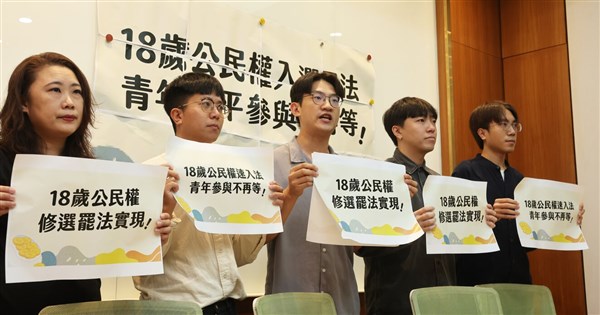
(Central News Agency, Reporter Chen Chih-chung, Taipei, May 5) The Legislative Yuan is set to discuss the issue of 18-year-old voting rights. Public law scholars and youth groups have launched a petition, calling for a "direct legislative amendment" to include 18-year-old voting rights in the two election and recall laws (Public Officials Election and Recall Act, and President and Vice President Election and Recall Act), to prevent the high threshold for constitutional amendments from becoming an obstacle.
Article 130 of the Constitution of the Republic of China stipulates that citizens of the Republic of China who are 20 years of age or older shall have the right to vote in accordance with law. Legislators across party lines have proposed amendments to the election and recall laws to lower the voting age from 20 to 18.
However, during a public hearing on "18-year-old voting rights amendment" held by the Legislative Yuan's Internal Administration Committee recently, opinions varied. Some experts believe that if the election age is lowered through legislative amendment, it is highly likely to be unconstitutional and should be done through constitutional amendment; others present suggested that a more feasible method would be through a "constitutional interpretation."
Youth Insight (青年思潮), One Drop of Excellence (一滴優), Generational Harmony (世代共好), Taiwan Alliance for the Advancement of Youth Rights and Welfare (台少盟), Youth Civil Association (青民協), and Taiwan Students' Union (台學聯), along with over 10 public law scholars, today issued a petition statement advocating for "direct legislative amendment."
The statement points out that there is already room for constitutional interpretation in lowering the voting age through legislative amendment. After 2015, there was a high consensus across party lines for constitutional amendment, and the agenda once prioritized constitutional amendment. However, the results of the 2022 referendum showed that even though 18-year-old voting rights had cross-party consensus and majority public support, it could still fail due to the high constitutional amendment threshold.
The statement emphasizes that democracy should not delay the realization of rights due to procedural thresholds. After the constitutional amendment failed, the Legislative Yuan should seriously address legislative amendment and swiftly realize 18-year-old voting rights.
Associate Professor Kung Wen-hsiang of Soochow University's Department of Law stated through the student group that young people play an important and crucial role in the establishment, existence, and necessary changes of the nation. Facing the future, Taiwan is at a critical juncture. To strengthen and deepen the democratic community, at least 18-year-olds should have the right to vote.
Assistant Professor Chiu Tzu-yu of Hsuan Chuang University's Department of Law also pointed out that the voting age of 20 stipulated in the constitution was because in that era, 20 was considered a mature adult and a person with full legal capacity in civil law. Today, societal conditions and intellectual capabilities are completely different, and the Civil Code has also been amended to set the age of majority at 18. Therefore, the right to vote should also move towards 18 through legislative amendment, which is a right granted by the constitution. (Edited by: Li Heng-shan) 1150505
Choose to stand with facts, every sponsorship is a force to protect press freedom.
Download the Central News Agency "First-Hand News" APP to stay updated with the latest news in real-time.
The text, images, and videos on this website may not be reproduced, publicly broadcast, publicly transmitted, or utilized without authorization.
(Central News Agency, Reporter Chen Chih-chung, Taipei, May 5) The Legislative Yuan is set to discuss the issue of 18-year-old voting rights. Public law scholars and youth groups have launched a petition, calling for a "direct legislative amendment" to include 18-year-old voting rights in the two election and recall laws (Public Officials Election and Recall Act, and President and Vice President Election and Recall Act), to prevent the high threshold for constitutional amendments from becoming an obstacle.
Article 130 of the Constitution of the Republic of China stipulates that citizens of the Republic of China who are 20 years of age or older shall have the right to vote in accordance with law. Legislators across party lines have proposed amendments to the election and recall laws to lower the voting age from 20 to 18.
However, during a public hearing on "18-year-old voting rights amendment" held by the Legislative Yuan's Internal Administration Committee recently, opinions varied. Some experts believe that if the election age is lowered through legislative amendment, it is highly likely to be unconstitutional and should be done through constitutional amendment; others present suggested that a more feasible method would be through a "constitutional interpretation."
Youth Insight (青年思潮), One Drop of Excellence (一滴優), Generational Harmony (世代共好), Taiwan Alliance for the Advancement of Youth Rights and Welfare (台少盟), Youth Civil Association (青民協), and Taiwan Students' Union (台學聯), along with over 10 public law scholars, today issued a petition statement advocating for "direct legislative amendment."
The statement points out that there is already room for constitutional interpretation in lowering the voting age through legislative amendment. After 2015, there was a high consensus across party lines for constitutional amendment, and the agenda once prioritized constitutional amendment. However, the results of the 2022 referendum showed that even though 18-year-old voting rights had cross-party consensus and majority public support, it could still fail due to the high constitutional amendment threshold.
The statement emphasizes that democracy should not delay the realization of rights due to procedural thresholds. After the constitutional amendment failed, the Legislative Yuan should seriously address legislative amendment and swiftly realize 18-year-old voting rights.
Associate Professor Kung Wen-hsiang of Soochow University's Department of Law stated through the student group that young people play an important and crucial role in the establishment, existence, and necessary changes of the nation. Facing the future, Taiwan is at a critical juncture. To strengthen and deepen the democratic community, at least 18-year-olds should have the right to vote.
Assistant Professor Chiu Tzu-yu of Hsuan Chuang University's Department of Law also pointed out that the voting age of 20 stipulated in the constitution was because in that era, 20 was considered a mature adult and a person with full legal capacity in civil law. Today, societal conditions and intellectual capabilities are completely different, and the Civil Code has also been amended to set the age of majority at 18. Therefore, the right to vote should also move towards 18 through legislative amendment, which is a right granted by the constitution. (Edited by: Li Heng-shan) 1150505
Choose to stand with facts, every sponsorship is a force to protect press freedom.
Download the Central News Agency "First-Hand News" APP to stay updated with the latest news in real-time.
The text, images, and videos on this website may not be reproduced, publicly broadcast, publicly transmitted, or utilized without authorization.