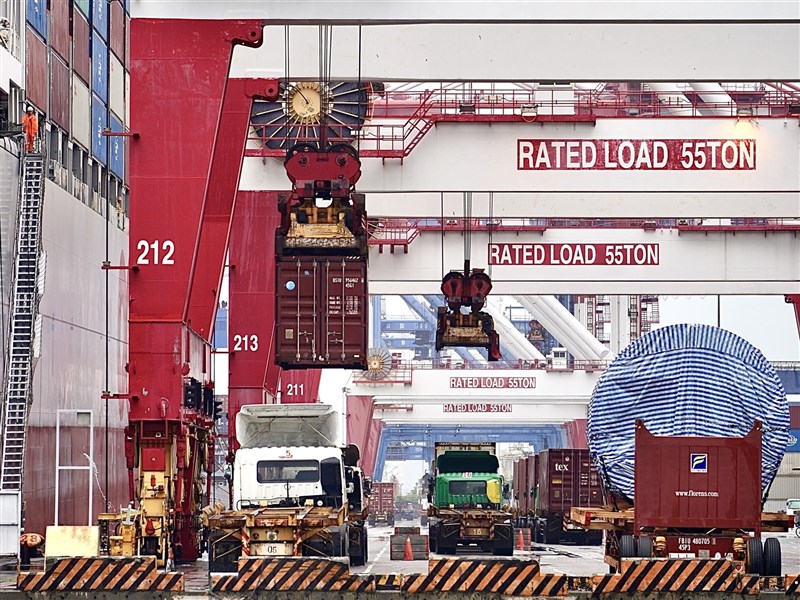
Taipei, April 15 (CNA) In response to the US Section 301 investigation targeting Taiwan and other countries, the Executive Yuan's Taiwan-US Economic and Trade Working Group announced today that the government submitted a written explanation on April 14, US Eastern Time. This aims to fully safeguard the negotiation achievements made under the Taiwan-US Bilateral Trade Agreement (ART) and Investment MOU. The written explanation addresses US concerns regarding structural overcapacity and forced labor.
After lengthy negotiations, Taiwan and the US signed an Investment Cooperation Memorandum of Understanding (MOU) in January and the ART in February. However, the legal basis for the US Reciprocal Trade Act has expired, and the US is currently investigating to re-establish a legal foundation under Section 301. Investigations have been launched against 16 trade partners, including Taiwan, for "structural overcapacity," and against 60 trade partners for "failure to effectively enforce import bans on forced labor goods." The ART signed between Taiwan and the US has not yet officially taken effect.
Today, the Taiwan-US Economic and Trade Working Group stated through a media group that the government has held multiple inter-ministerial meetings regarding the US Section 301 investigation and has been in close communication with the US. A written explanation was submitted on April 14, US Eastern Time, in the name of the government, hoping to fully maintain the negotiation outcomes of the ART and Investment MOU.
Regarding the US investigation into "structural overcapacity," the Taiwan-US Economic and Trade Working Group stated that Taiwan's opinion explains that Taiwan is a market economy, and its industrial profits come from value-added technology. Taiwan's top manufacturing capabilities, combined with US client innovation and R&D, are mutually complementary and beneficial, making them the most important strategic partners in the high-tech industry. Furthermore, Taiwan will cooperate with the US on semiconductor and ICT supply chains through the "Taiwan Model" in the future, which will help deepen Taiwan-US economic and trade strategic cooperation and promote Taiwan-US trade balance.
The opinion also mentions that Taiwan and the US are strengthening economic security cooperation to jointly maintain the security and resilience of high-tech supply chains.
The Taiwan-US Economic and Trade Working Group pointed out that Taiwan and US industries share similar views. For example, the US-Taiwan Business Council's written opinion states that Taiwan's trade surplus with the US stems from the high complementarity of their industries and strong market demand. Taiwan is a safe and reliable ally for the US in strengthening supply chain resilience and combating unfair trade practices. Taiwan's Machine Tool Association also explained to the US that Taiwan and the US are long-term trade partners, and Taiwan's industry is dominated by small and medium-sized enterprises, adopting a "build-to-order" model based on market demand, which is highly complementary to US aerospace and defense industries.
Regarding the US investigation into import bans on forced labor goods, the opinion explains that assisting enterprises in aligning with international labor rights standards is a set goal, and prohibiting the import of forced labor goods is an international trend. To reduce the risk of forced labor and operational risks for Taiwan's industries, and to maintain international supply chains that comply with human rights, resilience, and sustainable governance, Taiwan and the US have had full discussions and reached a high degree of consensus during the ART negotiations. This includes a commitment to prohibit the import of forced labor goods. In the future, relevant ministries will use the "Trade Act" as the legal basis for control, and after discussion and resolution through Taiwan's inter-ministerial review procedures, will restrict the import of forced labor goods.
To enhance the international competitiveness and trustworthiness of Taiwan's industries, the opinion also mentions that the government is committed to assisting businesses in preventing forced labor, including the issuance of the "Guidelines for Enterprises to Prevent Forced Labor" on February 13, which guides industries to recruit and manage migrant workers in accordance with international norms. On April 9, an amendment bill to the "Employment Service Act" was sent to the Legislative Yuan for review, aiming to comprehensively prohibit the retention of migrant workers' identity documents and the withholding of their property. In the future, efforts will continue to refine direct employment of migrant workers by employers, optimize the intermediary evaluation system, and enhance labor protection for foreign distant-water fishermen.
Regarding other procedures of the US Section 301 investigation, the Taiwan-US Economic and Trade Working Group stated that the US will hold public hearings on the forced labor investigation starting April 28, and on the overcapacity investigation starting May 5. The representative office in the US will send personnel to attend as observers. If stakeholders raise opinions unfavorable to Taiwan, Taiwan will subsequently provide clear rebuttals.
The Taiwan-US Economic and Trade Working Group pointed out that the US will arrange consultation meetings in the future to hear explanations from the investigated countries, and the government will formally send personnel to attend. (Editor: Chang Liang-chih) 1150415
FACT BOX
- Source: CNA (Central News Agency)
- Category: regulation