(Central News Agency reporter Wen Guixiang, Taipei, April 17) Wu Se-chih, director of the Taiwan Thinktank China Issues Research Center, stated today that Taiwan and China exhibit fundamental differences in their diplomatic approaches. He emphasized three major aspects: local empowerment, aid without political conditions, and value concepts. Taiwan's "value diplomacy" focuses on mutual prosperity, contrasting with China's economic diplomacy, which carries political coercion. The cross-strait competition is essentially a struggle between democratic and authoritarian governance models.
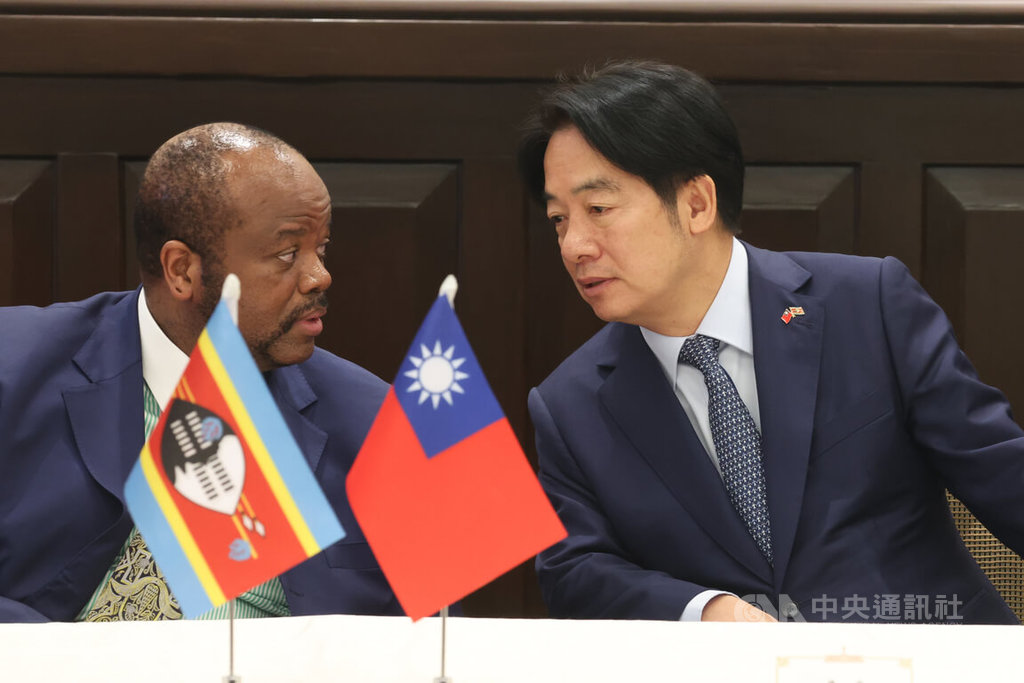
President Lai Ching-te is scheduled to visit the Kingdom of Eswatini, a diplomatic ally in Africa, from April 22 to 27, to attend the dual celebrations of King Mswati III's 40th enthronement anniversary and 58th birthday. China has consistently promoted various cooperation projects in Africa, attempting to expand its influence among African nations, and actively trying to poach Eswatini, Taiwan's only diplomatic ally in Africa, to limit Taiwan's international participation.
Wu Se-chih said in an interview that Taiwan's diplomatic model and China's diplomatic model take different paths in reality. How to highlight the differences between Taiwan and China's approaches and break through Taiwan's international participation space, which is the so-called competition of "governance models," makes value diplomacy Taiwan's most important option.
Wu Se-chih analyzed that the differences between Taiwan's and China's diplomatic models can be viewed from three aspects. First, from the perspective of interactive relations, Taiwan's long-term efforts in Africa, including medical missions, agricultural technical missions, vocational training, and small and medium-sized enterprise counseling, emphasize local empowerment and capacity building, enabling recipient countries to stand on their own. Although this model may seem small in scale, it can build long-term effects and even a certain degree of institutional trust.
Second, China's diplomatic model often carries political coercion, while Taiwan's diplomatic model does not carry any political conditions. For example, China's "Belt and Road" initiative in Africa carries economic development incentives, but behind it are strong political demands such as the "One China Principle." On the surface, it seems to be building local infrastructure, but in reality, it forms a relationship where political identity and economic interests are highly linked.
Wu Se-chih believes that this model has led to many problems. For example, African countries that have accepted China's "Belt and Road" initiative are already facing debt problems. It can be said that China implements a "debt trap diplomacy," which further proves the value of Taiwan's diplomacy, which focuses on capacity building and empowerment diplomacy.
Third, from the perspective of value concepts. Faced with China's coercive exchange diplomacy, many countries are gradually becoming unable to accept this zero-sum model. This is why European countries, although they do not have diplomatic relations with Taiwan, have deeper exchanges due to shared ideals and values in recent years. Another example is during the COVID-19 pandemic, when China forcibly exported vaccines while violating humanitarian principles by blocking Taiwan's access to vaccines internationally. Although Taiwan is not a member of the World Health Organization (WHO), Taiwan's mask diplomacy demonstrated greater responsibility and capability in global public health issues by comparison.
Wu Se-chih emphasized that the different diplomatic models across the strait are themselves a competition of governance models, or more precisely, the difference between democratic and authoritarian systems. China's authoritarian diplomacy may bring short-term economic growth, but in the long run, it will lead to more structural problems and various governance risks for the local areas, such as increased corruption, social injustice, widening wealth gaps, and political instability.
Regarding China's diplomatic actions in Africa, informed sources analyzed that while China-Africa cooperation ostensibly helps national development, China actually provides large loans to African countries through infrastructure construction and trade cooperation, pushing them into debt traps. Countries such as Kenya, Ghana, and Zambia have all fallen into debt crises due to Chinese loans, and most of the aid funds from China eventually return to Chinese state-owned enterprises.
Eswatini, Taiwan's only diplomatic ally in Africa, is also a target for China's poaching. Informed sources pointed out that China has long threatened to cut off all trade with Eswatini while continuously establishing commercial and economic interests in Eswatini. In 2025, China intervened in Eswatini's major infrastructure bidding projects with low bids. And starting in May this year, China will grant full zero-tariff treatment to 53 African countries, with Eswatini being the only African country excluded by China. From this, it is not difficult to see China's two-faced tactics.
Informed sources said that President Lai's visit to Eswatini this time will demonstrate to the international community that Taiwan and Eswatini are brotherly nations that transcend geographical distance, and at the same time, it will use concrete actions to explain Taiwan's values and contributions to African countries and the international community. (Editors: Lin Shuyuan) 1150417
Stand with the facts, every sponsorship you make is a force to protect press freedom.
Download the Central News Agency "First-hand News" APP to stay updated with the latest news.
The text, images, and videos on this website may not be reproduced, publicly broadcast, publicly transmitted, or utilized without authorization.
FACT BOX
- Source: CNA (Central News Agency)
- Category: political