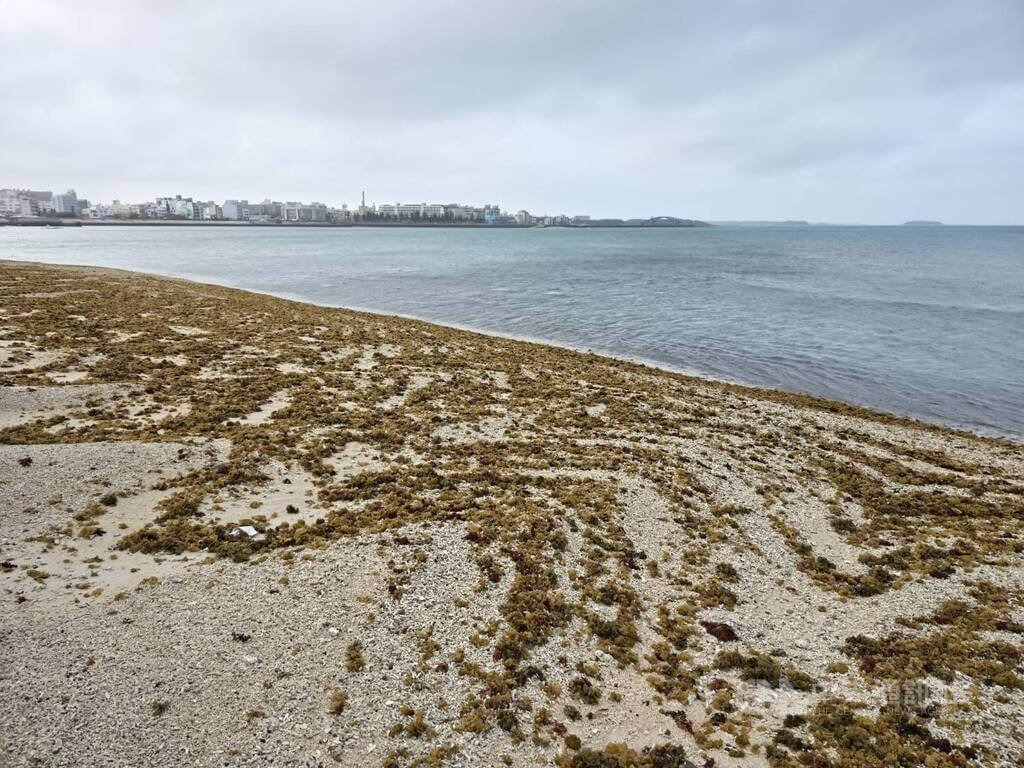
Central News Agency (CNA) Penghu, April 14 (CNA) -- Penghu's coastal sandy areas are currently, with the ebb and flow of the tide, covered with various green, brown, and red seaweeds, resembling an ink wash painting and adding beautiful colors to the vibrant coastline. Numerous intertidal zones, coastlines, and beaches in Penghu, such as Magong Caozaiwei and Shili, are filled with various seaweeds that have detached with the waves, including red, green, and brown types. Their quantity is so vast that they almost completely cover or overlap on the shore. The Penghu County Government Aquatic Seedling Breeding Farm states that from December to March each year, while island plants wither due to saltwater mist, Penghu's coastal intertidal zones enter the peak season for Ulva lactuca. Reefs and gravel grow filamentous, tubular, membranous, net-like, and sac-like green, brown, and red algae, including Ulva fasciata (broad reef film) and sea lettuce (commonly known as 'large leaf vegetable'). The Aquatic Seedling Breeding Farm points out that during winter, many residents collect seaweeds like Ulva lactuca and sea lettuce for eating, selling, processing, or as livestock feed. After the cold winter, with the arrival of spring warmth or the rainy season, these seaweeds naturally detach. Some return to the seabed as nutrients, while others drift to the shore, year after year. 'Liu Haicai' is a unique traditional industry activity in Penghu, referring to the 'harvesting' of natural wild seaweed from reefs in the intertidal zone using scraping nets and other tools, from winter to the following spring. (Editor: Li Shuhua) 1150414
FACT BOX
- Source: CNA (Central News Agency)
- Category: Taiwan