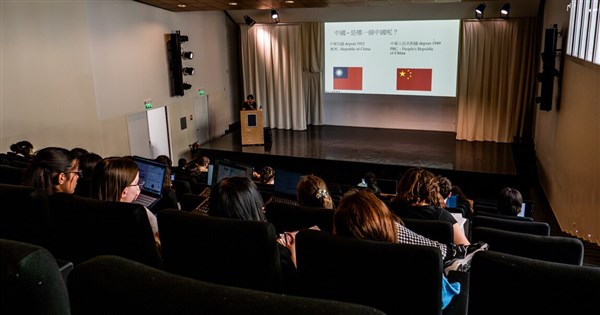
(Central News Agency reporter Li Ruo-yun, Paris, April 15) In response to the trend of Taiwan history remedial classes, the French National Institute of Oriental Languages and Civilizations (INALCO) and the International Taiwan Studies Research Center of National Taiwan Normal University (NTNU) recently held a "Taiwan History Remedial Class" and a screening of the documentary "Hand in Hand" in Paris. The course guides students to think about and deconstruct the consciousness behind technical terms through explanations of terminology, thereby understanding the transformation of Taiwanese society.
Liu Zhan-yue, one of the event organizers and head of Taiwan Studies at INALCO, also teaches Taiwan history at Université Paris Cité. Students come from Chinese, Japanese, Korean, History, and Sociology departments. The number of students enrolled has increased from nearly 70 in the first year to 150 in the third year.
Liu Zhan-yue stated in an exclusive interview with the Central News Agency that in February this year, when the film "Bloody Case of the Century," based on the 1980 "Lin Family Massacre," caused controversy, he happened to be in Taiwan. He then watched another documentary, "Hand in Hand," which is based on the history of Taiwan's democratic development, and hoped that after returning to France, he could echo this wave of Taiwan history remedial classes with Parisian students.
Liu Zhan-yue explained that in a semester-long Taiwan history course, Parisian students will learn from the indigenous period, the Dutch period, all the way to UN General Assembly Resolution 2758 and Taiwan's electoral system.
The Taiwan history remedial class series of activities focuses on the period from 1945 to 1980, mainly discussing the history of Taiwan's democratic development after the end of Japanese rule, the arrival of the Kuomintang, the 228 Incident, and the White Terror period.
Parisian students start from technical terms such as "Republic of China" (ROC), "People's Republic of China" (PRC), "benshengren" (native Taiwanese), and "waishengren" (mainlanders) to consider how these keywords are interpreted in history and their corresponding relationship with contemporary times.
Liu Zhan-yue added that Parisian students will discover non-single perspectives and positions on Taiwan history from non-single explanations and translations of terms. For example, for "Japanese colonial period," "Japanese occupation period," and "Japanese rule period," the corresponding French translations allow students to discuss from an international perspective which one is more suitable for the view of Taiwan history in the global context.
Liu Zhan-yue stated that from a contemporary academic perspective, many terms in Taiwan's contemporary history need to be retranslated. For example, "benshengren," "waishengren," and "indigenous people." Since the composition of Taiwanese society is diverse and exceeds the existing French language system, he lists corresponding French terms next to single Chinese terms to encourage students to think further.
For example, for "restoration" of Taiwan, as called by the Kuomintang after their arrival in 1945, he listed four corresponding French translations: recouvrer (recover), libérer (liberate), restaurer (restore), and rétrocéder (retrocede), allowing students to compare the differences and discuss which corresponding terms are incorrect.
Liu Zhan-yue said: "When students try to deconstruct the meaning and consciousness behind the terms, they can gradually understand the transformation of Taiwanese society."
Liu Zhan-yue stated that more and more students in Paris are choosing the "Taiwan History" course. About 70% of the students' motivation is an interest in Taiwan and a desire to understand Taiwan; some students also hope to further understand the historical context as Taiwan's voice in international discussions gradually increases. For example, history students want to know how Taiwan's history was formed, and sociology students analyze Taiwan's social phenomena.
Among the Chinese language students taking the Taiwan history course, about 20% are Chinese international students. Liu Zhan-yue stated that when the course reaches certain sensitive topics, some people leave, while others choose to stay and take notes.
The Parisian student version of the "Taiwan History Remedial Class" series of activities includes three courses and one screening event, held on the 9th and 15th at INALCO.
In addition to Liu Zhan-yue supplementing the historical framework discussed in the documentary "Hand in Hand" from the perspective of "technical terms," Bai Shi-ming, director of NTNU's Taiwan Art History Research Center, and Fang Wei-da, NTNU's associate dean of academic affairs and chairman of the Taiwan Wetland Society, also traveled from Taiwan to Paris to provide remedial classes on Taiwan history from the perspectives of "art" and "ecology," respectively. (Editor: Hsieh Yi-hsuan) 1150415
Choose to stand with facts, every sponsorship you make is a force to protect press freedom.
Download the Central News Agency "First-hand News" APP to stay updated with the latest news.
Text, images, and videos on this website may not be reproduced, publicly broadcast, publicly transmitted, or utilized without authorization.
FACT BOX
- Source: CNA (Central News Agency)
- Category: event