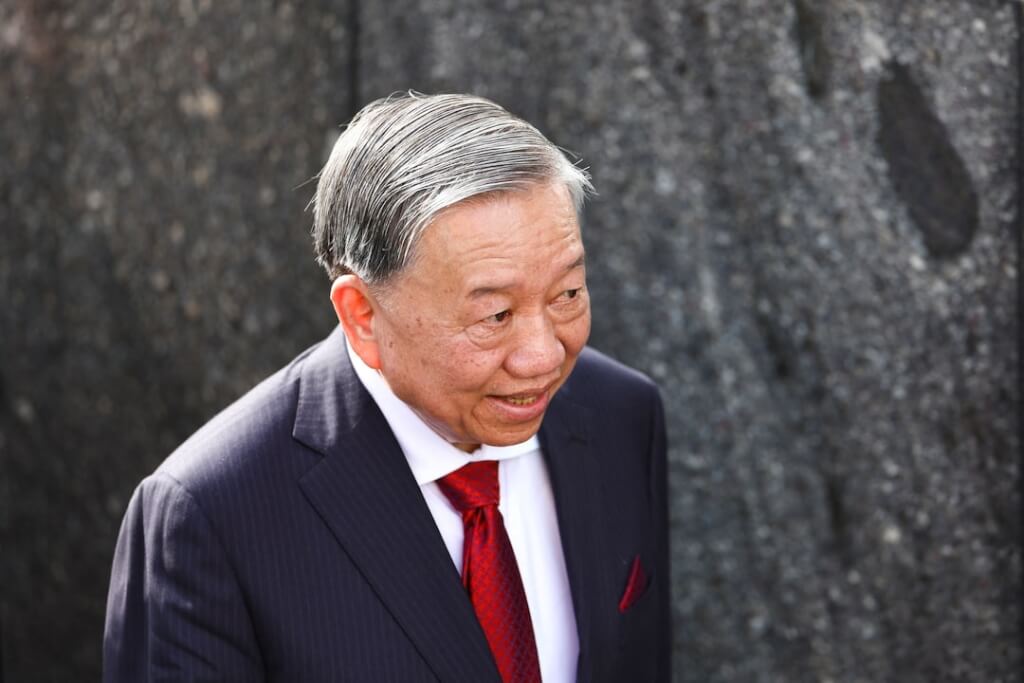
The 16th National Assembly of Vietnam, in its first session this morning, unanimously approved the resolution to elect General Secretary of the Communist Party of Vietnam, Tô Lâm, as the State President for the term 2026-2031, granting him dual authority to govern the country for the next five years.
This makes him the most powerful leader in Vietnam in decades, breaking the long-standing tradition of the one-party state's 'four pillars' – the General Secretary of the Communist Party, the State President, the Prime Minister, and the National Assembly Chairman – which emphasized power-sharing.
The National Assembly first proposed the resolution for Tô Lâm, General Secretary of the Communist Party of Vietnam, to also serve as the State President. Subsequently, all 495 attending National Assembly representatives cast their affirmative votes, formally passing the motion.
Analysts believe this significant move will alter Vietnam's collective leadership system, concentrating power in one individual. While it may accelerate decision-making, it could also lead the country towards a more centralized power structure, similar to China.
Tô Lâm briefly held both positions for two months in 2024 after the passing of then-General Secretary Nguyễn Phú Trọng. However, simultaneously serving as party leader and head of state from the start of a term is a first in Vietnamese political history.
Born on July 10, 1957, in Hưng Yên Province, Tô Lâm holds a doctorate in law and is a professor, having also led the Ministry of Public Security. Under his leadership, the role of the Ministry of Public Security is expected to become increasingly important in the future.
Le Hong Hiep, a senior fellow in the Vietnam program at the ISEAS-Yusof Ishak Institute, a Singaporean think tank, told Reuters that "concentrating more power in Tô Lâm's hands could pose risks to Vietnam's political system, such as the rise of authoritarianism."
However, he also stated that integrating the two powers "could enable Vietnam to formulate and implement policies more quickly and effectively" to achieve the Vietnamese government's ambitious target of 10% or more annual GDP growth.
Professor Alexander Vuving of the Asia-Pacific Center for Security Studies in Hawaii, USA, commented that the combination of the two roles "will usher Vietnamese domestic politics into a new normal, where most old assumptions about Vietnamese politics, including the assumption of collective leadership, will no longer be valid."
Over the past year, even with military figure Lương Cường serving as State President, responsible for symbolic state ceremonies and diplomatic meetings, Tô Lâm frequently traveled personally to represent the country and meet foreign leaders.
Immediately after the election, General Secretary and State President Tô Lâm was sworn in at the assembly. He expressed his honor in holding both positions, pledging to be driven by "science, technology, innovation, and digital transformation" to "build a new growth model" and prioritize the development of self-reliant defense.
In early 2025, Tô Lâm launched a series of drastic reforms dubbed the "streamlining revolution" by the media, involving large-scale provincial and municipal mergers and civil servant layoffs. These measures, aimed at enhancing Vietnam's competitiveness and governance efficiency, have received both praise and criticism.
Tô Lâm is pro-business, supports private enterprises, and emphasizes the dominant role of state-owned enterprises. He also actively welcomes foreign investment with practical measures and vigorously leads Vietnam's industrial transformation.
In foreign policy, Tô Lâm is pragmatic and flexible, adhering to Vietnam's "bamboo diplomacy," striving to balance relations with major powers while expanding international partnerships.
Khang Vu, a visiting scholar in the political science department at Boston College, told Reuters, "Even if there are concerns that power in Vietnam is increasingly concentrated in one person's hands, Tô Lâm's dual role does not mean any change in Vietnam's foreign policy."
After the 14th National Congress of the Communist Party of Vietnam, Vietnam's power structure expanded from four pillars to five, adding the position of Permanent Secretary of the Secretariat, which was originally a staff role. Now, with the merger of the General Secretary and State President positions, although it returns the five pillars to the past four-pillar norm, the balance of power may no longer be the same as before. (Edited by Wei Shu) 1150407
FACT BOX
- Source: CNA (Central News Agency)
- Category: personnel