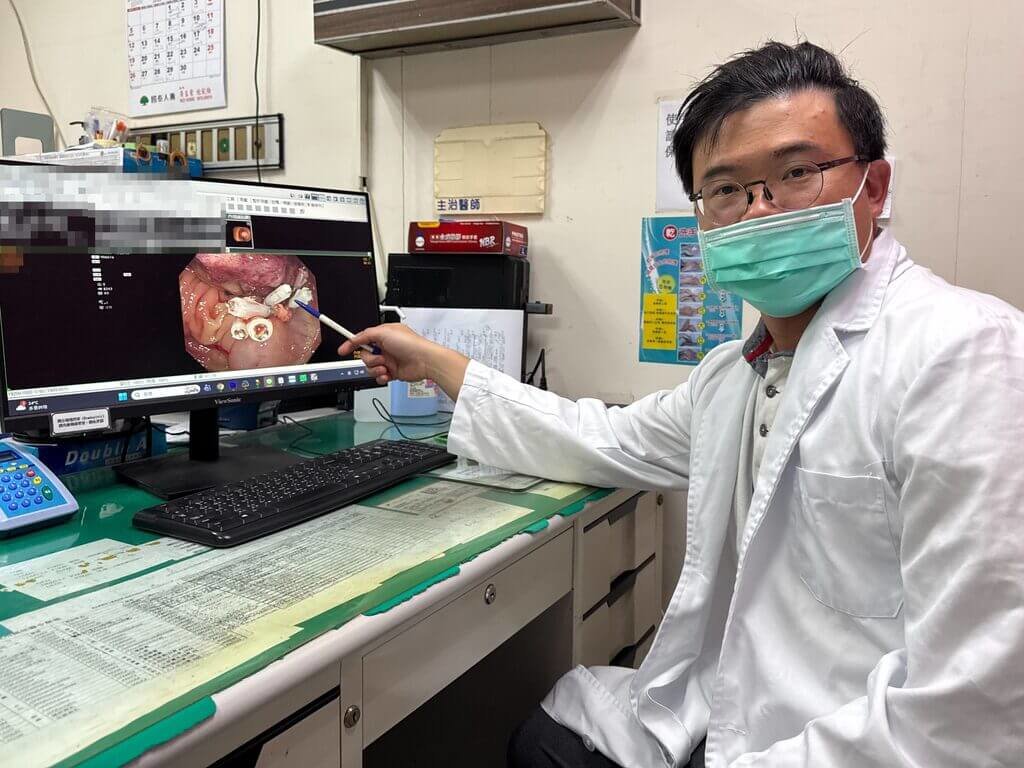
A 60-year-old man with a history of alcoholism and a family history of colon cancer, who had long ignored his family history, was persuaded by medical staff to undergo his first screening. The result was positive, and further examination revealed 6 tumors in his colon, the largest measuring 3 cm. Fortunately, they were benign and he is currently undergoing treatment. Dr. Wu Yan-ying, a physician at the Gastroenterology Department of Taichung Veterans General Hospital, stationed at Yuanli Li General Hospital in Miaoli County, stated today that the man had a family history of colon cancer and a habit of heavy drinking but never underwent colon cancer screening. It was only after medical staff encouraged him to take a fecal occult blood test, which came back positive, and a subsequent colonoscopy that 6 tumors were found in his colon, the largest being 3 cm. Dr. Wu mentioned that before the tumors were discovered, the patient reported no discomfort, no abdominal pain, smooth bowel movements without constipation, and a normal life. Despite his mother and brother having colon cancer, he had never undergone a colon cancer examination before the age of 60. During the colonoscopy, Dr. Wu found a tumor approximately 3 cm in diameter near the sigmoid colon, totaling 6 tumors, a number that surprised him. The tumors were subsequently removed and all were found to be benign after pathological examination. The man is currently receiving treatment. Dr. Wu reminds those with a family history of colon cancer that their risk of developing colon cancer is at least 2 to 5 times higher than that of the general population and they must be aware if they belong to a high-risk group and undergo regular screenings. The Ministry of Health and Welfare's National Health Administration also offers free "quantitative immunochemical assay" fecal occult blood tests every two years for individuals aged 45 to 74. Furthermore, colon polyps are a major precursor to colon cancer. Early-stage polyps are asymptomatic, but 80% to 90% of colon cancers develop from them. Symptoms like blood in stool, mucus in stool, changes in bowel habits, frequent diarrhea, constipation, or abdominal pain may be warning signs of cancerous transformation and require attention. Dr. Wu suggests that in addition to consuming plenty of high-fiber fruits and vegetables, one should reduce intake of red meat and processed foods. Especially, the popular consumption of grilled foods should be avoided as much as possible to reduce the risk of colon cancer. (Editor: Chang Ya-ching) 1150416
FACT BOX
- Source: CNA (Central News Agency)
- Category: research