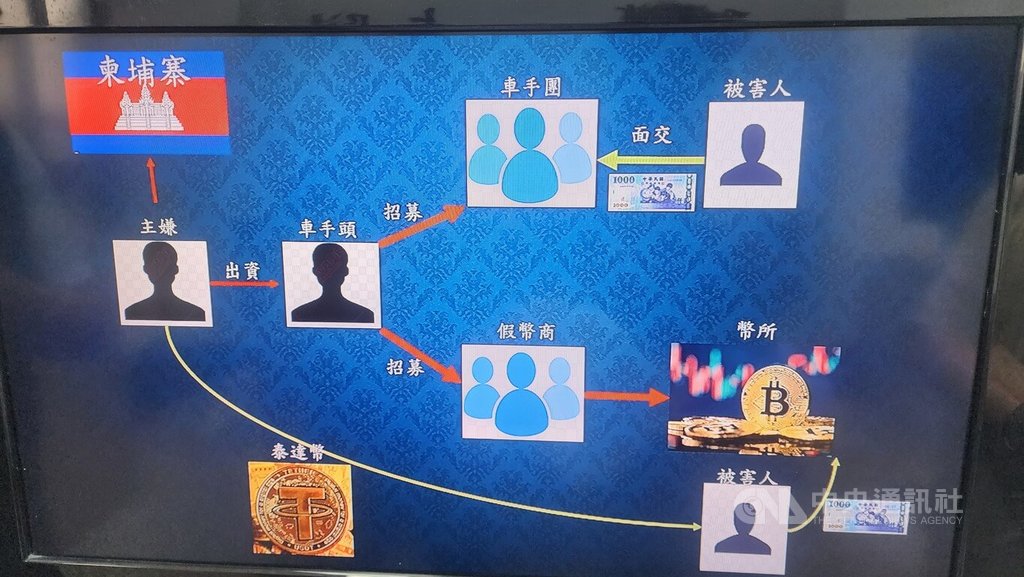
(Central News Agency reporter Hong Xueguang, Kaohsiung, April 14) A fraud group led by primary suspects Luo and Ding was involved in establishing a fraud 'water house' (money laundering operation) in Zuoying, Kaohsiung, and illegally using a physical cryptocurrency store as a cover. They enticed the public to transfer money to the fraud group's electronic wallets, with money laundering amounts reaching over NT$100 million. Luo and 10 others were sent for prosecution.
The Kaohsiung City Police Department's Criminal Investigation Division held a press conference this morning, stating that in October 2024, the Fourth Investigation Team, in conjunction with the Southern Crime Strike Center of the Criminal Investigation Bureau and the Taitung County Police Department's Criminal Investigation Division, investigated a drug case. During this, they discovered multiple messages on the mobile phones of 35-year-old Luo and 31-year-old Ding, both with prior drug and fraud records, assigning 'car hands' (money mules) for face-to-face cash collection. Tracing the source, they uncovered a fraud group and immediately reported it to the Kaohsiung District Prosecutors Office for investigation, forming a special task force for expanded pursuit.
Police investigations revealed that primary suspects Luo and Ding first went to Cambodia to discuss cooperation with offshore fraud call center leaders. After returning to Taiwan, they funded the establishment of a fraud 'water house,' with 23-year-old Xu acting as the 'car hand' controller, responsible for recruiting money mules. In addition to collecting money from victims' residences, group members also arranged for money mules to be stationed at a physical cryptocurrency store in Sanmin District, Kaohsiung City, acting as 'fake cryptocurrency merchants.'
The special task force found that the offshore call center would first use deceptive tactics to lure victims to designated physical stores to deliver cash to purchase Tether (USDT). Luo and others would then transfer their held virtual currency into the victims' electronic wallets, creating the illusion of a legitimate transaction. Subsequently, the call center would induce victims to transfer the virtual currency into the leader's electronic wallet, thereby creating a financial flow breakpoint. It was only when victims tried to retrieve their investment funds and were refused that they realized they had been scammed. A preliminary investigation revealed over 20 victims, with financial losses exceeding NT$10 million.
Following surveillance and evidence collection, the special task force located Luo and others hiding in a high-security luxury residential building in Zuoying District, Kaohsiung, traveling in luxury cars. From March 2025, prosecutors and police launched six waves of searches, apprehending Luo and 10 others. Evidence seized at the scene included cold wallets, cash counting machines, illicit funds, luxury vehicles, designer bags, and luxury watches. A preliminary investigation showed the group handled several million Tether coins, with money laundering amounts reaching NT$100 million. The entire case was transferred to the Kaohsiung District Prosecutors Office for investigation on charges including fraud.
Among them, primary suspects Luo, Ding, and three accomplices were granted detention by the prosecutor after further questioning, while the other five were released on bail.
The Kaohsiung Criminal Investigation Division appeals to the public that fraud groups often use physical stores to lower public guard. According to the Money Laundering Control Act, legitimate virtual asset service providers are not allowed to accept payments in 'cash' and must use traceable transfer methods. If the public encounters requests for cash transactions or transfers to individual cryptocurrency merchant accounts, it is highly likely to be a scam. They must follow the principles of '1. Stay calm, 2. Verify, 3. Report to the police,' and make good use of the 165 anti-fraud hotline for verification. (Editor: Li Shuhua) 1150414
Choose to stand with facts, every sponsorship you provide is a force to protect press freedom.
Download the Central News Agency 'First-hand News' APP to stay updated with the latest news.
The text, images, and videos on this website may not be reproduced, publicly broadcast, or publicly transmitted and used without authorization.
FACT BOX
- Source: CNA (Central News Agency)
- Category: Taiwan